Swish & Dunk Player Skills Guide: All 49 Basketball Skills Explained
Open any player's card in Swish & Dunk and you find 49 numbers from 1 to 100. Some are obvious, like Three-Point Shot or Block. Others, like Help Defense, Box Out or Consistency, are much less so. This guide explains every single skill in detail: what it represents on a real basketball court, exactly where the match engine uses it, how much it weighs on the Overall and which players need it. At the end you will know why two players with the same Overall can play completely different games, and which numbers to look at before you sign, train or start someone.
Skills at a glance
- 49 skills from 1 to 100, split into six groups: Shooting, Playmaking, Defense, Rebounding, Physical and Mentality.
- Overall is a weighted average: Shooting and Defense 25% each, Playmaking and Physical 15%, Rebounding and Mentality 10%.
- Every possession is a chain of duels: attacking skill against defending skill, where 4 points of difference move the probability by 1 percentage point.
- Ratings are never used raw: fatigue, Game Shape, morale, the night's form and home court change them in every possession.
- Skills also decide who plays: who gets the ball, which play is run, who shoots, who rebounds and who gets the assist.
- Seven skills work only through the Overall; all the others enter the match engine directly.
How skills work in the match engine
Swish & Dunk simulates every game possession by possession, and every possession is a sequence of small duels: ball handler against on-ball pressure, shooter against the defender closing out, offensive rebounders against defensive rebounders. Each duel starts from a base rate and moves with the difference between the two ratings involved:
probability = base rate + (attacking rating − defending rating) ÷ 400 → kept between 1% and 99%
In practice every 4 points of difference are worth 1 percentage point. A shooter rated 80 from three against a contest of 60 has a 5-point bonus on the base rate; against a contest of 80 he has none. Five points don't sound like much, but a team takes over 80 shots a game, and those points add up possession after possession.
Skills don't only decide whether a shot goes in. They also decide who does what: the engine chooses who brings the ball up, which play he runs, who takes the shot, who grabs the rebound and who is credited with the assist by drawing lots weighted by the players' skills. A player with great Off-Ball Movement doesn't make more catch-and-shoot threes than another with the same shooting: he gets more of them. That is why the description of each skill below says both what it improves and how often it comes into play. To see how a whole game is built, read our guide to the match engine.
From raw rating to effective rating
The number on the card is the raw rating. In a game the engine always uses an effective rating, recalculated in every possession by stacking these factors:
| Factor | Effect | Depends on |
|---|---|---|
| Fatigue | up to −30% with an empty tank | remaining in-game stamina and the Stamina skill |
| Game Shape | ×0.90 at 80, ×1.00 at 100 | minutes played in recent games, Shape training |
| Morale | ×0.90 at 0, ×1.00 at 100 | starting or coming off the bench |
| Rust | ×0.85 in the first quarter | 10+ straight games on the bench before starting |
| The night's form | ±3% to ±23% | the Consistency skill |
| Home court | +1.2% | playing at home |
| Clutch and experience | ±10% and ±8% | the Clutch skill and age, only in close finishes |
The effective rating can never go above 100. The practical consequence is huge: a starter rated 85 who is out of shape, unhappy and exhausted can play like a 65. Before blaming a skill, always check the conditions the player is in.
How skills make up the Overall
The Overall is not a separate number: it is calculated from the skills every time one of them changes. Each group is the simple average of its skills, and the six groups are combined with fixed weights. On the card you see the six group values as SHO, PLA, DEF, REB, PHY and MEN.
| Group | Skills | Weight on Overall | Overall from +10 in one skill |
|---|---|---|---|
| Shooting | 11 | 25% | +0.23 |
| Playmaking | 9 | 15% | +0.17 |
| Defense | 9 | 25% | +0.28 |
| Rebounding | 3 | 10% | +0.33 |
| Physical | 7 | 15% | +0.21 |
| Mentality | 10 | 10% | +0.10 |
The Overall matters well beyond the card. It sets the salary, as explained in our economy guide. It decides the pecking order on the floor: a player much stronger than the other four gets more touches, more shots, more rebounds and more assists (about 1.5 times the touches with a 10-point edge). And in close finishes it pushes the ball into the hands of the best player. But the Overall is only a summary: two 80-rated players can be a sniper who can't defend and a stopper who can't shoot. To know what a player really does on the court you have to read the individual skills, one by one.
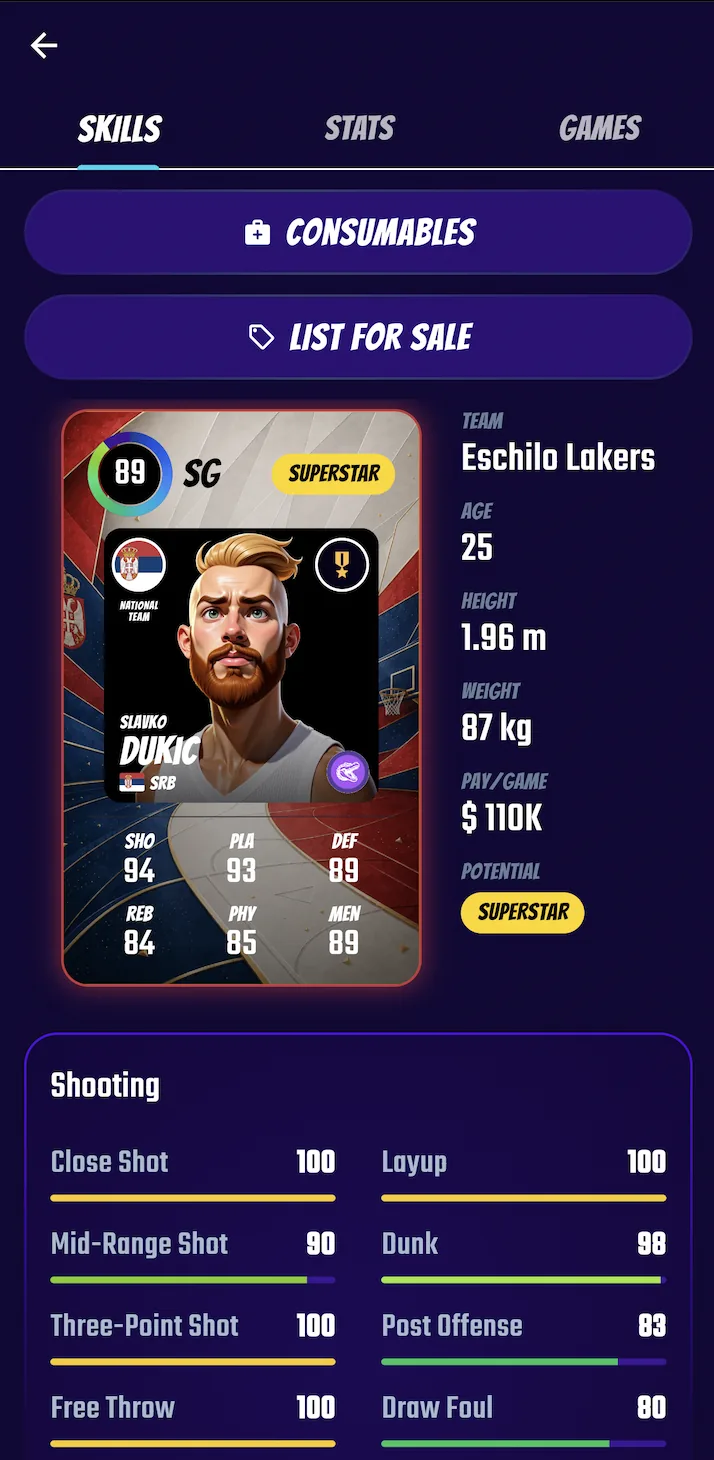
Shooting: the 11 scoring skills
Shooting is the biggest group (11 skills, 25% of the Overall). It's also the only group that feels the night's form in full: on a cold night these are the ratings that drop, while defense and passing barely move. Before going skill by skill, know the three types of field goal the engine distinguishes, each with its own base rate:
| Shot | Base rate | Shooter's skill | Defender's contest |
|---|---|---|---|
| Close (at the rim) | 56% | average of Close Shot, Layup, Dunk | average of Interior Defense, Shot Contest, Block |
| Mid-range | 37% | average of Mid-Range Shot, Off-Dribble Shot | average of Perimeter Defense, Shot Contest |
| Three-pointer | 31.5% | average of Three-Point Shot, Catch and Shoot | average of Perimeter Defense, Shot Contest |
Close Shot
The touch around the basket: short hooks, floaters, put-backs, the shots taken a step or two from the rim that are neither a layup nor a dunk. In the engine Close Shot is one third of the skill used on every shot at the rim, and together with Layup and Draw Foul it decides how often a player chooses to attack the basket instead of shooting from outside. For bigs it also counts in the pick-and-roll: it is one of the three skills that decide whether a center is chosen as the roll man. Height adds a bonus on top: ±0.35% per centimetre compared with 1.98 m, up to ±6%, so a 2.13 m center finishes about 5 points better than a guard with the same skills.
Mid-Range Shot
The jumper from inside the arc, off a pull-up or after a pass. It makes up half of the mid-range shooting skill (the other half is Off-Dribble Shot) and raises the chance of choosing a mid-range shot. Keep in mind that, as in today's NBA, the mid-range has become rare: the engine gives it a low weight in every role, and it accounts for about 15% of attempts. A great mid-range shooter is useful, but he isn't a game-changer like a great three-point shooter.
Three-Point Shot
The most important shooting skill in modern basketball. It makes up half of the three-point shooting skill and enters almost every decision about the long ball: how often the player looks for the three, how often he is chosen as the shooter on catch-and-shoot plays and as the "pop" option in the pick-and-roll. It also opens or closes the three-point shot completely: the engine averages Three-Point Shot and Catch and Shoot, and below 70 a player of any role looks for the three less and less, down to almost never at 35. For power forwards and centers the same average decides whether they are stretch bigs: from 60 to 85 the penalty of their role disappears, and above 85 a center shoots threes like a wing and pops out of the pick-and-roll up to 75% of the time. If your 5-Out or Pace and Space needs five shooters, this is the number to look at.
Free Throw
The only shot with no defender. Free Throw converts directly into a percentage with the formula 32% + rating × 0.66: 50 means about 65% from the line, 70 means 78% (the NBA average), 90 means 91%, with a ceiling of 95%. In clutch time the percentage is further multiplied by the shooter's Clutch and experience. It matters more than it seems: a team goes to the line around twenty times a game, and over a whole season a few percentage points at the line are worth dozens of points.
Off-Dribble Shot
Shooting off the bounce: the step-back, the pull-up after a crossover, the jumper created alone. It counts in three places. It's half of the mid-range shooting skill. It's one of the two skills that decide how often a ball handler goes for an isolation, together with Ball Handle. And in the pick-and-roll it decides, together with Pick & Roll Handler, how often the ball handler keeps the ball and shoots himself. It also protects jumpers from blocks: on mid-range and three-point shots it's the skill the engine pits against the defender's block.
Catch and Shoot
Shooting straight off a pass, feet set, without dribbling. It's half of the three-point shooting skill, and in the selection of who shoots on a catch-and-shoot play it weighs even more than Three-Point Shot (×1.2). It's also the main skill of the "pop" in the pick-and-roll and, together with Three-Point Shot, it decides whether a big is a stretch big. The ideal role player for a team with a creative point guard has a high Catch and Shoot and good Off-Ball Movement.
Layup
Finishing at the rim with a layup, including through contact. It's one third of the shot at the rim, it raises the chance of attacking the basket and is one of the skills that decide who finishes fast breaks. It also protects against blocks: the engine averages Layup, Dunk and Strength to decide whether a missed shot at the rim was blocked. Guards who drive a lot need it as much as centers do.
Dunk
The ability to finish above the rim. It's the third ingredient of the shot at the rim, it carries weight in choosing a close shot on the fast break and it's part of the defense against blocks along with Layup and Strength. On its own it doesn't make someone a great finisher: what counts is the average of Close Shot, Layup and Dunk, so a center with 95 in Dunk and 50 in Layup finishes like a 72.
Post Offense
Playing with your back to the basket: post-ups, footwork, turnaround jumpers. In the engine Post Offense decides how often a player goes to the post, not how well he finishes: post-ups end at the rim 80% of the time and with a mid-range shot in the other 20%, and the percentage depends on the close and mid-range skills. Power forwards and centers use it a lot (weight ×1.45), the other roles very little (×0.25). It's the heart of the Triangle Offense: a center with high Post Offense and low Close Shot will look for the ball a lot and waste it.
Draw Foul
The art of earning fouls: selling contact, attacking the defender's body, going up strong. On every shot the engine calculates the probability of a shooting foul as a duel between the shooter's Draw Foul and Aggressiveness and the defender's Defensive Discipline and Emotional Control. The base is 6% on jumpers and almost 9% at the rim, with a range from 2% to 22%. A foul on a made shot is an and-one, on a missed shot two or three free throws. Draw Foul also pushes a player to attack the rim more often. Combined with a high Free Throw it's one of the most efficient ways to score.
Weak Hand
The ability to dribble and finish with the non-dominant hand. In the current match engine Weak Hand does not enter any duel directly: it counts only through the Overall, of which it is 1/11 of the 25% Shooting weight (about +0.23 Overall for every 10 points). It's a skill to consider when you compare players' value and salary, not one to train on purpose.
Playmaking: the 9 skills of the ball and the system
Playmaking (9 skills, 15% of the Overall) decides who runs the offense, how many turnovers the team commits, which plays are run and how many baskets are assisted. Some of these skills belong to the point guard, others to the big who sets screens.
Ball Handle
Control of the dribble. It's the main skill in choosing who starts the play: in the half court the engine draws the ball handler weighting 55% Ball Handle, 25% Pass Accuracy and 20% Court Vision, multiplied by role (point guard ×3, shooting guard ×2.2, small forward ×1.6, power forward ×1, center ×0.6). It also raises the chance of an isolation and, together with Decision Making, it reduces how often the possession is interrupted by a non-shooting foul. Note: it does not protect against turnovers directly, that's Ball Security's job.
Pass Accuracy
The precision and timing of the pass. It counts in choosing the ball handler and, with Court Vision, decides how often a play becomes a pass for a teammate's catch-and-shoot. After a made basket it decides who gets the assist: if the basket is assisted, the player who created the shot is credited with a probability equal to the average of his Pass Accuracy and Court Vision (between 45% and 90%), otherwise the assist goes to a teammate, weighted by the same skills and by role. A point guard with 90 in both skills easily racks up assists.
Court Vision
Seeing the play before it happens: the open teammate, the extra pass, the backdoor cut. In the engine it works hand in hand with Pass Accuracy: 20% of the choice of the ball handler, half of the weight of the catch-and-shoot play and half of the assist chances. It's the soul of systems built on ball movement such as the Princeton Offense and the Motion Offense, which multiply the catch-and-shoot play and the number of assists.
Decision Making
Choosing the right option under pressure: when to pass, when to shoot, when to hold the ball. It's 35% of the ball security score the engine pits against defensive pressure in every possession to decide whether a turnover happens. The base rate is 12%, so a ball handler whose security is 20 points above the pressure loses the ball about 7% of the time, one 20 points below about 17%. It also reduces how often the possession is broken up by a non-shooting foul.
Pick & Roll Handler
The ability to use a screen as the ball handler: reading the defense, getting into the paint, finding the roll man. It decides how often a ball handler starts a pick-and-roll (weight ×1.35, multiplied by your tactic's pick-and-roll tendency) and, together with Off-Dribble Shot, how often he finishes the play with his own shot instead of serving the screener. It's the key number for anyone running the Spread Pick-and-Roll.
Ball Security
Protecting the ball from steals and errors. It's the heaviest skill in the anti-turnover duel: 45% of the security score, together with Decision Making (35%) and Basketball IQ (20%). On the other side are the average of the on-ball defender's Perimeter Defense and Steal, multiplied by your tactic's risk and the opponent's pressure. Against a Full-Court Press or a Half-Court Trap, a point guard with low Ball Security is a disaster.
Off-Ball Movement
Moving without the ball: cuts, relocations, coming off screens to receive. It decides who gets the shot on catch-and-shoot plays: the engine chooses the shooter weighting Catch and Shoot (×1.2), Three-Point Shot and Off-Ball Movement (×0.7). It doesn't make a shot easier, it makes a player more likely to be the one taking it. Two shooters with equal shooting skills don't take the same number of shots if one moves better.
Screening
Setting solid, legal screens. In the pick-and-roll it's one of the three skills that decide whether a power forward or a center is chosen as the roll man (with Pick & Roll Roll Man and Close Shot), weight ×0.6. It only matters for bigs: guards and wings never roll in the engine.
Pick & Roll Roll Man
The ability to dive to the rim after the screen and catch the ball on the move. It's the main skill in choosing the roll man among power forwards and centers. A big who rolls finishes at the rim 85% of the time (alley-oops, layups, dunks), so his percentage then depends on his close-range skills. If the big is a stretch big, a share of these plays becomes a pick-and-pop for a three instead.
Defense: the 9 skills that stop the opponent
Defense weighs as much as Shooting (25% of the Overall) and its skills appear in every duel: contests, turnovers, fouls, blocks and steals.
Perimeter Defense
Staying in front of your man on the perimeter: lateral feet, pressure on the ball, closing out on shooters. It's the most used defensive skill. It's half of the contest on every mid-range and three-point shot (with Shot Contest), it's half of the pressure that forces turnovers (with Steal) and, as in real basketball, a more active defender also makes more non-shooting contact. A wing with high Perimeter Defense takes away both the three and the ball.
Interior Defense
Defending the paint: positioning, verticality, holding position against those who attack the rim. It's one third of the contest on every shot at the rim (with Shot Contest and Block) and, with Perimeter Defense, it adds to the non-shooting contact of an active defender. Your tactic's interior contest multiplier applies to it: a Pack Line or a Drop Coverage lean on it heavily.
Post Defense
Defending against back-to-the-basket play. In the current match engine Post Defense doesn't enter any duel directly: a post-up is contested with the skills of the shot at the rim, that is Interior Defense, Shot Contest and Block. It counts only through the Overall (about +0.28 for every 10 points), like all Defense skills.
Help Defense
Rotating to help a beaten teammate. It comes into play in two places. On shots at the rim the engine chooses who goes for the block among all five defenders, weighting Block (60%), Help Defense (20%) and Vertical (20%) by role: a center weighs 2.6, a point guard 0.4, and the on-ball defender has a bonus of ×1.5. In steals, half are credited to the on-ball defender and half to a helper chosen by Steal and Help Defense. A center with great Help Defense collects blocks even on other players' men.
Pick & Roll Defense
Reading and defending the screen and roll. In the current match engine it isn't used directly: the pick-and-roll is defended by the skills of the shot that follows, that is Perimeter Defense and Shot Contest for jumpers, Interior Defense, Shot Contest and Block at the rim. It counts towards the Overall like the other eight Defense skills.
Steal
Quick hands, reading passing lanes. It's half of the pressure that forces turnovers (with Perimeter Defense) and decides who is credited with the steal: 60% of turnovers are steals, and half of them go to the on-ball defender, the other half to a helper chosen by Steal and Help Defense. Defensive tactics that force turnovers, like the Full-Court Press, make it even more valuable.
Block
Timing and reach to swat shots. It's one third of the contest on shots at the rim, so it lowers opponents' percentages near the basket. When a shot is missed, it also decides whether the miss was a block: the base is 29% of misses at the rim, 5% from mid-range and 1.5% from three, and the duel pits the blocker's Block (with a touch of Vertical) against the shooter's ability to finish. And it's the main skill in choosing which defender goes for the block.
Shot Contest
Getting a hand up on every shot without fouling. It's the most versatile defensive skill: half of the contest on jumpers and threes, one third at the rim. It has a downside: a hard contest also makes contact more likely, and the engine adds a quarter of the contest to the opponent's chance of drawing a foul. A great contester with low Defensive Discipline will send opponents to the line more often.
Defensive Discipline
Defending without fouling: no reaching, no useless contact, no unnecessary jumps on pump fakes. It's half of the defense against shooting fouls (with Emotional Control) and decides who commits off-ball fouls: the engine picks the fouler weighting Aggressiveness and the lack of discipline. A player with low discipline gets into foul trouble, and at six fouls he's out for the rest of the game.
Rebounding: the 3 skills that win possessions
Only three skills, 10% of the Overall: that makes them the most "concentrated" skills in the game, because 10 points in one of them is worth +0.33 Overall. On every missed shot the engine draws the rebounder among all ten players on the court, weighting skills, role (center ×1.5, power forward ×1.2, small forward ×0.95, shooting guard ×0.85, point guard ×0.75), height (±1.5% per centimetre compared with 1.95 m) and the tactics' rebounding tendency. On average the offense wins about 24% of rebounds, as in the NBA.
Offensive Rebound
Going after the ball on your own team's misses. It's 65% of a player's weight on offensive rebounds, with Box Out (20%) and Strength (15%). Every offensive rebound is a new possession, worth about one more point for your team.
Defensive Rebound
Securing the ball after the opponent's miss to end the possession. It's the main ingredient of a player's weight on defensive rebounds (×0.75), ahead of Box Out (×0.35) and Strength (×0.15). A team with weak defensive rebounders concedes second chances even with good defenders.
Box Out
Sealing the opponent behind you to win position. It counts on both sides of the glass: ×0.20 on the offensive end and ×0.35 on the defensive end, where it's worth almost half of Defensive Rebound. It's the skill that lets a less athletic power forward rebound like a center.
Physical: the 7 athletic skills
The Physical group (7 skills, 15% of the Overall) includes the two transition skills, raw athleticism and the most underrated skill of all: Stamina.
Transition Offense
Running the floor and finishing on the fast break. When a possession starts in transition, the engine gives the ball to the player with the highest sum of Transition Offense and Speed, without drawing lots. It's also the main skill in choosing who finishes the fast break, and it pushes the shot towards the rim instead of the three. A key number for the Run and Gun and for Small Ball.
Transition Defense
Getting back in time and stopping the fast break. A shot in transition gets a bonus of up to +12% because the defense isn't set, and Transition Defense of the defender reduces it: at 20 or less the attacker gets the full bonus, at 70 about +6%, at 100 only +2.4%. Against a team that runs, it's the skill that saves you the most points.
Speed
Top speed with and without the ball. In the engine it counts in transition: together with Transition Offense it decides who brings the ball up on the break, and it carries weight (×0.5) in choosing who finishes it.
Acceleration
The first step, the burst from standing still. In the current match engine Acceleration doesn't enter any duel directly: speed on the fast break is measured by Speed and Transition Offense. It counts only through the Overall.
Strength
Physical power, holding position, playing through contact. It's 15% of the weight on both offensive and defensive rebounds and, together with Layup and Dunk, it protects shots at the rim from blocks: a strong player finishes through the contest.
Vertical
The ability to jump. It counts in blocks: it's 20% of the weight in choosing who goes for the block on shots at the rim and 20% of the skill pitted against the shooter in deciding whether a miss is a block.
Stamina
Physical endurance, and probably the most important skill that nobody looks at. Every player starts the game with 100 in-game stamina, loses about 0.8 to 1.1 points every minute on the floor depending on this skill, and recovers about 2 per minute on the bench. As the tank empties, all his ratings drop, up to 30%. The Stamina skill acts twice: a player rated 100 tires about 20% more slowly than one rated 40, and every point of fatigue costs him less (the penalty is reduced by up to 60%). In numbers: at half tank a player rated 50 plays about 10% below his ratings, one rated 90 only about 7%. Since fatigue applies to every skill, Stamina protects shooting, defense and passing all at once. Give your heaviest minutes to the players who have it high.
Mentality: the 10 mental skills
Mentality weighs only 10% on the Overall and is diluted across ten skills, so it's the group that moves the card least. But several of these skills have very specific effects in the match engine, often in the moments that decide the game.
Basketball IQ
Understanding the game: reading situations, anticipating the defense. In the engine it's 20% of the ball security score: a ball handler with high IQ reads the pressure and makes the safe pass in time, so he commits fewer turnovers. Combined with Ball Security and Decision Making it makes a reliable point guard.
Clutch
Composure when the game is on the line. It only works in clutch time: the last 5 minutes of the fourth quarter or of an overtime, with a margin of 8 points or fewer. In those minutes it multiplies every rating involved in the player's duels: the shooter's skill, the defender's contest, free throws, ball security and pressure, from −10% at Clutch 1 to +10% at Clutch 100, with 50 neutral. Clutch also decides who gets the ball in the final minutes: together with Overall it can multiply a star's touches by up to 2.6. Age adds an experience factor of ±8% (neutral at 24, maximum for veterans aged 38).
Leadership
Being the reference point for teammates. In clutch time the engine takes the two highest Leadership values among the five players on the floor, averages them and uses the result to reduce the team's turnover probability by up to 15%. Two leaders with 90 cut turnovers by about 13.5% in the most important minutes. That's why it's worth keeping a veteran leader on the floor in the finale, even when he's no longer the best player.
Aggressiveness
Intensity and physical play, with pros and cons. On offense it's half of the ability to draw shooting fouls, together with Draw Foul. On defense it raises the chance of being the one who commits off-ball fouls. And it increases the risk of injury: at 100 Aggressiveness the risk per contact is 80% higher than at 0. It's a double-edged skill, ideal for scorers who attack the rim, less so for a defender in foul trouble.
Work Ethic
Commitment in practice. Despite the name, in the current version of the game it doesn't change training speed or the match engine: growth depends on age, Potential, minutes, training type and the Practice Facility, as explained in our training guide. It counts only through the Overall.
Professionalism
Behaviour and reliability off the court. Like Work Ethic, it doesn't enter the match engine or training: it counts only as one of the ten Mentality skills that make up the Overall.
Emotional Control
Keeping your nerves in check: not reacting, not taking reckless fouls out of frustration. In the engine it's half of the defensive discipline that limits shooting fouls (with Defensive Discipline). A defender with high Emotional Control sends opponents to the line less often.
Consistency
How reliable a player is from one game to the next. Before tip-off every player draws a "night" modifier that stays the same for the whole game: a player with Consistency 100 swings by at most ±3%, one with 50 by about ±13%, one with 1 by up to ±23%. The draw is bell-shaped, so extreme nights are rare. The swing hits shooting skills in full and the rest only by 30%: a player with a cold hand still defends and passes. A streaky player can win you a game alone and lose you the next one; a consistent one gives you what his card says.
Durability
Physical resilience and resistance to injury. On every contact play (a shot or a rebound) there's a small injury risk that grows with fatigue and Aggressiveness, and Durability reduces it by up to 60%. When an injury does happen, Durability also decides how serious it is: at 100 about 80% of injuries are mild (1–4 days), at 0 only 62%, with up to 10% severe (10–14 days). The Team Physician and the Medical Center then shorten recovery.
Coachability
Willingness to learn and follow instructions. Like Work Ethic and Professionalism, in the current version it doesn't change training or games: it counts only towards the Mentality group and therefore the Overall.
What's not a skill but still counts
Some numbers next to the skills are not skills, but they change every duel:
- Game Shape (80–100): multiplies all ratings from 0.90 to 1.00. It rises with 20–35 minutes per game and with Shape training.
- Morale (0–100): another multiplier from 0.90 to 1.00, which rises when a player starts and falls when he comes off the bench. Combined with Game Shape it can reach 0.81.
- Height: up to ±6% on shots at the rim and from −30% to +40% in the weight on rebounds.
- Age: the experience factor in close finishes and, above all, growth speed in training.
- Role: weighs on who brings the ball up, what type of shot is taken, who goes for the block, rebounds and assists.
The key skills for each role
| Role | Must-have skills | Nice to have |
|---|---|---|
| Point guard | Ball Handle, Ball Security, Decision Making, Pass Accuracy, Court Vision | Pick & Roll Handler, Basketball IQ, Three-Point Shot, Perimeter Defense |
| Shooting guard | Three-Point Shot, Catch and Shoot, Off-Ball Movement, Perimeter Defense | Off-Dribble Shot, Free Throw, Steal, Transition Offense |
| Small forward | Three-Point Shot, Catch and Shoot, Perimeter Defense, Shot Contest | Layup, Draw Foul, Transition Defense, Defensive Rebound |
| Power forward | Defensive Rebound, Box Out, Interior Defense, Close Shot | Three-Point Shot and Catch and Shoot (stretch four), Screening, Strength |
| Center | Interior Defense, Block, Help Defense, Defensive Rebound, Close Shot | Pick & Roll Roll Man, Screening, Dunk, Post Offense, Offensive Rebound |
For everyone: Stamina, because it protects all the other ratings, and Consistency for your main scorers. The best choice also depends on the system: our guide to basketball tactics explains which players each offense and defense needs.
The seven skills that only count through the Overall
To be completely transparent: in the current version of the match engine seven skills don't appear in any duel or any choice made during a game. They are Weak Hand, Acceleration, Post Defense, Pick & Roll Defense, Work Ethic, Professionalism and Coachability. They are not useless: they are part of the Overall, and the Overall sets salary, the pecking order on the floor and who takes over in close finishes. But if you have to choose between two players with the same Overall, the one who has his points in the skills that enter the duels will perform better on the court. And when you choose a training focus, remember that these skills grow too, absorbing a share of the growth.
Eight tips to read skills like a pro
- Look beyond the Overall. Two players with the same Overall can have opposite profiles: read the skills that matter for the role.
- Read the skills in pairs. The engine almost always uses averages: Three-Point Shot with Catch and Shoot, Close Shot with Layup and Dunk, Perimeter Defense with Shot Contest. A 95 paired with a 55 is worth a 75.
- Protect the ball first. Ball Security, Decision Making and Basketball IQ of the main ball handler are worth more than any shooting skill against aggressive defenses.
- Don't underestimate Stamina. It's the only skill that multiplies all the others.
- Check discipline. A great contester with low Defensive Discipline and Emotional Control gives away free throws and ends up in foul trouble.
- Consistency for scorers, Clutch for finishers. Those who take the most shots should be consistent; those who take the last ones should be clutch.
- Rebounding is worth more than it looks. Three skills at 10% of the Overall: each point is worth more Overall, and every rebound is a possession.
- Build the roster on the tactic. Shooters for the 5-Out, a strong pick-and-roll handler for the Spread Pick-and-Roll, passers for the Princeton.
Frequently asked questions
How many skills does a player have in Swish & Dunk?
Every player has 49 skills rated from 1 to 100, split into six groups: Shooting (11), Playmaking (9), Defense (9), Rebounding (3), Physical (7) and Mentality (10). Game Shape and morale are shown next to them but are conditions, not skills.
How is a player's Overall calculated?
Overall is a weighted average of the six group averages: Shooting 25%, Defense 25%, Playmaking 15%, Physical 15%, Rebounding 10% and Mentality 10%. Each group is the simple average of its skills, so one point in a Rebounding skill is worth more Overall than one point in a Mentality skill.
What are the most important skills in Swish & Dunk?
It depends on the role, but the ones that enter the most duels are Three-Point Shot, Catch and Shoot, Close Shot, Layup and Dunk on offense, Ball Security and Decision Making for ball handlers, Perimeter Defense, Interior Defense and Shot Contest on defense, and Stamina, which decides how much of every other rating survives fatigue.
Do mental skills matter in games?
Several do. Consistency sets how much a player's shooting swings from night to night, Clutch and Leadership act in the last five minutes of close games, Basketball IQ reduces turnovers, Emotional Control limits shooting fouls, Aggressiveness draws fouls and Durability lowers injury risk. Work Ethic, Professionalism and Coachability only count through the Overall.
Are there skills that do nothing in the match engine?
Seven skills do not enter any duel directly in the current engine: Weak Hand, Acceleration, Post Defense, Pick & Roll Defense, Work Ethic, Professionalism and Coachability. They still count towards the Overall, which affects salary, how often a player gets the ball compared with his teammates and who takes over in close finishes.
How much does a 10-point skill difference change a duel?
Every duel adds the difference between the attacking and defending rating divided by 400 to a base rate. A 10-point edge is worth about 2.5 percentage points, a 20-point edge about 5: small on one shot, decisive over a hundred possessions.
Now that you know what every number means, find out how to raise them in our training guide, see where to find the players who have them in our guide to cards and pack odds, or start from the complete guide to Swish & Dunk.
Ready to read your roster with new eyes? Take over a club and build the team your skills deserve.
Play now — it's freeLast updated: