Shooting Guard (SG) Skills Guide in Swish & Dunk: What Makes a Great Shooter
The shooting guard is the team's three-point specialist in Swish & Dunk. The engine gives him the strongest tendency to look for the long ball of any role, makes him the second ball handler after the point guard and, on defense, has him guard the opponent's shooting guard, usually their best perimeter shooter. This guide explains what makes a good SG in the match engine: which skills really count and how they are used, how much height and athleticism matter, what the mental attributes change, and what doesn't count as much as it seems. Every claim is backed by tests on 3,000 games simulated with the real engine.
The shooting guard at a glance
- A three-point role: 55% of his shots are threes, the highest share of any position.
- Shooting first: +15 in Three-Point Shot and Catch and Shoot took him from 36% to 39.6% from three and from 17.3 to 19.0 points per game.
- Defense is worth even more: +20 in Perimeter Defense and Shot Contest held the opposing shooting guard to 31.9% from three and was worth +1 point per game.
- Free throws are an underrated weapon: Draw Foul and Aggressiveness +20 added 1.4 free throws per game.
- Off-Ball Movement and Consistency change much less than their names suggest.
- A star at shooting guard takes over: with 12 points of Overall over his teammates he scored 32 points per game and the team won 65% of the time.
What the engine asks of a shooting guard
The engine weights almost every decision by the primary position on the card. For a shooting guard the weights are clear:
| Decision | SG weight | Rank among the five roles |
|---|---|---|
| Looking for the three | ×1.4 | 1st |
| Who starts the half-court play | ×2.2 | 2nd, after the PG (×3.0) |
| Who gets the assist | ×1.3 | 2nd |
| Mid-range shot | ×0.5 | tied with the other perimeter players |
| Attacking the rim | ×0.8 | 5th |
| Rebounding | ×0.85 | 4th |
With a typical starting five the shooting guard starts about a quarter of half-court possessions. In our simulations a 72-rated starting SG playing 32 minutes averaged 17.3 points on 13.3 shots, 7.3 three-point attempts at 36%, 3.8 assists, 3.9 rebounds, 1.3 steals and 2.4 turnovers. 55% of his shots were threes, 30% at the rim and 15% from mid-range. 46% came from isolations, 22% from catch-and-shoot, 14% from the pick-and-roll and 12% on the fast break. To see how a whole game works, read our guide to the match engine.
How we tested
We simulated 3,000 games with the real Swish & Dunk match engine between two identical teams (starters rated about 72, bench about 66, neutral tactics), changing one thing at a time on the shooting guard. Differences smaller than about 0.3 points per game are within random noise.
Shooting: the heart of the role
Three-Point Shot and Catch and Shoot
Every three is resolved with the average of Three-Point Shot and Catch and Shoot against the average of the defender's Perimeter Defense and Shot Contest, starting from a base rate of 31.5%. The same average decides how much he looks for the three: at 70 or more there's no penalty, below 70 the engine makes him shoot from outside less and less, and at 35 almost never. For a shooting guard, falling below 70 means losing the reason he's on the floor.
Catch and Shoot has a second job: in catch-and-shoot plays the engine chooses the shooter by weighting Catch and Shoot ×1.2, Three-Point Shot ×1 and Off-Ball Movement ×0.7. In our tests, +15 in both skills raised his three-point percentage from 36.1% to 39.6%, his attempts from 7.3 to 8.1 and his points from 17.3 to 19.0, adding about 0.6 points to the team's margin.
Off-Dribble Shot and Mid-Range Shot
Off-Dribble Shot is half of the mid-range skill, one of the two skills (with Ball Handle) that decide how often he goes into isolation, and in the pick-and-roll it decides how often he keeps the ball and shoots. It also protects his jumpers from blocks. Mid-Range Shot is the other half of the mid-range skill. +20 in both added half a point per game to the shooting guard but didn't move the team's margin: the mid-range is only 15% of his shots, so it's a refinement, not a priority.
Free Throw, Draw Foul and Aggressiveness
On every shot the engine calculates the probability of a shooting foul by pitting the average of the shooter's Draw Foul and Aggressiveness against the defender's Defensive Discipline and Emotional Control. With +20 in both, our shooting guard went from 3.5 to 4.9 free throws per game, gained 1.2 points and the team +0.8 per game; his direct opponent went from 2.5 to 3.1 fouls. Free Throw then converts directly into a percentage (70 = 78%, 90 = 91%). For a guard who also shoots a lot from the line, it's one of the most efficient upgrades. Mind the downside: Aggressiveness also raises the risk of injury and of off-ball fouls.
Layup, Close Shot and Dunk
30% of his attempts are at the rim, converted at 61.5%. The skill used is the average of Close Shot, Layup and Dunk, plus a height bonus of ±0.35% per centimetre compared with 1.98 m. They're useful skills for a guard who attacks closeouts, but less decisive than shooting for a pure shooter.
The second ball handler
With a role weight of 2.2, the shooting guard is the team's second creator. That's why some playmaking skills matter for him too:
- Ball Handle decides how often he starts the play instead of the point guard.
- Ball Security, Decision Making and Basketball IQ protect the ball in the possessions he runs: he averages 2.4 turnovers, half of a point guard's but still the second-highest on the team.
- Pass Accuracy and Court Vision count for assists (role weight ×1.3), with the same caveat as for point guards: they distribute shots more than they create points.
- Pick & Roll Handler matters if you play the Spread Pick-and-Roll and want two players capable of running it.
Off-Ball Movement deserves an honest note. It decides who takes the shot in catch-and-shoot plays, but the shooting guard is already the favorite thanks to his shooting skills: in our tests +20 in Off-Ball Movement didn't change his attempts or his points. It's worth more for a role player who must "steal" shots from better shooters.
Defense: stopping their shooter
In the engine every player guards the opponent with the same primary position. Your shooting guard guards theirs, and their shooting guard is the role that takes the most threes. That makes the SG's perimeter defense one of the most important skills on the team.
- Perimeter Defense and Shot Contest are the contest on every jumper and three by his man (half each).
- Steal and Perimeter Defense make up the pressure when his man has the ball.
- Interior Defense, Shot Contest and Block contest his man's drives to the rim.
- Defensive Discipline limits fouls: a hard contest also brings more contact.
The test is clear: +20 in Perimeter Defense and Shot Contest held the opposing shooting guard from 44.6% to 41.3% from the field and from 36.0% to 31.9% from three, from 17.6 to 16.1 points per game. Net effect on the team: +1 point per game and 53.5% wins. It's more than the +15 in shooting was worth. A shooting guard who defends their shooter is a "3-and-D" in the true sense of the word.
Watch the lineup: if you play two point guards and no shooting guard, the opposing SG gets a random defender, who could be your slowest big.
Height, speed and stamina
Shooting guards are generated between 1.91 and 2.01 m. Height affects shots at the rim (±0.35% per centimetre compared with 1.98 m) and the weight on rebounds (±1.5% per centimetre compared with 1.95 m). With 30% of his shots at the rim, the difference between a 1.91 m and a 2.01 m SG is worth about 3.5 percentage points on those shots, roughly a third of a point per game. Useful, not decisive.
Speed and Transition Offense matter because 12% of his shots come on the fast break: the engine gives the ball to the player with the highest sum of the two and picks the finisher by weighting Transition Offense, half of Speed, Layup and a quarter of Three-Point Shot. Transition Defense reduces the bonus of up to +12% on fast breaks finished by his man. Stamina protects all his ratings in the second half and keeps him on the floor: a tired player loses up to 30% of his ratings and the engine subs him off. Acceleration doesn't enter any duel; Strength and Vertical matter little for a guard.
Mental attributes
- Consistency sets the "night" modifier on shooting skills: from ±3% for a very consistent player to ±23% for a streaky one. It sounds decisive for a shooter, but on a duel a few percent of rating are worth a percentage point or two: in our simulations the spread of his points per game was almost the same with Consistency 30 or 95. It's a tiebreaker, not a priority.
- Clutch multiplies his shooting skill from −10% to +10% in the last 5 minutes of close games and, together with Overall, decides who gets the ball in the finale. If your shooting guard is your best scorer, Clutch makes him your closer.
- Aggressiveness helps draw fouls, at the cost of more injury risk.
- Emotional Control limits the shooting fouls he commits on defense.
When the shooting guard is the star
The engine gives more touches to the player who is clearly stronger than the other four on the floor: the "star factor" is exponential in the Overall difference. To measure it we raised all of a shooting guard's skills by 12 points: he went from 17.3 to 32.0 points per game (10% of the time under 20, 10% over 44) and the team went from 50% to 65% wins, with almost +5 points of margin. In close finishes the "hero ball" pushes the ball into his hands even more. A dominant shooting guard is one of the fastest ways to win in Swish & Dunk.
Three types of shooting guard
| Type | Key skills | Best tactics |
|---|---|---|
| 3-and-D | Three-Point Shot, Catch and Shoot, Perimeter Defense, Shot Contest, Steal | 5-Out, Motion, Switch-Everything on defense |
| Shot creator | Three-Point Shot, Off-Dribble Shot, Ball Handle, Pick & Roll Handler, Clutch | Spread Pick-and-Roll, Pace and Space |
| Slasher | Layup, Close Shot, Draw Foul, Aggressiveness, Free Throw, Transition Offense | Run and Gun, Small Ball |
For most teams the 3-and-D profile is the most efficient, because it adds points on offense and takes them away from the opponent's best shooter on defense. Which offense to pair with which defense is explained in our guide to basketball tactics.
How to find and develop a shooting guard
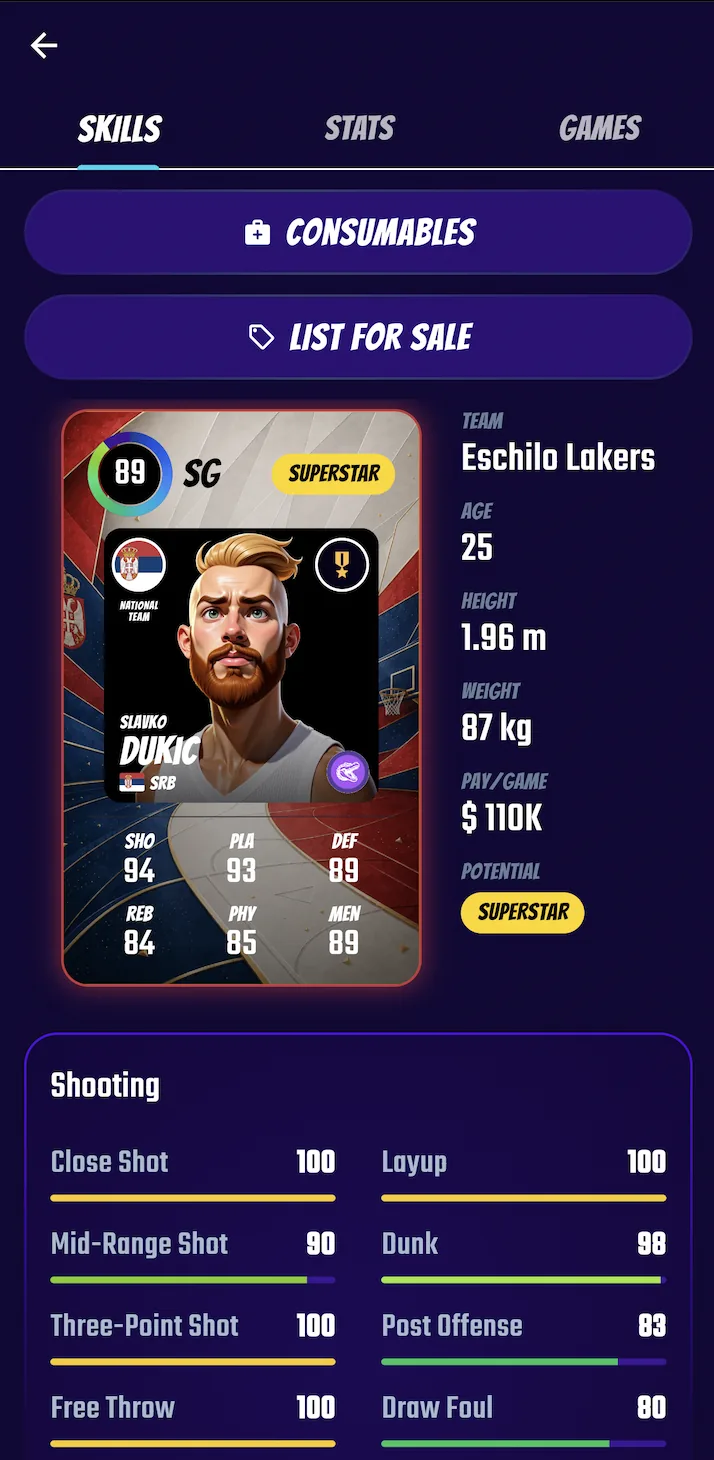
On the market or in the draft, read the card in this order: average of Three-Point Shot and Catch and Shoot (at least 70), Perimeter Defense and Shot Contest, Free Throw and Draw Foul, then the ball skills. The Shooting group weighs 25% of the Overall and has 11 skills, so a great shooter doesn't necessarily have a huge Overall: it's a profile that's often undervalued on the market.
In training, the Player Development Coach (from Level 3) puts young shooting guards on specialized Shooting. It's the right choice to start, but when the Shooting group reaches the high 80s it pays to switch to Defense, which weighs 25% too and contains the skills that, in our tests, were worth the most. All the details are in our training guide, and the meaning of every rating is in the guide to all 49 player skills.
Checklist: the ideal shooting guard
- Average of Three-Point Shot and Catch and Shoot above 70, ideally 80+.
- Perimeter Defense and Shot Contest high: he guards their best shooter.
- Free Throw, Draw Foul and Aggressiveness to turn drives into free points.
- Ball Handle and Ball Security decent, because he's the second ball handler.
- Stamina high, to keep his shooting intact in the fourth quarter.
- Clutch if he's your main scorer.
- Off-Ball Movement, Consistency and height: tiebreakers, not priorities.
Frequently asked questions
What are the most important skills for a shooting guard in Swish & Dunk?
Three-Point Shot and Catch and Shoot on offense, because more than half of his shots are threes, and Perimeter Defense and Shot Contest on defense, because he guards the opponent's main three-point shooter. In our tests +20 in Perimeter Defense and Shot Contest was worth +1 point per game, +15 in the two shooting skills about +0.6.
How tall should a shooting guard be?
Shooting guards are generated between 1.91 and 2.01 m. Height only matters on shots at the rim (±0.35% per centimetre compared with 1.98 m), which are 30% of his attempts: the difference between the shortest and the tallest SG is worth about a third of a point per game.
Does Off-Ball Movement help a shooting guard?
It decides who gets the shot on catch-and-shoot plays, but the shooting guard is already the favorite thanks to his shooting. In our tests +20 in Off-Ball Movement didn't change his shots or his points in a measurable way.
Is a streaky shooter a problem?
Consistency sets how much his shooting ratings swing from night to night (from ±3% to ±23%), but in our simulations the spread of his points was almost the same with Consistency 30 or 95: the randomness of single shots counts much more.
Which tactics suit a great shooting guard?
The ones that look for the three and the catch-and-shoot: 5-Out, Pace and Space, Motion and Princeton. On defense, a shooting guard with Perimeter Defense and Steal fits Switch-Everything and the pressing defenses.
Complete your roster with the other position guides: the point guard (PG), the small forward (SF), the power forward (PF) and the center (C).
Looking for your sniper? Take over a club and build your team around the right shooting guard.
Play now — it's freeLast updated: