Center (C) Skills Guide in Swish & Dunk: What Makes a Great Big Man
The center is the player closest to the basket in Swish & Dunk. The engine gives him the strongest tendency to attack the rim, the heaviest weight on rebounds and blocks, and makes him the main finisher of the pick-and-roll. It's also the only role where height really changes the results. This guide explains which skills make a good center in the match engine and exactly how each one is used, how much height and physique matter, what rim protection really means in the engine, how fouls weigh and what changes less than it seems. Every claim is backed by tests on 3,000 games simulated with the real engine.
The center at a glance
- A rim role: 80% of his shots are at the rim, at 65.8%, and 54% of them come from the pick-and-roll.
- Height counts, up to a point: a 2.06 m center lost 0.9 points per game compared with a 2.14 m one; from 2.15 m on the gain becomes small.
- Finishing and rebounds are worth the same: +20 in Close Shot, Layup and Dunk or +20 in the rebounding trio, about +0.5–0.6 points per game each.
- Rim protection is more about matchups than blocks: the center contests the shots of the opposing center; Block and Help Defense mostly add stats.
- Fouls are his weak spot: a center with poor discipline loses minutes and gives away free throws.
- The stretch five exists: with Three-Point Shot and Catch and Shoot near 90, he went from 0.6 to 6.6 threes per game.
What the engine asks of a center
The engine weights almost every decision by the primary position on the card. For the center the weights are extreme in both directions:
| Decision | C weight | Compared with the PG |
|---|---|---|
| Attacking the rim | ×2.4 | ×0.85 |
| Rebounding | ×1.5 | ×0.75 |
| Going for the block | ×2.6 | ×0.4 |
| Posting up | ×1.45 | ×0.25 |
| Off-ball fouls | ×1.5 | ×0.7 |
| Looking for the three (before the stretch effect) | ×0.35 | ×1.25 |
| Who starts the half-court play | ×0.6 | ×3.0 |
| Who gets the assist | ×0.6 | ×2.6 |
In our simulations a 72-rated starting center playing 33 minutes averaged 12.4 points on just 8.8 shots (60% from the field), 10.7 rebounds (2.6 offensive), 1.4 blocks, 1.1 assists, 0.4 turnovers and 2.1 fouls. 80% of his shots were at the rim (65.8%), 15% from mid-range and 6% threes; 54% came from the pick-and-roll as the roll man, 17% on the fast break, 11% from post-ups and 11% from isolations. He's the most efficient player on the team, but also the one who touches the ball least. To see how a whole game works, read our guide to the match engine.
How we tested
We simulated 3,000 games with the real Swish & Dunk match engine between two identical teams (starters rated about 72, bench about 66, neutral tactics), changing one thing at a time on the center. Differences smaller than about 0.3 points per game are within random noise.
Height: the only role where it really counts
Centers are generated between 2.08 and 2.21 m and 110–130 kg. Height enters the engine in two places:
- Shots at the rim: +0.35% per centimetre over 1.98 m, up to a maximum of +6%, reached at 2.15 m.
- Rebounds: +1.5% of weight per centimetre over 1.95 m, up to a maximum of ×1.4, reached at 2.22 m.
Since 80% of his shots are at the rim and he takes more rebounds than anyone, height is worth more for a center than for any other role. The tests confirm it: against a 2.14 m center, a 2.06 m center went from 60.4% to 58.3% from the field, from 10.7 to 10.1 rebounds, and the team lost 0.9 points per game (46.5% wins). A 2.22 m center, on the other hand, gained almost a rebound but only +0.1 points per game: beyond 2.15 m the bonus at the rim is already capped. The practical rule: between a 2.10 m and a 2.16 m center with the same skills, take the taller one; between 2.16 and 2.21, look at the skills.
Finishing at the rim
Every shot at the rim is resolved with the average of Close Shot, Layup and Dunk against the average of the defender's Interior Defense, Shot Contest and Block, starting from a base rate of 56%, plus the height bonus. It's the most important offensive skill for a center, because almost all his shots go through it. With +20 in all three our center went from 60% to 63.7% from the field and from 12.4 to 13.7 points per game, and the team gained +0.6 points per game (52.4% wins). Strength, Layup and Dunk also protect his shot from blocks.
The roll man in the pick-and-roll
More than half of his shots come from the pick-and-roll. When a guard starts one, the engine chooses the screener who rolls to the rim by weighting Pick & Roll Roll Man ×1, Screening ×0.6 and Close Shot ×0.5; the roll man finishes at the rim 85% of the time (alley-oops, layups, dunks). In our tests +20 in Pick & Roll Roll Man and Screening gave him +0.7 points but didn't change the team's margin: these skills decide who finishes the pick-and-roll, while the percentage depends on finishing.
Post Offense
For PF and C, Post Offense has a weight of ×1.45 in deciding how often the player posts up. Post-ups end at the rim 80% of the time and with a mid-range shot 20% of the time. Post Offense decides the frequency, not the percentage, which depends on Close Shot, Layup, Dunk and Mid-Range Shot: a center with high Post Offense and weak finishing asks for a lot of balls and wastes plenty. It's a useful skill in the Triangle Offense, not in itself.
Rebounding
On every missed shot the engine draws the rebounder among all ten players on the floor. For a center the weight is the highest of all: role ×1.5 and height up to ×1.4, so a 2.14 m center weighs about 1.9 times his skills, compared with 0.67 for a 1.88 m point guard. The skills:
- Defensive rebound: Defensive Rebound ×0.75, Box Out ×0.35, Strength ×0.15.
- Offensive rebound: Offensive Rebound ×0.65, Box Out ×0.20, Strength ×0.15.
With +20 in Offensive Rebound, Defensive Rebound and Box Out our center went from 10.7 to 12.5 rebounds per game, the team's offensive rebounds rose from 10.8 to 11.2 and the margin by +0.5 points per game. Every offensive rebound is a new possession.
Rim protection: what it really means in the engine
This is the most important section for understanding the center in Swish & Dunk, because the engine works differently from what many expect.
Every shot is contested by the defender with the same primary position as the shooter. Your center contests the shots of their center; their point guard's drives are contested by your point guard. So the center's Interior Defense, Shot Contest and Block mostly lower the percentages of the opposing center. With +20 in Interior Defense, Block, Help Defense, Vertical and Shot Contest, the opposing center went from 60.4% to 57.5% from the field and our center's blocks from 1.4 to 1.9 per game, but the opponent's overall percentage at the rim only went from 63.0% to 62.5%, and the gain for the team was +0.3–0.6 points per game.
Blocks are decided after the miss. When a shot at the rim misses, the engine chooses who went for the block among all five defenders, weighting Block (60%), Help Defense (20%) and Vertical (20%) by the role (×2.6 for a center, with a ×1.5 bonus for the direct defender), and then decides whether the miss was a block. That's why a center with great Block and Help Defense collects many blocks: but the shot had already missed, so those skills fill the stat sheet more than they lower the opponents' percentages.
The practical consequence: to protect the paint you need good interior defenders in every position, not just a shot-blocking center. When we raised Interior Defense, Block and Shot Contest by 15 for both the center and the power forward, the opponents' percentage at the rim fell to 61.9% and the team gained +0.8 points per game, more than a super-center alone. Defenses like Drop Coverage and Pack Line then multiply the interior contest of all five, as explained in our guide to basketball tactics.
Fouls: the center's real limit
The center has the heaviest weight for off-ball fouls (×1.5): blocks, post fights and boxing out involve him above all. The engine picks the fouler by weighting Aggressiveness and the lack of Defensive Discipline, and on shots it pits the defender's Defensive Discipline and Emotional Control against the shooter's Draw Foul and Aggressiveness. Fouls cost twice: free throws for the opponents and minutes for him, because with 3 fouls in the first half, 4 in the third quarter or 5 in the fourth he goes to the bench (except in a close finale), and at 6 he's out of the game. In our tests, −25 in Defensive Discipline and Emotional Control took his fouls from 2.1 to 2.7 per game, the opposing center's free throws from 2.1 to 2.9 and cost the team 0.75 points per game (47.5% wins).
The stretch five
A center normally looks for the three very little (×0.35), and the typical profile has −14 in Three-Point Shot and −8 in Catch and Shoot compared with his level. But the engine allows big men who shoot: when the average of Three-Point Shot and Catch and Shoot goes from 60 to 85, the role penalty disappears and he looks for the three like a wing, and in the pick-and-roll he pops out for the three up to 75% of the time instead of rolling. In our test, with both skills near 90, our center went from 0.6 to 6.6 threes per game at 40% and from 12.4 to 16.4 points, with +0.5 points per game for the team. In return he took fewer shots at the rim, where he shot 66%. A stretch five makes sense in the 5-Out, much less next to a power forward who already shoots.
Physique
- Strength: 15% of the weight on both rebounds, and it protects shots at the rim from blocks. It's the center's most useful athletic skill.
- Vertical: 20% of the weight in choosing who goes for the block and 20% of the block skill.
- Stamina: centers are generated with −2 in Stamina, and fatigue cuts all ratings by up to 30%. A tired center finishes and rebounds worse.
- Speed and Transition Offense: they're a bonus. 17% of his shots come on the fast break, as the trailer finishing at the rim.
- Transition Defense: it reduces the bonus of up to +12% on fast breaks finished by the opposing center.
- Acceleration: it doesn't enter any duel.
Mental attributes
- Defensive Discipline and Emotional Control: the most important for a center, for the reasons above.
- Durability: injuries happen on contact plays, that is shots and rebounds, and the center is the player who takes the most rebounds. Durability lowers the risk by up to 60% and makes long layoffs rarer.
- Aggressiveness: it helps draw shooting fouls (centers have +4 in Draw Foul), but it raises off-ball fouls and the risk of injury.
- Clutch: it multiplies his duels in close finishes, from −10% to +10%.
- Free Throw: not mental, but worth remembering: the typical profile has −6, and a center who goes to the line twice a game at 70% wastes points.
- Basketball IQ and Leadership: they count little, because a center handles the ball rarely; Leadership can still help if he's among the two leaders on the floor in clutch time.
Four types of center
| Type | Key skills | Best tactics |
|---|---|---|
| Rim protector | Interior Defense, Shot Contest, Block, Help Defense, Vertical, Defensive Discipline | Drop Coverage, Pack Line |
| Rebounder and finisher | Close Shot, Layup, Dunk, Defensive Rebound, Offensive Rebound, Box Out, Strength | Spread Pick-and-Roll, Run and Gun |
| Post scorer | Post Offense, Close Shot, Mid-Range Shot, Strength, Draw Foul, Free Throw | Triangle, Princeton |
| Stretch five | Three-Point Shot and Catch and Shoot (85+), Defensive Rebound, Box Out | 5-Out, Pace and Space |
For most teams the rebounder and finisher is the most efficient profile: he turns the guards' pick-and-rolls into high-percentage shots and wins the extra possessions. The other types fit specific systems.
How to find and develop a center
Read the card in this order: height (at least 2.12–2.15 m), finishing at the rim, the rebounding trio and Strength, Defensive Discipline, then Interior Defense and Block. Be wary of a center with a huge Block and poor finishing: the block stats look great on the card, but the points come from the rim.
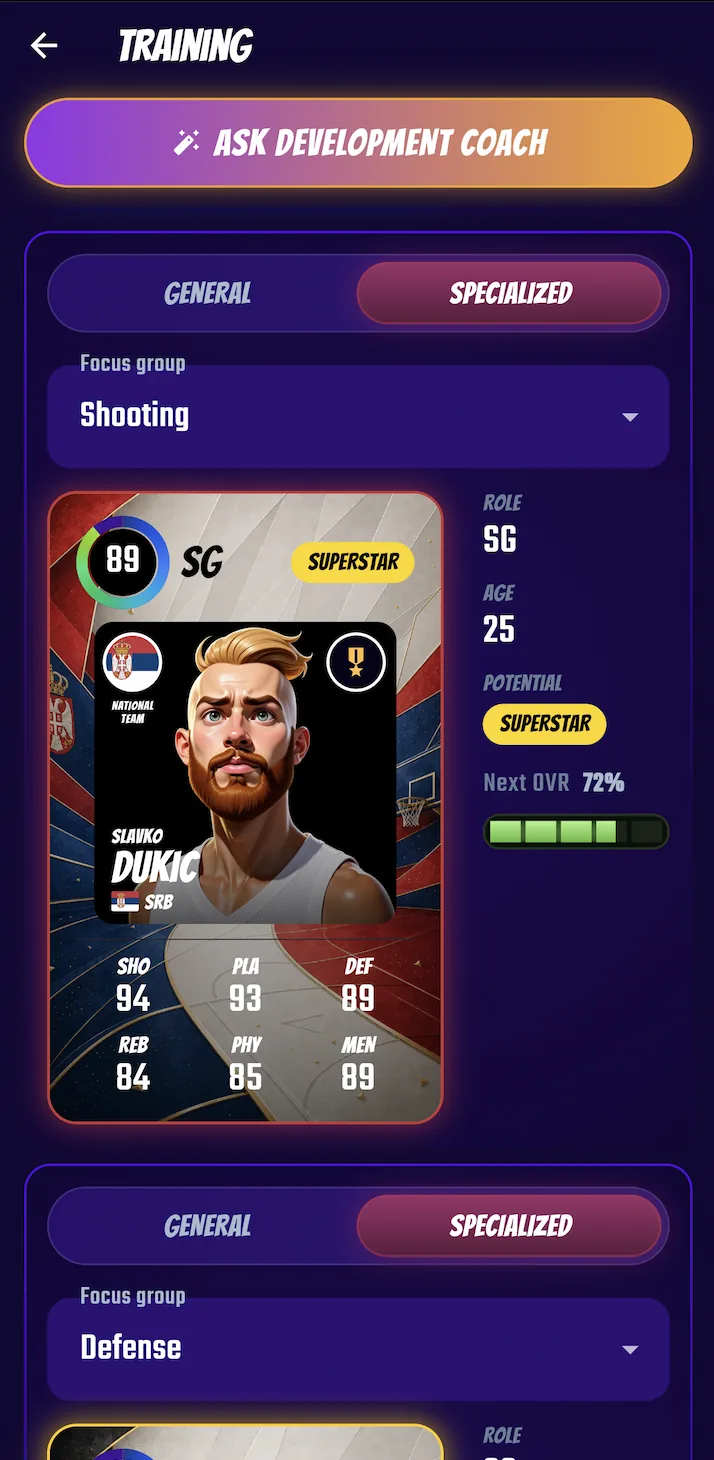
In training, the Player Development Coach (from Level 3) puts young centers on specialized Rebounding: it gives quick Overall jumps, because the group has only three skills, but it saturates within a season or two. Then switch to Defense (25% of the Overall) or, if you want a scorer, Shooting, which contains Close Shot, Layup and Dunk. The details are in our training guide, and the meaning of every rating is in the guide to all 49 player skills.
Checklist: the ideal center
- Height of 2.15 m or close to it.
- Close Shot, Layup and Dunk high: 80% of his shots are at the rim.
- Defensive Rebound, Offensive Rebound, Box Out and Strength the best on the team.
- Defensive Discipline and Emotional Control to stay on the floor.
- Interior Defense and Shot Contest to stop the opposing center.
- Pick & Roll Roll Man and Screening if your guards run the pick-and-roll.
- Durability because he's the player most exposed to contact.
- Block and Help Defense: nice for the stats, but not the first thing to look at.
Frequently asked questions
What are the most important skills for a center in Swish & Dunk?
Finishing at the rim (Close Shot, Layup, Dunk), because 80% of his shots are there; the rebounding trio (Defensive Rebound, Offensive Rebound, Box Out); Interior Defense, Shot Contest and Block to stop the opposing center; and Defensive Discipline so he doesn't get into foul trouble. In our tests +20 in finishing was worth +0.6 points per game, as much as +20 in rebounding.
How tall should a center be in Swish & Dunk?
Centers are generated between 2.08 and 2.21 m. Height counts a lot up to about 2.15 m, where the bonus on shots at the rim reaches its +6% cap: a 2.06 m center lost 0.9 points per game compared with a 2.14 m one. Above that the gain is small, only on rebounds (capped at 2.22 m).
Does a shot-blocking center protect the rim?
Less than you'd think. Every defender contests the shots of the opponent with his own position, so the center's Interior Defense mostly affects the opposing center. Block, Help Defense and Vertical decide who blocks a shot that has already missed: they add blocks to the stat sheet, but they don't lower the other players' percentages.
Can a center shoot threes in Swish & Dunk?
Yes. When the average of Three-Point Shot and Catch and Shoot goes from 60 to 85, the role penalty disappears and he looks for the three like a wing, popping out of the pick-and-roll up to 75% of the time. In our tests a stretch five went from 0.6 to 6.6 threes per game at 40%.
Why does my center get into foul trouble so often?
The center has the heaviest weight for off-ball fouls (×1.5), and the engine picks the fouler by Aggressiveness and lack of Defensive Discipline. With 3 fouls in the first half he goes to the bench. In our tests −25 in Defensive Discipline and Emotional Control cost him minutes and the team 0.75 points per game.
The center works in tandem with the power forward: read the power forward (PF) guide too, and complete your roster with the guides to the point guard (PG), the shooting guard (SG) and the small forward (SF).
Ready to build around your big man? Take over a club and find the center who anchors your paint.
Play now — it's freeLast updated: