Small Forward (SF) Skills Guide in Swish & Dunk: What Makes a Great Wing
The small forward is the most balanced role in Swish & Dunk. The engine gives him intermediate weights in almost everything: he shoots threes almost as much as a guard, attacks the rim more than a guard, rebounds more than a guard and less than a big. That's why the best small forwards are the ones who don't have a weakness, and above all the ones who defend. This guide explains which skills make a good SF in the match engine and how each one is used, how much height and athleticism count, the trap of small ball and what changes less than it seems. Every claim is backed by tests on 3,000 games simulated with the real engine.
The small forward at a glance
- A balanced role: 48% of his shots are threes and 36% at the rim; he's in the middle of the rankings for rebounds, assists and blocks.
- Defense first: +15 in Perimeter Defense, Shot Contest and Steal held the opposing small forward to 31.4% from three and was worth +1 point per game.
- Then shooting: +15 in Three-Point Shot and Catch and Shoot took him to 39% from three.
- Rebounds are a trap: a small forward who rebounds more takes rebounds away from his own big men.
- Watch out for speed: if he's the fastest player on the floor, he brings the ball up on every fast break, with more assists and more turnovers.
- In small ball the engine keeps treating him as a small forward and the matchups can get mixed up.
What the engine asks of a small forward
The engine weights almost every decision by the primary position on the card. For the small forward the weights are always in the middle:
| Decision | PG | SG | SF | PF | C |
|---|---|---|---|---|---|
| Who starts the half-court play | ×3.0 | ×2.2 | ×1.6 | ×1.0 | ×0.6 |
| Looking for the three | ×1.25 | ×1.4 | ×1.2 | ×0.8 | ×0.35 |
| Attacking the rim | ×0.85 | ×0.8 | ×1.0 | ×1.5 | ×2.4 |
| Rebounding | ×0.75 | ×0.85 | ×0.95 | ×1.2 | ×1.5 |
| Going for the block | ×0.4 | ×0.5 | ×0.9 | ×1.6 | ×2.6 |
| Off-ball fouls | ×0.7 | ×0.8 | ×1.0 | ×1.3 | ×1.5 |
In our simulations a 72-rated starting small forward playing 33 minutes averaged 14.1 points on 10.8 shots (46%), 5.2 three-point attempts at 35%, 5.2 rebounds, 2.8 assists, 1.1 steals, 0.5 blocks and 1.6 turnovers. 48% of his shots were threes, 36% at the rim (at 62.9%) and 16% from mid-range; 40% came from isolations, 25% from catch-and-shoot, 15% from the pick-and-roll and 15% on the fast break. He's the third option on offense, which is why his value is measured above all on the other end of the floor. To see how a whole game works, read our guide to the match engine.
How we tested
We simulated 3,000 games with the real Swish & Dunk match engine between two identical teams (starters rated about 72, bench about 66, neutral tactics), changing one thing at a time on the small forward. Differences smaller than about 0.3 points per game are within random noise.
Defense: the most valuable part of a wing
In the engine every player guards the opponent with the same primary position. Your small forward guards theirs, a player who shoots almost half his shots from three, attacks the rim and handles the ball in a fifth of the possessions. Defending him well means touching every type of duel:
- Perimeter Defense and Shot Contest: the contest on every jumper and three of his man.
- Steal: half of the pressure (with Perimeter Defense) when his man has the ball.
- Interior Defense and Block: with Shot Contest, the contest on his man's drives. +20 in both lowered the opposing small forward's finishing at the rim from 62.1% to 60.4%.
- Help Defense: it doesn't change the opponents' percentages, but it gives him blocks and steals as a helper.
- Transition Defense: it reduces the bonus of up to +12% on fast breaks finished by his man.
The test: +15 in Perimeter Defense, Shot Contest and Steal held the opposing small forward from 45.9% to 43.3% from the field and from 34.8% to 31.4% from three, and raised his turnovers from 1.6 to 2.0. Net effect: +1 point per game and 53.7% wins, the best upgrade we found for the role. A wing who locks down his man is worth more than one who scores two extra points.
Shooting: the three and the catch-and-shoot
Every three is resolved with the average of Three-Point Shot and Catch and Shoot against the defender's contest. Below 70 of average the engine makes him look for the three less and less, and the small forward has a high role tendency (×1.2): a wing who doesn't shoot clogs the spacing of the whole offense. With +15 in both skills our SF went from 35% to 39% from three, from 5.2 to 5.9 attempts and from 14.1 to 15.4 points per game. On the team the effect was positive but small (+0.3): the three-point percentage of a third option weighs less than his defense.
In catch-and-shoot plays the shooter is chosen by weighting Catch and Shoot ×1.2, Three-Point Shot and Off-Ball Movement ×0.7: a small forward who shoots well and moves without the ball takes catch-and-shoot shots away from the shooting guard. Off-Dribble Shot and Mid-Range Shot count for the 16% of mid-range shots and for isolations.
Attacking the rim
36% of his shots are at the rim, more than any guard. The skill used is the average of Close Shot, Layup and Dunk against the defender's Interior Defense, Shot Contest and Block, plus a height bonus: at the rim every centimetre over 1.98 m is worth +0.35%, and small forwards are generated between 1.98 and 2.06 m. Draw Foul and Aggressiveness decide the free throws he earns. With +15 in finishing and Draw Foul our SF went from 46.0% to 48.2% from the field and from 2.9 to 3.3 free throws, +1.1 points per game. Good for a slasher, but the effect on the team stayed small.
Rebounding: the trap
Rebounds are drawn among all ten players on the floor, weighted by skills, role and height. The small forward has a role weight of 0.95 compared with 1.2 for the power forward and 1.5 for the center. When we gave him +20 in Defensive Rebound and Box Out he went from 5.2 to 6.2 rebounds per game, but the team's rebounds didn't change and neither did the margin: he was taking them from his own big men. Unless you play a lineup without true bigs, rebounding is a secondary skill for a small forward.
Speed and the fast break
When a possession starts in transition, the engine gives the ball to the player on the floor with the highest sum of Transition Offense and Speed, every time, without drawing lots. Normally it's the point guard (whose profile is +8 in both), but an athletic small forward can overtake him. We tested it: with +20 in Transition Offense, Transition Defense and Speed, our SF became the fast-break ball handler. His assists went from 2.8 to 4.4, his turnovers from 1.6 to 2.8 and his points from 14.1 to 15.1, while the team's result stayed the same. It isn't a disaster, but if your fastest small forward has low Ball Security and Decision Making, all those fast breaks become turnovers.
Small ball and versatility
The small forward is the player most often moved around: to shooting guard in big lineups, to power forward in Small Ball. Two engine rules are worth knowing:
- Behavior follows the primary position on the card, not the slot he occupies in the lineup. A small forward playing the PF slot keeps rebounding, shooting and going for the block like a small forward.
- Matchups also follow the primary position. If you put two small forwards on the floor and no power forward, the opposing PF doesn't find a defender of his own position and the engine assigns him a random one, while only one of your two SFs is ever matched with their small forward.
Versatility also helps the bench: when a substitution is needed and no player of the same role is available, the engine falls back on adjacent roles, and the small forward is adjacent to two positions (SG and PF). A backup SF can therefore cover two holes in your rotation.
Height and athleticism
Small forwards are generated between 1.98 and 2.06 m. Height gives him up to +2.8% on shots at the rim compared with the 1.98 m reference and a slightly heavier weight on rebounds; it's an advantage but not a priority. Stamina counts as for every starter: it protects all ratings from fatigue (up to −30%) and keeps him on the floor. Strength helps him finish through contact and rebound; Vertical only counts in blocks; Acceleration doesn't enter any duel.
Mental attributes
- Defensive Discipline and Emotional Control: with an off-ball foul weight of 1.0 (higher than the guards'), the small forward gets into foul trouble more easily than you'd think. These two skills limit the shooting fouls he commits.
- Clutch: it multiplies his duels from −10% to +10% in close finishes. If he's your best player, together with Overall it also makes him the one who gets the ball.
- Basketball IQ: it protects the ball in the possessions he runs and on fast breaks.
- Consistency: it sets the swing of his shooting from night to night; in our tests the effect on results was small.
- Durability: it lowers the risk of injury on every contact play.
Three types of small forward
| Type | Key skills | Best tactics |
|---|---|---|
| 3-and-D wing | Perimeter Defense, Shot Contest, Steal, Three-Point Shot, Catch and Shoot | 5-Out, Pace and Space, Switch-Everything |
| Two-way slasher | Layup, Close Shot, Dunk, Draw Foul, Transition Offense, Speed | Run and Gun, Small Ball |
| Point forward | Ball Handle, Pass Accuracy, Court Vision, Ball Security, Basketball IQ | Motion, Princeton |
The 3-and-D profile is the one that wins the most games, because it adds the most valuable defense in the role to a shot that keeps the floor open. How to build the rest of the system is explained in our guide to basketball tactics.
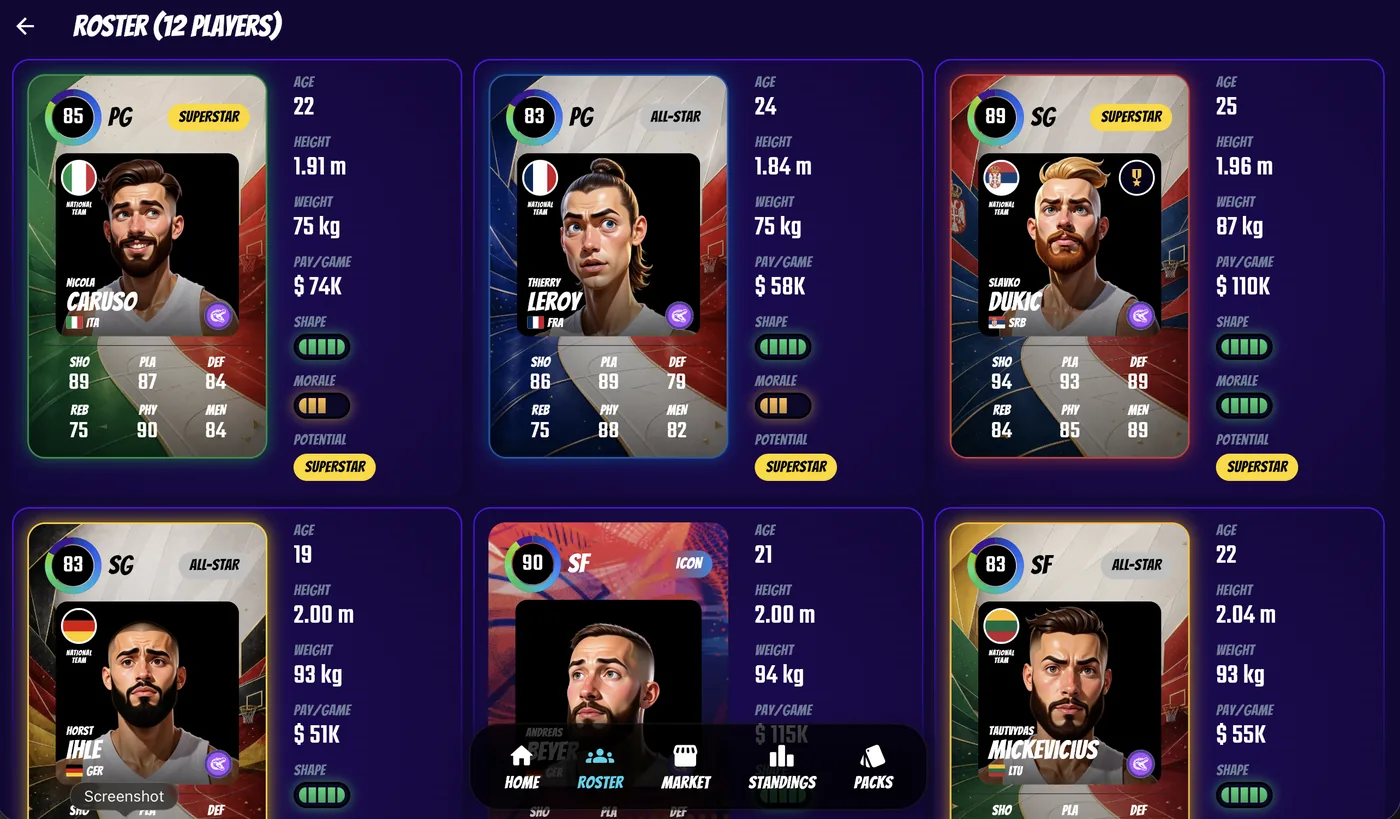
How to find and develop a small forward
Read the card in this order: Perimeter Defense, Shot Contest and Steal; average of Three-Point Shot and Catch and Shoot (at least 70); finishing at the rim; then ball skills and rebounding. Overall can fool you less than in other roles, because a good small forward uses skills from every group.
In training, the Player Development Coach (from Level 3) puts young small forwards on specialized Shooting. It's a good start, but for the role the Defense group (25% of the Overall, related group Physical) is just as important: alternating the two gives the most complete wing. The details are in our training guide; to find a young player with room to grow, check the draft and the market as explained in the guide to cards and pack odds. The meaning of every rating is in the guide to all 49 player skills.
Checklist: the ideal small forward
- Perimeter Defense, Shot Contest and Steal: the priority of the role.
- Average of Three-Point Shot and Catch and Shoot at 70 or more.
- Close Shot, Layup and Dunk good, because more than a third of his shots are at the rim.
- Ball Security and Decision Making decent, especially if he's fast.
- Defensive Discipline so he doesn't get into foul trouble.
- A backup small forward on the bench: he can cover both SG and PF in an emergency.
- Rebounding: a bonus, not a priority.
Frequently asked questions
What are the most important skills for a small forward in Swish & Dunk?
Perimeter Defense, Shot Contest and Steal, because he guards the opposing small forward, then Three-Point Shot and Catch and Shoot, because almost half of his shots are threes. In our tests +15 in the three defensive skills was worth +1 point per game, more than any offensive upgrade.
Should a small forward be a good rebounder?
It helps him but barely moves the result: with +20 in Defensive Rebound and Box Out our small forward went from 5.2 to 6.2 rebounds, but the team's rebounds and margin stayed the same, because he was mostly taking them from his own big men.
Can a small forward play power forward in small ball?
Yes, but the engine keeps treating him as a small forward: rebounds, blocks and shot selection follow the primary position on the card. And if no player with the PF position is on the floor, the opposing power forward is guarded by a random defender.
Why does my small forward commit so many turnovers?
Probably because he has the highest sum of Transition Offense and Speed on the floor: the engine gives him the ball on every fast break. In our tests that took his turnovers from 1.6 to 2.8 per game, along with his assists from 2.8 to 4.4.
Which tactics suit a great small forward?
5-Out, Pace and Space and Small Ball for a wing who shoots; Run and Gun for an athletic one; Switch-Everything and Match-Up Zone on defense for a versatile perimeter defender.
The small forward connects guards and big men: read the other position guides too, the point guard (PG), the shooting guard (SG), the power forward (PF) and the center (C).
Ready to find your two-way wing? Take over a club and build the team that suits him.
Play now — it's freeLast updated: