Swish & Dunk Training Guide: How to Develop Young Players and Reach Their Potential
In Swish & Dunk you can buy a finished star on the market, but the real satisfaction is building one: picking an 18-year-old in the draft and watching him become the leader of your team. To do that you need to understand how training works. This guide explains every part of player development in detail: the daily session, growth after games, the role of age and Potential, how OVR jumps happen, what each training type and each specialized focus improves, the Practice Facility, the Player Development Coach and the most common mistakes. All the numbers are the ones the game actually uses.
Training at a glance
- Two sources of growth: a daily session every morning at 07:00 and a smaller boost after every game, proportional to minutes played.
- Age slows everything: an 18-year-old grows at full speed, a 30-year-old at about two thirds.
- Potential is a hard ceiling: the closer a player gets to it, the slower he grows, and when he reaches it he stops for good.
- Training types decide where growth goes: Physical, Mentality, Shape or Specialized with a focus group.
- Not all skills weigh the same: Shooting and Defense count for 25% of Overall each, Mentality only 10%.
- The Practice Facility multiplies all growth, up to 3 times at Level 5.
Where growth comes from
Every player in Swish & Dunk has around fifty individual skills, rated 1 to 100 and split into six groups. Training never raises the Overall directly: it adds small amounts to the skills, and the Overall is recalculated from them. Growth arrives from two sources.
The daily session. Every morning at 07:00 Central European Time every player in the league trains, including injured players and those who don't play. At full speed (an 18-year-old with a lot of room to grow and a Level 1 Practice Facility) a session hands out about 2.5 skill points, spread across the skills according to his training type.
The post-game boost. After every game a player takes part in, he receives an extra amount of growth proportional to his minutes: a player with 30 minutes gets two thirds of a daily session, one with 45 minutes or more gets one and a half times the base amount, one who stays on the bench gets nothing. Regular season, playoffs, friendlies and cup games all count.
The same factors apply to both sources:
| Factor | Effect on growth |
|---|---|
| Age | −3% for every year above 18 |
| Gap to Potential | full speed with 25+ points of gap, slower as the gap closes |
| Specialized training | ×1.10 |
| Practice Facility | ×1.0 at Level 1, up to ×3.0 at Level 5 |
| Minutes (games only) | minutes ÷ 30, up to ×1.5 |
| Random factor | ±10% per session |
Within a session each skill receives its share with a further random swing, so some skills move more than others even within the same group. Fractions are never lost: the game keeps track of every tenth of a point and turns it into +1 as soon as it adds up to a whole point.
Age: why young players grow faster
Age multiplies all growth by a factor that starts at 100% at 18 and drops by 3 points every year:
| Age | Growth speed |
|---|---|
| 18 | 100% |
| 20 | 94% |
| 22 | 88% |
| 25 | 79% |
| 28 | 70% |
| 30 | 64% |
| 35 | 49% |
Players age by one year at every season rollover, so a draft pick who arrives at 18 trains at full speed only for his first season. There is no physical decline with age: a veteran doesn't lose skills, he simply improves more slowly. In fact the match engine rewards experience in close moments, with a small bonus of up to 8% for veterans and a small penalty for 19-year-olds, as explained in our guide to the match engine.
Potential: the ceiling you can't break
Every player has a Potential, fixed the moment he is created and never changed afterwards. It is the highest Overall he can reach through training. Potential works in two ways.
It is a hard ceiling. As soon as the Overall, including the progress towards the next point, reaches Potential, the player stops improving for good: no more growth from training or from games.
It also controls speed. Growth is full only when the gap between Potential and Overall is 25 points or more; below that it shrinks proportionally, down to a minimum of 8%:
| Gap to Potential | Growth speed |
|---|---|
| 25 points or more | 100% |
| 20 points | 80% |
| 15 points | 60% |
| 10 points | 40% |
| 5 points | 20% |
| 2 points or less | 8% |
This is the most important rule in the whole system. Most players are created with a Potential between 0 and 7 points above their Overall, so they grow slowly and stop soon. The ones worth building around are those with a big gap: a young player with 15 or 20 points of margin can grow quickly for several seasons. Many draft prospects arrive with exactly this profile, with gaps that in some cases go beyond 20 points: always check the difference between Overall and Potential before ranking them.
How OVR jumps happen
The Overall is a weighted average of the six skill groups, and each group is the average of its skills. The weights are fixed:
| Group | Weight on Overall | Skills | Which skills |
|---|---|---|---|
| Shooting | 25% | 11 | Close Shot, Mid-Range, Three-Point, Free Throw, Off-Dribble Shot, Catch and Shoot, Layup, Dunk, Post Offense, Draw Foul, Weak Hand |
| Defense | 25% | 9 | Perimeter Defense, Interior Defense, Post Defense, Help Defense, Pick & Roll Defense, Steal, Block, Shot Contest, Defensive Discipline |
| Playmaking | 15% | 9 | Ball Handle, Pass Accuracy, Court Vision, Decision Making, Pick & Roll Handler, Ball Security, Off-Ball Movement, Screening, Pick & Roll Roll Man |
| Physical | 15% | 7 | Transition Offense, Transition Defense, Speed, Acceleration, Strength, Vertical, Stamina |
| Rebounding | 10% | 3 | Offensive Rebound, Defensive Rebound, Box Out |
| Mentality | 10% | 10 | Basketball IQ, Clutch, Leadership, Aggressiveness, Work Ethic, Professionalism, Emotional Control, Consistency, Durability, Coachability |
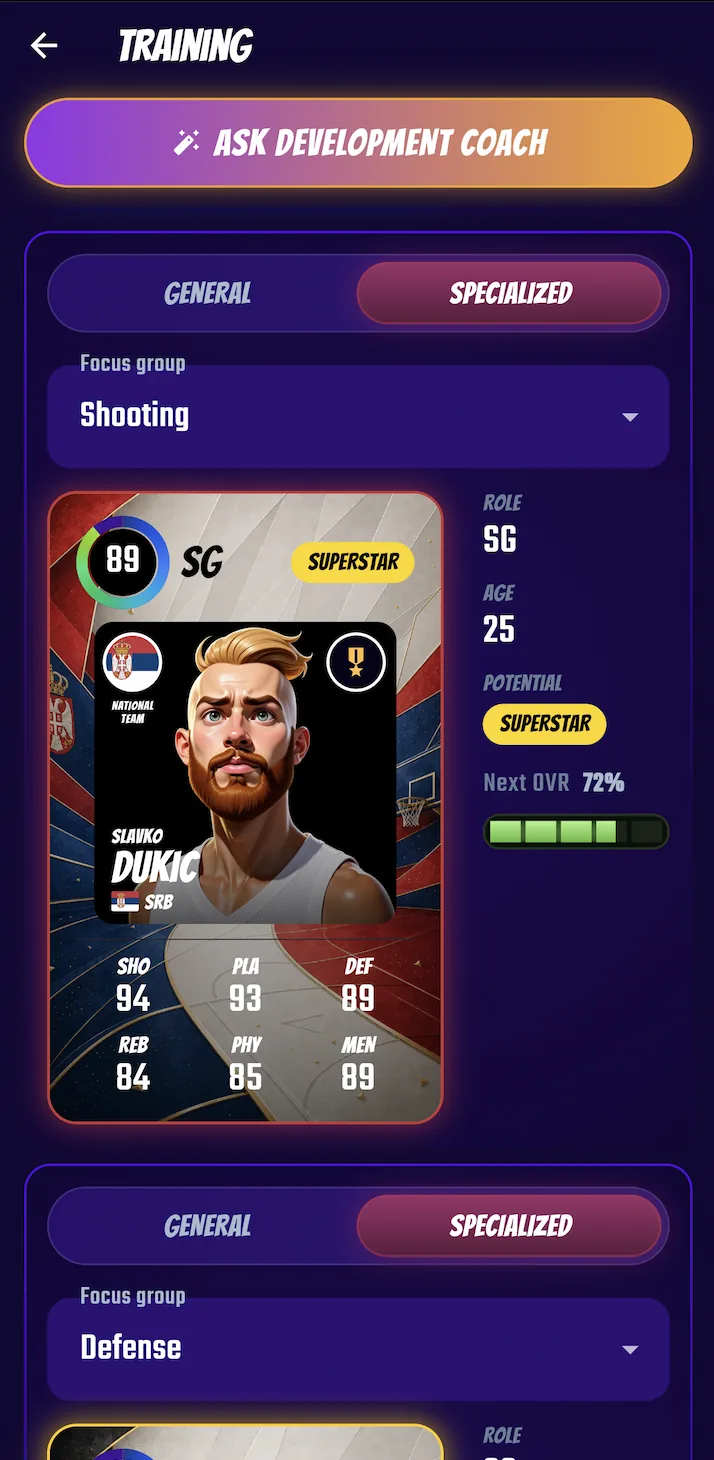
The real Overall is a number with decimals: the card shows the whole part, and the Next OVR bar on the Training screen shows how far the player is towards the next point. When the bar fills up, you get an OVR jump: the Overall goes up by one, and if the jump happens during the morning session the game celebrates it with the "OVR JUMP!" reveal and lists it among the week's jumps on the Training screen. Growth from games fills the same bar, just more quietly.
The table explains a detail many managers miss: one skill point is not always worth the same. A point in Rebounding is spread across only three skills, so it moves the Overall a lot; a point in Mentality is diluted across ten skills that weigh only 10% together, so it barely moves it. That's why two players with the same growth can make very different OVR jumps.
The four training types
For every player you choose a training type, in two families: General (Physical, Mentality or Shape) and Specialized (with a focus group). The type decides where growth goes, both from the daily session and from games.
General: Physical and Mentality
Physical puts 100% of growth into the 7 Physical skills: speed, acceleration, strength, vertical, stamina and transition. It's the default training for most players and it's a solid start, because those skills matter in every possession and Stamina also decides how quickly a player tires during a game. Its limit is that it only covers 7 skills: once they reach the high 80s, growth slows sharply and the Overall stops rising.
Mentality puts 100% into the 10 Mentality skills. It's the training that moves the Overall least, because those skills weigh only 10% and are spread over ten values. It still has a purpose: Clutch and Consistency weigh on the match engine in tight finishes and on a player's reliability from game to game, and Durability lowers the risk of injury. Use it on purpose, not by default.
Shape
Shape gives up skill growth completely. In exchange the player gains Game Shape every day, about 3 points a week, regardless of age or Potential. It's the right choice for players who have already reached their Potential and therefore have nothing left to gain from other training, or for a key player who needs to recover form. Game Shape runs from 80 to 100, and at 80 a player performs about 10% below his ratings: keeping your starters fit is worth wins.
Specialized
Specialized training lets you choose a focus group and splits growth like this: 70% to the chosen group, 20% to a related group and 10% spread across all the others. On top of that it gets a fixed ×1.10 bonus over general training. The related groups are fixed:
| Focus | Related group (20%) | Overall gained per 100 skill points |
|---|---|---|
| Rebounding | Physical | about 3.3 |
| Defense | Physical | about 2.8 |
| Physical | Defense | about 2.5 |
| Shooting | Playmaking | about 2.3 |
| Playmaking | Shooting | about 2.0 |
| Mentality | Playmaking | about 1.4 |
For comparison, general Physical gives about 2.1 Overall per 100 skill points and general Mentality about 1.0. The last column shows how much the Overall rises for the same growth, as long as the skills still have room: it's not the whole story, as the next section shows.
Skills above 90 and why you should change focus
Skills can't go past 100, and above 90 they grow more slowly: every point above 90 takes away about 9% of their growth, so a skill at 95 grows at about half speed and one at 99 at a fifth. That's why the focus that looks fastest on paper isn't always the best one:
- Rebounding gives the biggest early jumps, but has only three skills that take 70% of the growth: within one or two seasons they reach the 90s and the jumps disappear.
- Defense and Shooting weigh 25% each and have many skills (9 and 11), so they absorb growth for much longer. Over several seasons they are the focuses that raise the Overall the most.
- General Physical fills up quickly too: with only 7 skills, a young player on Physical for years ends up with maxed-out physical skills and an Overall that no longer moves.
The practical rule: when the chosen group reaches the high 80s, change focus. Rotating between the groups that still have room keeps growth high for many more seasons. Look at the player's group values on his card: the lowest groups with a big weight are where the next Overall points are.
Playing time
Minutes are the second engine of growth. A player who plays 30 minutes in a game gets two thirds of a daily session on top; one who plays 45 minutes gets one and a half sessions. With roughly one game a day, a starter grows two thirds to twice as fast as a bench player of the same age and Potential. A player who doesn't play still trains every morning, but at the end of the season he will have grown about 40% less.
Two practical consequences. First, if you want to develop a prospect, give him minutes, even in friendlies and cup games, which count exactly like the others. Second, young players with a big gap are the ones who make the most of minutes: playing time given to a veteran close to his Potential produces almost nothing. Remember, though, that minutes also move Game Shape (it rises with 20–35 minutes, falls otherwise) and that starting a game raises morale: find a balance between development and form.
The Practice Facility
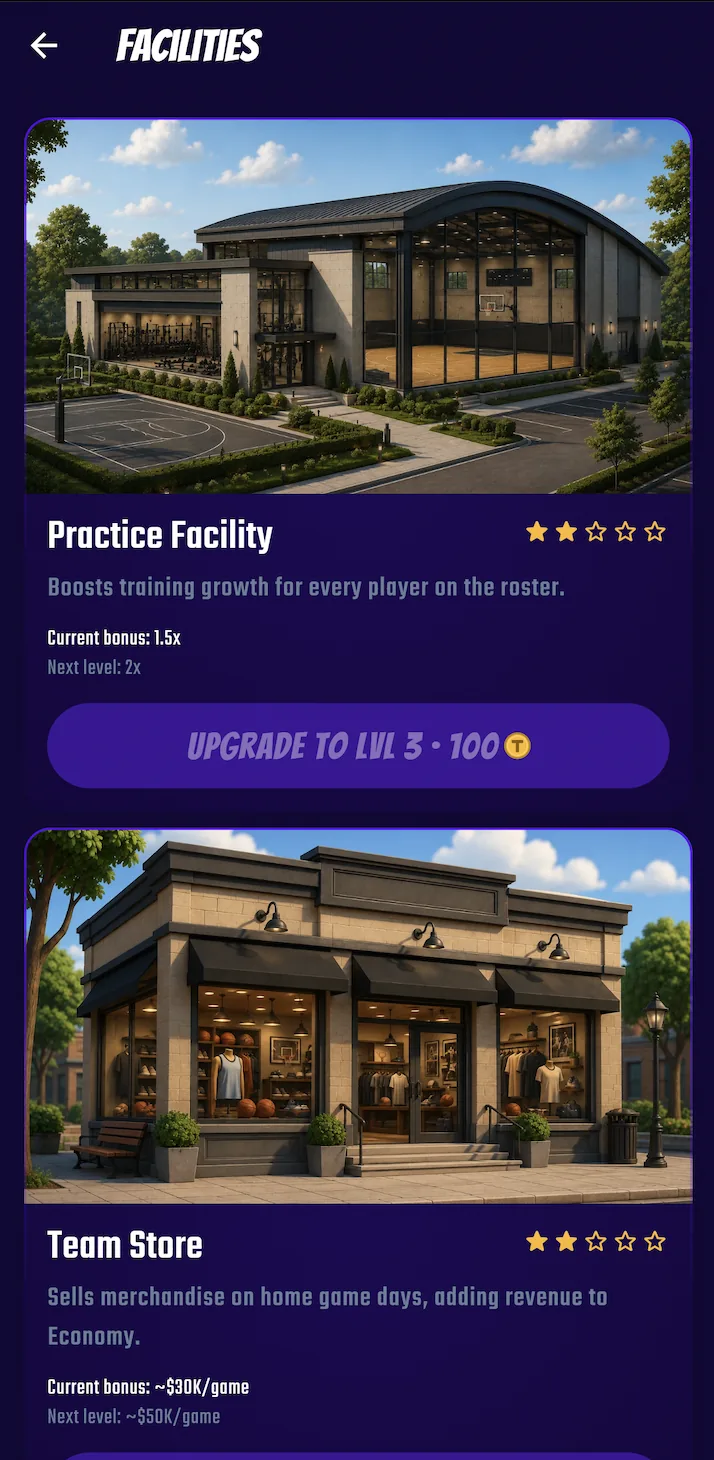
The Practice Facility is the biggest lever you have on development: it multiplies every source of growth, from the daily session and from games, for every player on the roster.
| Level | Growth multiplier | Upgrade cost |
|---|---|---|
| 1 | ×1.0 | – |
| 2 | ×1.5 | 50 tokens |
| 3 | ×2.0 | 100 tokens |
| 4 | ×2.5 | 250 tokens |
| 5 | ×3.0 | 500 tokens |
It is paid in tokens, not money, and it lasts forever. If your plan is to grow players rather than buy them, it's the best way to spend tokens: Level 2 alone, for 50 tokens, makes the whole roster grow 50% faster. How to earn tokens is explained in our guide to rewards.
The Player Development Coach
If you don't want to set the training of every player by hand, the Player Development Coach can do it with one tap ("Ask development coach"). The quality of his plan depends on his level:
- Levels 1–2: he puts everyone on Physical, except players who have already reached their Potential or whose Physical group is already at 92 or more: they go on Shape.
- Levels 3–4: every player with at least 5 points of margin, whatever his age, goes on Specialized with a focus on his role: Playmaking for point guards, Shooting for shooting guards and small forwards, Rebounding for power forwards and centers, moving on to the next group of the role if that one is already at 92 or more. Players less than 2 points from their Potential, or less than 4 points away with Game Shape under 90, go on Shape.
- Level 5: instead of the role's main group he picks the weakest of the groups relevant to the role (still skipping those at 92 or more), and he also sends players with low Game Shape who are close to their Potential to Shape.
From Level 4 the coach asks you to choose between two modes: Development, which follows the rules above, and Matches, which also puts starters with Game Shape under 88 on Shape, whatever their margin, so they are at their best right away. The coach doesn't change growth speed: he only chooses the training type. His plans are a solid base, but he never picks Mentality: if you want to work on Clutch, Consistency or Durability, set it by hand.
What to expect: some numbers
To give you an idea, we simulated an 18-year-old with all skills at 70 and a Potential of 90, who plays 30 minutes per game, over seasons of about 25 game days. The figures are averages and real players start from more uneven skills, but the proportions hold.
| Training | Facility Lv 1, after 1 season | Facility Lv 1, after 3 seasons | Facility Lv 5, after 1 season | Facility Lv 5, after 3 seasons |
|---|---|---|---|---|
| General Physical | 71.7 | 74.0 | 74.1 | 74.5 |
| General Mentality | 70.8 | 72.2 | 72.3 | 73.0 |
| Specialized Shooting | 71.5 | 74.4 | 74.5 | 79.6 |
| Specialized Defense | 71.9 | 75.3 | 75.4 | 80.2 |
| Specialized Rebounding | 72.3 | 73.9 | 73.9 | 76.4 |
| Specialized, rotating focus | 71.9 | 74.9 | 75.4 | 81.8 |
Three lessons emerge. The Practice Facility makes the difference between a player who grows by a few points and one who becomes a starter. A training that only covers one small group stalls within a few seasons, even with the best facility. And rotating the focus, starting with Defense and moving on to Shooting, Physical and Playmaking as each fills up, is the strategy that gets closest to Potential. By comparison, a 27-year-old with a 6-point gap on Specialized Defense with a Level 1 facility gains barely one point in three seasons: at that age the work is already done.
Where to find young players worth developing
The best candidates combine three things: young age, a big gap to Potential and a decent starting Overall.
- The draft is the main source: every season each group gets 32 prospects aged 18–19, and every club picks two. Some of them have very large gaps. Rank them by gap and Potential, not only by current Overall.
- The transfer market lets you filter players and see their Potential: a 20-year-old with 12–15 points of margin is often worth more than a finished 27-year-old who costs much more.
- Packs give players aged 19 to 28 with a Potential up to 7 points above their Overall: they are useful immediately, but rarely long-term projects.
The draft and the cards are explained in detail in our guide to cards and pack odds. Keep in mind the cost too: salary depends on Overall and is recalculated every season, so a young player who grows will cost more the following season. How salaries work is explained in our economy guide.
Eight tips to develop your players
- Look at the gap, not just the Overall. Potential minus Overall is the real measure of a young player's future.
- Upgrade the Practice Facility early. It multiplies the growth of every player, every day, forever.
- Prefer Specialized to general training for young players with margin: the ×1.10 bonus and the control over where growth goes are worth it.
- Start with Defense or Shooting, the groups that weigh most on Overall and have most skills.
- Change focus when a group reaches the high 80s: skills above 90 grow slowly.
- Give minutes to the young players who need them, including in friendlies and cup games.
- Put players at their Potential on Shape: they can't grow any more, but they can stay sharp.
- Use the Development Coach as a starting point, then adjust the plan by hand for your most important prospects.
Frequently asked questions
How does training work in Swish & Dunk?
Every player trains automatically every morning at 07:00 (Central European Time) and gets a smaller extra boost after every game he plays, scaled to his minutes. The growth goes into his skills according to the training type you choose, and his Overall rises as those skills improve.
What is the best training for young players?
Specialized training on a group with room to grow. Defense and Shooting move the Overall the most over time because they weigh 25% each; Rebounding gives the fastest early gains but its three skills fill up quickly. Change focus when the chosen group reaches the high 80s.
Why has my player stopped improving?
Either he has reached his Potential, which is a hard ceiling, or he is old and close to it: growth slows with age and with the gap between Overall and Potential. A player at his Potential never grows again; put him on Shape training.
Does playing time affect growth?
Yes. After every game a player gets an extra boost proportional to his minutes, up to 1.5 times the normal amount at 45 minutes. A player who never plays still trains every morning, but grows about 40% more slowly than a starter.
Can Potential change?
No. Potential is fixed when the player is created and never moves. It is the maximum Overall the player can reach through training.
Is the Practice Facility worth upgrading?
Yes, it is the single biggest lever on growth: it multiplies all training by up to 3 times at Level 5. It costs tokens (50, 100, 250 and 500 for Levels 2 to 5), not money.
Training is one piece of a bigger plan: for an overview of the whole game, start with the complete guide to Swish & Dunk, and to choose the right system for the players you develop, read our guide to basketball tactics.
Ready to build your first star? Take over a club today and start training tomorrow morning.
Play now — it's freeLast updated: