Swish & Dunk Economy Guide: Salaries, TV Rights, Tickets and Merchandise
Behind every win in Swish & Dunk there is a balance sheet. Players and staff are paid at every game, the arena has to be maintained, and income arrives from TV rights, tickets, merchandise and prizes. This guide explains the whole economy of the basketball manager in detail: how salaries are calculated, how TV rights are distributed across the ten divisions, how attendance and ticket prices work, where merchandise revenue comes from, what the arena really costs and when an expansion pays off. All figures are the ones the game uses, including the formulas.
The economy at a glance
- One ledger entry per game: every game a club plays records income and expenses, home or away, in every competition.
- Income: TV rights (both teams), win bonus, tickets and merchandise (home team only), plus prizes and transfer sales.
- Expenses: player salaries, staff pay and arena maintenance at every game, plus one-off costs for transfers, hiring staff and expansions.
- Salaries grow steeply with Overall, from about $2,600 to $250,000 per game, and are fixed for the whole season.
- TV rights go from $250,000 per game in Division 10 to $800,000 in Division 1.
- Tickets are where the big money is in the top divisions: a full arena in Division 1 can take in several million per game.
How the ledger works
Every time a game ends, the game records a full ledger entry for each human-managed club taking part. There are no estimates and no monthly settlements: income and expenses hit the balance immediately, game by game. The rule is the same for the regular season, the playoffs, friendlies and the Swish & Dunk Cup, so every game day counts, even when your season is over and you are only playing friendlies.
A typical entry contains:
| Item | Type | Who |
|---|---|---|
| TV rights | Income | Both teams |
| Win bonus | Income | Winner only |
| Ticket revenue | Income | Home team only |
| Merchandise revenue | Income | Home team only |
| Player salaries | Expense | Both teams |
| Staff pay | Expense | Both teams |
| Arena maintenance | Expense | Both teams |
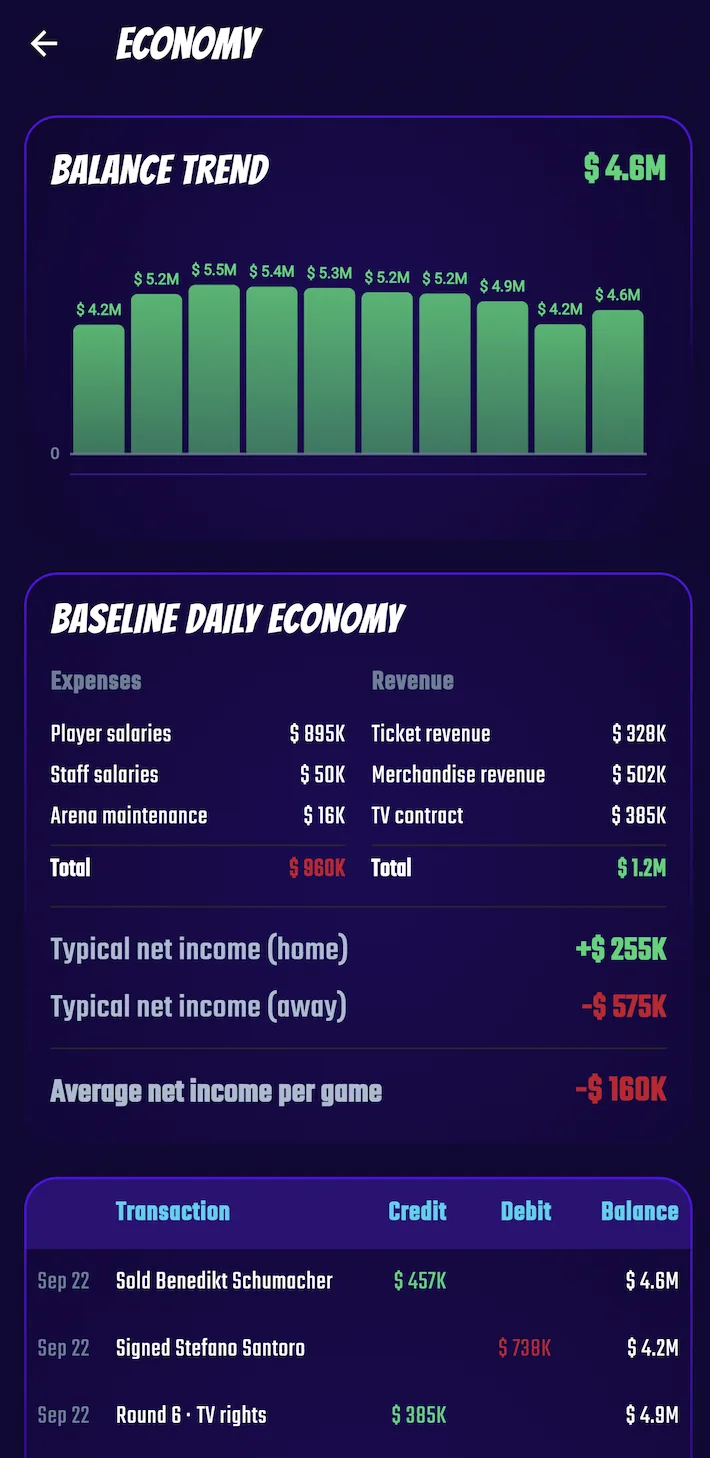
The consequence is simple: home games are where you make money, away games are where you spend it. Away from home you only collect TV rights and, if you win, the win bonus, while salaries, staff and maintenance are paid in full. A well-run club makes a solid profit at home and keeps away games close to break-even.
Every new manager starts with $500,000. The balance can go negative, and there is no bankruptcy, but while it is too low you cannot bid on the transfer market, hire staff or start an arena expansion: every purchase checks that the money is there first.
TV rights: guaranteed income in every division
TV rights are the most stable income in the game. Both teams receive them at every game, home or away, win or lose, and the amount depends only on the division:
| Division | TV rights per game | Win bonus |
|---|---|---|
| Division 1 | $800,000 | $100,000 |
| Division 2 | $710,000 | $90,000 |
| Division 3 | $635,000 | $80,000 |
| Division 4 | $565,000 | $70,000 |
| Division 5 | $500,000 | $60,000 |
| Division 6 | $440,000 | $50,000 |
| Division 7 | $385,000 | $40,000 |
| Division 8 | $335,000 | $30,000 |
| Division 9 | $290,000 | $20,000 |
| Division 10 | $250,000 | $10,000 |
The curve is deliberately flat: the top division pays a little over three times the bottom one. That keeps the lower divisions viable, because even a small club in Division 10 can count on $250,000 per game, while the real difference between divisions is made by tickets, as we will see. In cup games, where the two teams can come from different divisions, each one is paid according to its own division. The win bonus, from $10,000 to $100,000, goes to the winner on top of the TV rights.
Ticket revenue: sectors, prices and attendance
Tickets are sold only by the home team, and in the higher divisions they become by far the biggest item in the ledger. Three things determine them: how many seats you have, what price you charge and how many fans actually come.
The four sectors
The arena is split into four sectors, each with its own capacity and its own price:
| Sector | Starting seats | Maximum seats |
|---|---|---|
| Courtside (VIP) | 50 | 200 |
| Boxes | 500 | 2,000 |
| Lower Bowl | 2,000 | 8,000 |
| Upper Bowl | 2,450 | 9,800 |
Price ranges by division
You set the price of each sector yourself, but only within a range that depends on your division. If you never touch it, the game uses the midpoint of the range.
| Division | Courtside | Boxes | Lower Bowl | Upper Bowl |
|---|---|---|---|---|
| 1 | $7,500–20,000 | $900–2,000 | $350–750 | $100–250 |
| 2 | $3,500–8,000 | $500–1,000 | $200–400 | $60–120 |
| 3 | $1,500–4,000 | $300–600 | $120–250 | $35–70 |
| 4 | $1,000–2,400 | $240–500 | $100–200 | $40–80 |
| 5 | $800–1,800 | $220–400 | $90–180 | $35–60 |
| 6 | $400–900 | $140–250 | $60–120 | $25–45 |
| 7 | $250–500 | $90–160 | $40–80 | $18–30 |
| 8 | $150–300 | $60–100 | $25–50 | $12–20 |
| 9 | $90–180 | $40–70 | $20–35 | $10–15 |
| 10 | $60–100 | $30–50 | $15–25 | $8–12 |
The jump between divisions is huge: a courtside seat costs at most $100 in Division 10 and up to $20,000 in Division 1. With the starting arena sold out at the maximum price, a home game is worth about $109,000 in tickets in Division 10 and about $4.1 million in Division 1. Fully expanded, the arena of a Division 1 club can take in over $16 million in a single sold-out night.
How attendance is calculated
Attendance is decided game by game, in three steps:
- Your position in the standings. The group leader starts from 100% attendance, last place from 60%, and everyone else in between in a straight line. In a 16-team group, the eighth-placed club starts at about 81%.
- The opponent. A strong opponent draws more people, a weak one fewer: attendance moves by up to 10% either way, with a small random factor of about two points. It never drops below 30%.
- The price. Each sector fills according to how high its price is within the range. How much fans care about price depends on your form: for the group leader it barely matters, while for teams near the bottom it matters a lot.
In practice, at the maximum price the group leader still fills about 95% of a sector, while the last-placed team fills only about a quarter of it. At the minimum price, the last-placed team fills almost every seat it has. Each sector always keeps at least 5% of its seats occupied and can never go above 100%.
The rule that follows is clear: when you are winning, charge the maximum; when you are losing, lower your prices. The arena screen shows the optimal price for each sector based on your current position, and the ticket history lets you check attendance and price sector by sector, game after game. In cup games, attendance depends only on your position in your own group's standings.
If you don't want to do the maths, the Chief Revenue Officer can set prices for you. At level 1 he moves each price 60% of the way from the midpoint of the range toward the optimal price, and every level adds 10%, until at level 5 he hits the optimal price exactly.
Merchandise revenue
Merchandise sales, too, are collected only at home games, and depend on three factors.
1. The Team Store level. It's the base of the income, upgraded with tokens (50, 100, 250 and 500 tokens for levels 2 to 5):
| Team Store | Base per home game | Actual range (±15%) |
|---|---|---|
| Level 1 | $20,000 | $17,000–23,000 |
| Level 2 | $30,000 | $25,500–34,500 |
| Level 3 | $50,000 | $42,500–57,500 |
| Level 4 | $100,000 | $85,000–115,000 |
| Level 5 | $250,000 | $212,500–287,500 |
2. Your national team players. Every player called up to his national team for the S&D World Cup adds an extra amount at every home game, based on his Overall:
| Overall of the international | Extra per home game |
|---|---|
| 70 or lower | $20,000 |
| 75 | $27,500 |
| 80 | $35,000 |
| 85 | $42,500 |
| 90 or higher | $50,000 |
The bonus varies by about 5% from game to game and adds up player by player: three internationals rated 80 are worth about $105,000 more per home game, more than a level 4 Team Store. How call-ups work is explained in our guide to cards and national team cards.
3. The Chief Revenue Officer. He multiplies the whole merchandise income, national team bonus included, by 2% per level: from +2% at level 1 to +10% at level 5.
One warning: if a club can't field enough players and forfeits a home game, it earns nothing from tickets or merchandise for that game.
Player salaries
Salaries are the biggest expense for almost every club. In Swish & Dunk there's no negotiation: a player's salary depends only on his Overall and grows along a very steep curve. Up to 60 Overall it stays at the minimum, then it rises with the cube of the points above 60, until it hits the cap of $250,000.
| Overall | Salary per game (approx.) |
|---|---|
| 60 or lower | $2,600 |
| 65 | $3,100 |
| 70 | $6,800 |
| 75 | $16,700 |
| 80 | $35,900 |
| 85 | $67,700 |
| 90 | $115,100 |
| 95 | $181,300 |
| 99 | $250,000 (cap) |
Each player's actual salary differs from the table by up to 10% either way, so two players with the same Overall can cost slightly different amounts. Four rules are worth remembering:
- It's paid at every game the team plays, home and away, including friendlies and cup games.
- It's fixed for the season. It's recalculated only at the season rollover, based on the Overall at that moment. A young player who improves by 10 points during the season keeps costing what he cost in the summer, and only gets more expensive the following season.
- There's no salary cap for the team: the only limit is what your balance can absorb.
- The curve punishes stars. Going from 80 to 90 Overall more than triples the salary. Two players rated 80 cost less than one rated 88.
To give a sense of scale: the average club in Division 10 pays about $125,000 per game for its whole roster, while in Division 1 the average is close to $700,000, and the most ambitious rosters go well past $1.5 million per game.
Remember that salaries follow growth: a young player who improves costs more the following season. How to develop players efficiently is explained in our training guide.
Staff costs
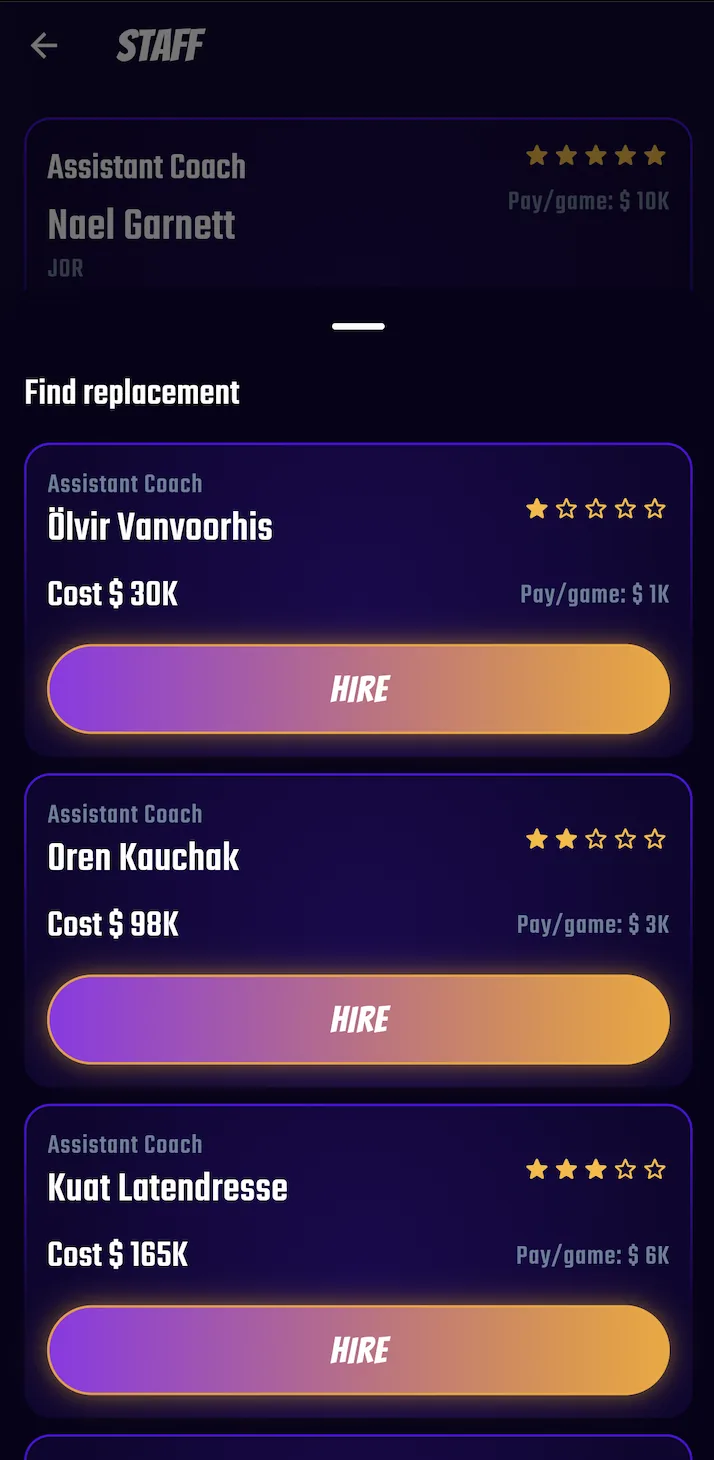
Each club has five staff roles: Assistant Coach, Player Development Coach, Strength & Conditioning Coach, Team Physician and Chief Revenue Officer. Every one of them, at every level, costs two things: a one-off hiring fee and pay at every game.
| Level | Pay per game | Hiring fee |
|---|---|---|
| 1 | $1,000 | $30,000 |
| 2 | $3,250 | $97,500 |
| 3 | $5,500 | $165,000 |
| 4 | $7,750 | $232,500 |
| 5 | $10,000 | $300,000 |
The hiring fee is always 30 times the pay per game. Every club starts with all five roles at level 1, which costs $5,000 per game in total; a full level 5 staff costs $50,000 per game. When you use "Find replacement", you pay the new hire's fee in full and nothing is refunded for the outgoing one, so plan your upgrades rather than changing staff often.
Next to player salaries, the staff is a modest expense, and some roles pay for themselves. A level 5 Chief Revenue Officer, for example, costs $9,000 more per game than a level 1, but sets ticket prices at their optimum and adds 8% more to merchandise: in the middle and upper divisions he earns that back easily.
Arena maintenance
The arena costs $3 per seat for every game, home or away. It's the same rule for all clubs and all divisions:
| Arena capacity | Maintenance per game |
|---|---|
| 5,000 seats (starting arena) | $15,000 |
| 10,000 seats | $30,000 |
| 15,000 seats | $45,000 |
| 20,000 seats (maximum) | $60,000 |
Maintenance is paid on every seat you own, whether it's sold or empty, and at away games too, where the arena earns nothing. That's why a seat that stays empty is a net loss: an important detail when deciding whether to expand.
Arena expansions: cost, time and payback
Each sector can be expanded independently, up to its maximum. You pay the whole cost when the work starts, the new seats only arrive when it's finished, and each sector can only have one construction project at a time.
| Sector | Cost per seat | Construction speed | Minimum time |
|---|---|---|---|
| Courtside (VIP) | $20,000 | 1 seat per day | 14 days |
| Boxes | $6,000 | 8 seats per day | 14 days |
| Lower Bowl | $1,200 | 25 seats per day | 21 days |
| Upper Bowl | $500 | 60 seats per day | 21 days |
Small projects take the minimum time, big ones much longer: taking courtside from 50 to 200 seats costs $3 million and takes 150 days, and filling the Lower Bowl to 8,000 seats costs $7.2 million and takes 240 days. That's why many managers expand in steps, a little at a time.
Whether an expansion is worth it depends almost entirely on the division, because ticket prices change dramatically while construction costs don't:
- In Division 1 a courtside seat sells for $7,500 to $20,000 per home game: a $20,000 seat earns its cost back in one to three home games. A Lower Bowl seat ($1,200) pays for itself in two to four games.
- In the middle divisions (4 to 6) the payback takes roughly ten to twenty-five home games: it's worth it if you're climbing and fill your arena regularly.
- In Division 10 a courtside seat sells for $60 to $100: it would take more than two hundred home games to recover $20,000, and in the meantime you pay $3 per game in maintenance. Expanding the Upper Bowl (cost $500, revenue $8–12) also takes more than a hundred home games once maintenance is counted.
The practical advice: in the low divisions put your money into the roster and the Team Store, and save the big arena projects for when you reach the higher divisions, where every new seat turns into revenue within a few games. Above all, never expand a sector you don't already fill: empty seats only add maintenance.
One-off income and expenses
Besides the per-game ledger, the balance moves with a few one-off events:
- Transfer market. Purchases and sales go through live auctions. Money for active bids is held until someone outbids you, so you can never bid more than you have.
- Prizes. Each round won in the Swish & Dunk Cup pays from $20,000 to $2,000,000, and promotion is worth up to $1,000,000 (plus $3,000,000 for winning the Division 1 final). All the figures are in our guide to rewards.
- Staff hiring and arena expansions, paid in full at the moment you confirm them.
Tokens are a separate currency: they pay for packs, consumables, facility upgrades and new arenas, they are earned only by playing and they never mix with club money.
Two sample budgets
Real numbers help more than formulas. These are the averages recorded by human-managed clubs in Division 10 over recent game days:
| Division 10, per game | Home | Away |
|---|---|---|
| TV rights | +$250,000 | +$250,000 |
| Tickets (about 81% attendance) | +$72,000 | – |
| Merchandise | +$29,000 | – |
| Win bonus (if you win) | +$10,000 | +$10,000 |
| Player salaries | −$122,000 | −$122,000 |
| Staff | −$5,000 | −$5,000 |
| Arena maintenance | −$15,000 | −$15,000 |
| Average net result | about +$215,000 | about +$110,000 |
At the start, the economy is generous: TV rights alone cover the whole roster, and the club makes money at every game, which leaves room to invest in the market. The picture changes as you climb. A club in Division 1 with a roster costing $1.5 million per game spends more than its TV rights at every away game, and must earn it back at home: that's where the expanded arena, prices set at the right level and a strong Team Store make the difference between a club that grows and one that slowly bleeds.
Seven tips for running the finances
- Look at the net result, not the balance. The Economy screen shows the average net per game: if it's negative, every game makes you poorer.
- Watch out for stars' salaries. Thanks to the curve, a player rated 90 costs more than three rated 80. Before buying a star, check what he will cost over a full season.
- Remember that salaries go up in the summer. The young players who improved will cost more next season: plan ahead.
- Adjust prices to your form. High when you're near the top, lower when you're struggling; or let a good Chief Revenue Officer do it.
- Upgrade the Team Store early. It costs tokens, not money, and earns at every home game for the rest of the game.
- Expand the arena only when it pays. In the low divisions, empty seats are a cost; in the high ones, a full arena is the biggest source of income in the game.
- Don't stay at zero. Keep a cushion: with a balance that's too low you can't bid, hire or build when the opportunity arrives.
Frequently asked questions
How are player salaries calculated in Swish & Dunk?
A player's salary depends only on his Overall and grows steeply with it: about $2,600 per game up to 60 Overall, about $36,000 at 80, about $115,000 at 90, with a cap of $250,000. It is set at the start of each season and paid at every game the team plays, home or away.
How much are TV rights worth?
TV rights are a fixed amount per game that both teams receive, win or lose: $250,000 in Division 10, rising step by step to $800,000 in Division 1.
How does ticket revenue work?
Only the home team sells tickets. Revenue depends on the seats in each of the four arena sectors, the price you set within your division's range and attendance, which falls from 100% for the group leader to 60% for last place and also reacts to the opponent and to your prices.
How much does the arena cost to run?
Arena maintenance is $3 per seat for every game you play, home or away. A starting 5,000-seat arena costs $15,000 per game; a fully expanded one about $60,000.
Can a club go bankrupt?
No. The balance can go negative, but while it is too low you cannot bid on the market, hire staff or start an arena expansion, because every purchase checks that you have the money first.
Is it worth expanding the arena in the lower divisions?
Rarely. Ticket prices in the lower divisions are so low that a new seat takes dozens or hundreds of home games to pay for itself, while maintenance is paid every game. Expansions pay off quickly in the top divisions, where a courtside seat can earn back its cost in one or two home games.
Money is only half the story: to see what you can earn in tokens, prizes and consumables, read our guide to rewards. For an overview of the whole game, start with the complete guide to Swish & Dunk, and to win more games, and so fill your arena, discover how the match engine works.
Ready to balance the books? Take over a club today and play your first game tomorrow.
Play now — it's freeLast updated: