Swish & Dunk: The New Free Basketball Manager, No Pay-to-Win and with Pack Opening
Swish & Dunk is a free online basketball manager game with no pay-to-win. It combines the slow, thoughtful pace of the classic manager games with everything you expect from a modern game: an interface built for your phone, collectible cards with semi-realistic AI-generated faces, pack opening and consumables. Take over a club, build your roster, pick your tactics and climb ten divisions against other managers, with one game a day simulated possession by possession. This article covers everything: how it works, what makes it different, and every part of the game from the arena to the draft.
Swish & Dunk at a glance
- Truly free: no subscriptions, no premium plan, nothing to buy with real money.
- No pay-to-win: the game's currency, tokens, is earned only by playing and can't be bought.
- Old-school pace: one game a day, long seasons, players who develop over time.
- Modern presentation: a smooth app on phone, tablet and computer, cards with AI-generated faces, pack opening, consumables, custom jerseys and crests.
- A serious simulation: around 50 ratings per player, 8 offensive and 8 defensive systems, fatigue, chemistry, morale, clutch time and momentum.
- A whole club to run: a live auction market, the draft, daily training, staff, facilities, the arena and the club's finances.
| Fact sheet | Swish & Dunk |
|---|---|
| Genre | Online multiplayer basketball manager |
| Price | Free, with no in-app purchases and no ads |
| Platforms | Browser on phone, tablet and computer (installable on the home screen) |
| Games | One a day, simulated possession by possession, with a live replay |
| League | 10 divisions, groups of 16 clubs split into East and West conferences |
| Season | 22 regular-season games, playoffs and a best-of-three final |
| Cups | The Swish & Dunk Cup and the S&D World Cup for national teams |
| Players | Cards with AI-generated faces, around 50 ratings each, 10 rarity tiers |
| Tactics | 8 offensive and 8 defensive systems |
| Languages | 21 |
What is Swish & Dunk?
Swish & Dunk is a basketball manager game: you don't control the players on the court, you are the general manager and head coach of a club. You decide who to buy and who to sell, who starts, which system to run, how to train each player, what to charge for tickets and where to invest. Then you watch your team play, and the result depends on how well you did your job.
The game is online and persistent: every manager lives in the same world, with the same leagues, the same market and the same cups. Tomorrow's opponent might be another fan on the other side of the planet. Open spots in the groups are filled by computer-run clubs, so every league is always full and you can start right away instead of waiting for a league to fill up.
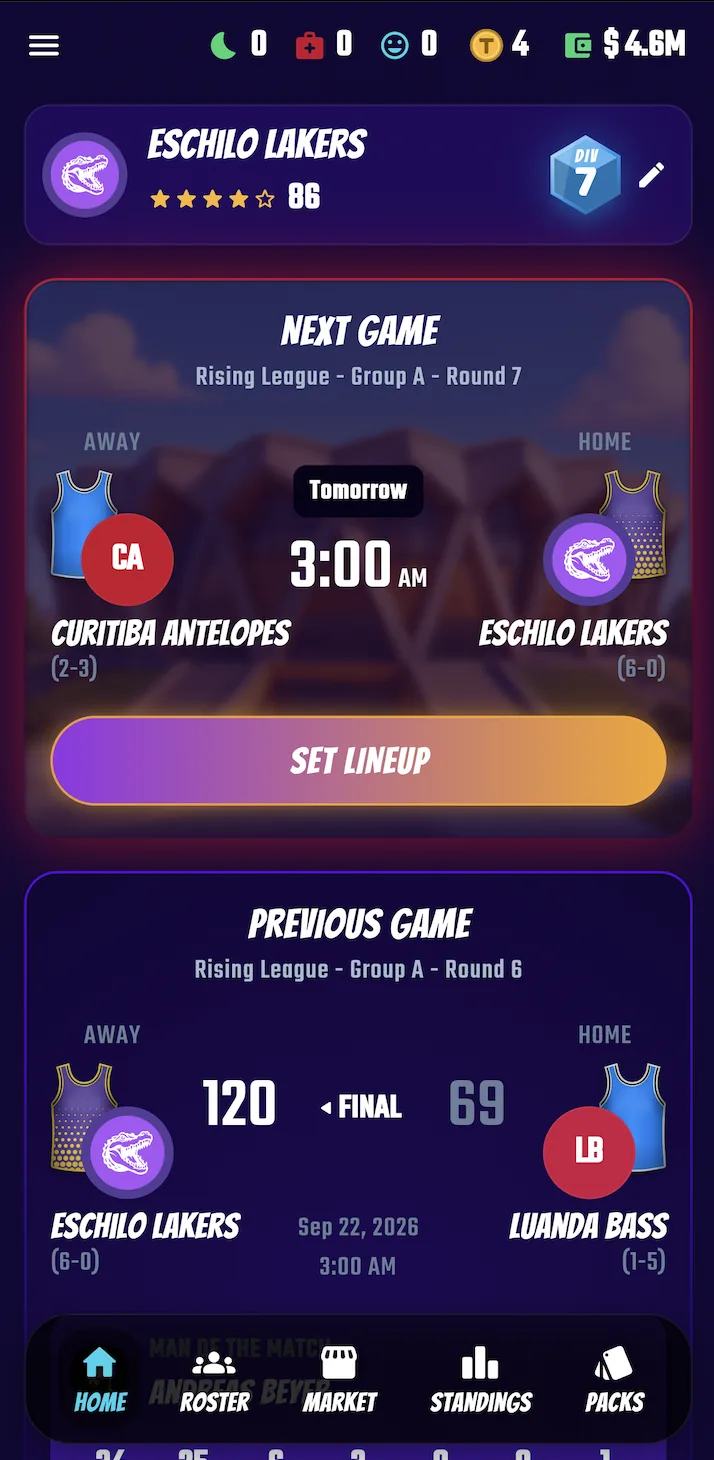
You don't start from an empty roster when you sign up: you take over one of the league's unclaimed clubs, players included, and you can rename it, choose its colors and design its crest and jersey. A welcome pack introduces your team card by card, all the way to your best player.
The best of old-school manager games, with a modern look
Anyone who played the great online manager games of the 2000s remembers the charm of that pace: one game a day, seasons that last weeks, youngsters that take months to develop, and the satisfaction of watching a project take shape little by little. That slowness isn't a flaw: it's what makes every decision matter. You can't sim ten seasons in an afternoon, so every signing, every training choice and every draft pick really counts.
Swish & Dunk keeps all of that. A regular season lasts 22 match days, followed by the playoffs, promotion, relegation and the draft. Players improve every day through training, age and reach their potential. The league keeps moving while you're offline, exactly like the manager games that defined the genre.
The difference is in how all of it is presented. Many classic manager games are deep but look like fifteen-year-old software: tables, nested menus, pages designed for an office monitor. Swish & Dunk brings the same depth to a modern app:
- An interface built for phones, not squeezed onto them: every screen is designed to be used with one thumb, and on tablets and computers the extra space becomes multi-column layouts.
- Players as collectible cards, with semi-realistic faces generated by artificial intelligence, a nationality flag, position, Overall and rarity tier at a glance.
- Pack opening with reveal animations, and consumables to rest, treat or motivate your players.
- Club identity: a crest and jersey you design yourself, with dozens of patterns, symbols and colors, and an arena you can choose and expand.
- Live games: every game plays out as a roughly 12-minute broadcast with play-by-play, box score and top performers.
The result is a game with the heart of a pure manager sim and the face of a 2026 game: deep for anyone who wants to think through every detail, instant for anyone who just wants to set a lineup and watch the game.
Free and no pay-to-win: how tokens work
Many games with cards and packs are built to make you pay: the best card sits in the most expensive pack, and the most expensive pack is bought with a credit card. Swish & Dunk works differently. There is nothing to buy with real money: no subscription, no premium plan, no season pass, no currency for sale. There are no ads either.
The game's special currency is tokens, and you earn them only by playing:
| How you earn tokens | How many |
|---|---|
| Your club's starting allowance | 50 |
| Every win (league, playoffs, friendlies, cup) | 3 |
| Daily reward, collected once a day | 1 |
| Promotion to a higher division | 50 to 250, more the closer you get to the top flight |
Tokens open packs, buy consumables, upgrade your club's facilities and unlock new arenas. Since they can't be bought, you build your edge by winning, not by paying. Two managers who put in the same effort have the same chances: the only difference is how you run your club.
Club money is something else: it's the balance you use to pay salaries and staff, bid on the market and expand your arena. That too is earned only by playing, through tickets, TV rights, merchandise and prizes.
The match engine: every game simulated possession by possession
A manager game lives or dies by its simulation, and Swish & Dunk doesn't decide games with a dice roll on team Overall. Every game is played possession by possession, over four 12-minute quarters and, if needed, 5-minute overtimes until there's a winner. The full explanation, with every number, is in our match engine guide; here are the essentials.
- Player duels. Every possession is a chain of matchups between an attacker and his defender: the ball handler against pressure, the shooter against his contest, the bigs on the boards. The specific ratings for that play matter, not a generic average.
- Around 50 ratings per player, from close shot to weak hand, from court vision to box out, up to mental traits like clutch, leadership and consistency.
- Fatigue and rotations. Energy drains on the court and cuts ratings by up to 30%; stamina softens the drop. Substitutions follow energy, fouls and your rotation's minute targets, always within the same position.
- Tactics. 8 offensive and 8 defensive systems change pace, shot selection, pick-and-roll use, transition, pressure, contests and rebounding.
- Hot and cold nights. Before tip-off every player draws a night modifier: consistent players barely swing, streaky ones can explode or disappear.
- Clutch time. In the final minutes of a close game, clutch, experience, leadership and "hero ball" come into play.
- Momentum and timeouts. Runs shift momentum, and the coach calls timeouts to stop them.
- Home court, fouls, the bonus and injuries, just like real basketball.
Every game uses a seeded random generator: the replay you watch is exactly the simulated game, and the box score always matches the play-by-play. The better-built team wins more often, but upsets happen, just like in a real season.
Live games: replay, play-by-play and box score
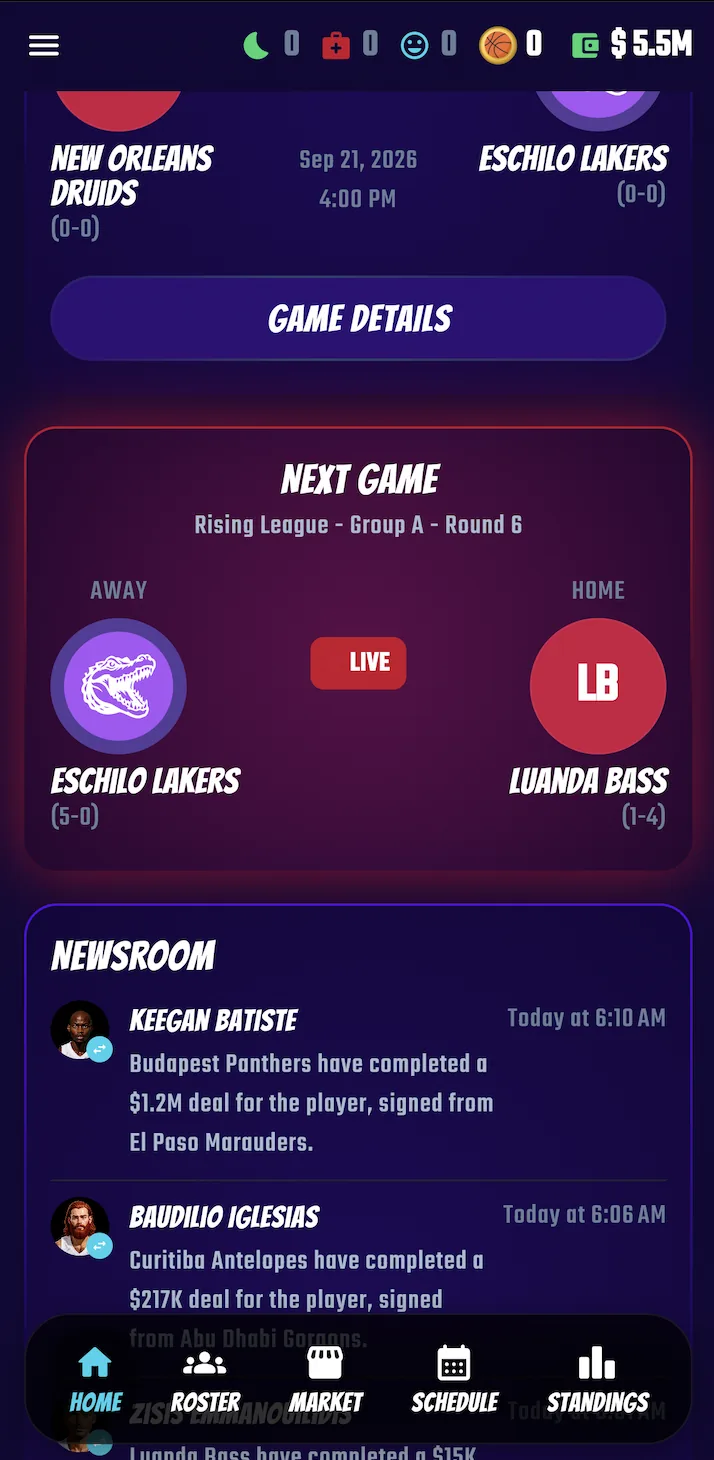
Every match day tips off at a set time. At tip-off the whole game is simulated and becomes watchable as a compressed live broadcast of about 12 minutes: score, clock, quarter-by-quarter totals and a play-by-play feed with baskets, assists, blocks, fouls, timeouts and substitutions.
You don't need to be online when it's played: lineup and tactics are set beforehand, and if you miss the game you'll find the replay, the full play-by-play, every player's box score line, the game leaders and the Man of the Match. On the Home screen the next game shows both teams' jerseys and the home arena, so you always know where and against whom you play.
Season, divisions and playoffs
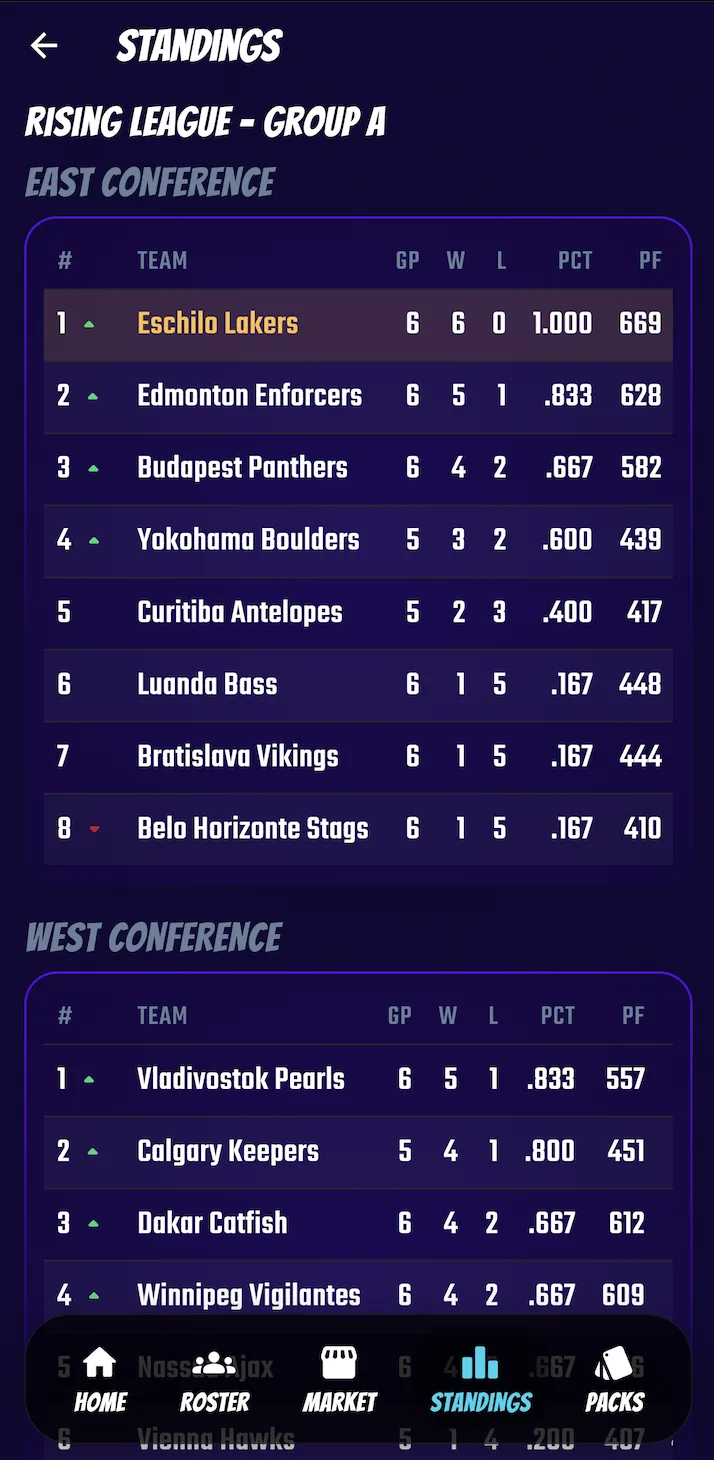
The league has 10 divisions: you start near the bottom and the goal is to reach the top flight. Each division is made of groups of 16 clubs, split into East and West conferences.
| Phase | How it works |
|---|---|
| Regular season | 22 games, one a day |
| Playoffs | Top four in each conference: quarterfinals, semifinals and a best-of-three final |
| Promotion | Both finalists move up one division |
| Relegation | The bottom two move down one division |
| Individual awards | Regular-season MVP and Defensive Player of the Year, Finals MVP |
| Draft | After the playoffs every club makes two picks, worst record first |
Eliminated teams don't sit idle: they keep playing friendlies, which are perfect for developing youngsters, testing new tactics and earning tokens with wins. Standings are ranked by winning percentage, and the Standings section also shows the group's statistical leaders in points, rebounds, assists, blocks, steals and shooting percentages.
Moving up a division brings money and token prizes, bigger the closer you get to the top, and tougher opponents. Promotion is never a given: a team built only to win now can struggle one floor higher.
The cups: Swish & Dunk Cup and S&D World Cup
Beyond the league, two competitions give every season a second goal.
The Swish & Dunk Cup is a knockout cup open to clubs from every division. It's the tournament of upsets: a lower-division side can knock out a giant and keep advancing round after round, with prize money for every round won and a trophy for whoever lifts the cup.
The S&D World Cup is the national-team tournament, with a group stage followed by playoffs. National teams are built from the game's players by nationality: called-up players get a national-team badge on their cards, and watching one of your players become world champion is an extra thrill.
Players: modern cards with AI-generated faces
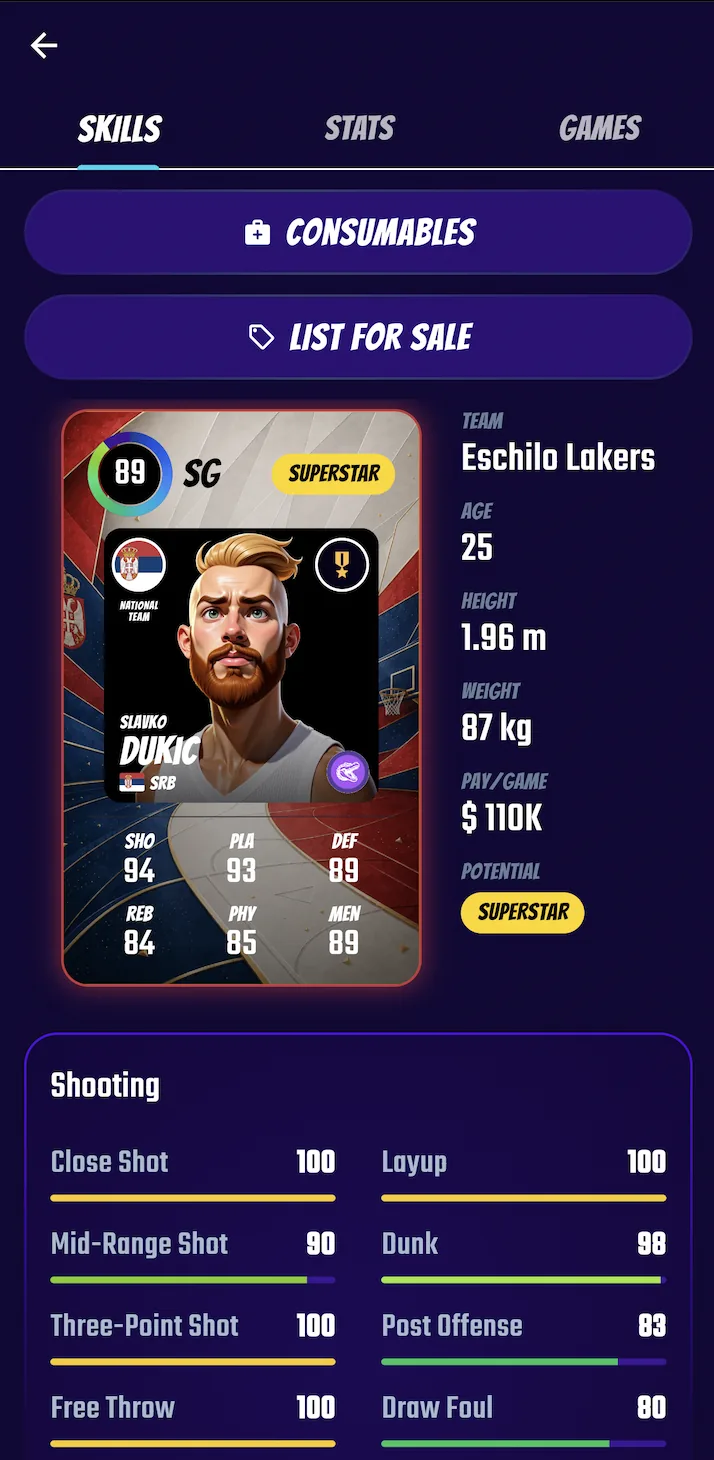
In Swish & Dunk every player is a card. On the front you see the face, name, flag, position, Overall and the six group ratings: shooting, playmaking, defense, rebounding, physical and mentality. The faces are semi-realistic portraits generated by artificial intelligence, unique to each player: after a few games you recognize your starters at a glance, like trading cards of real stars.
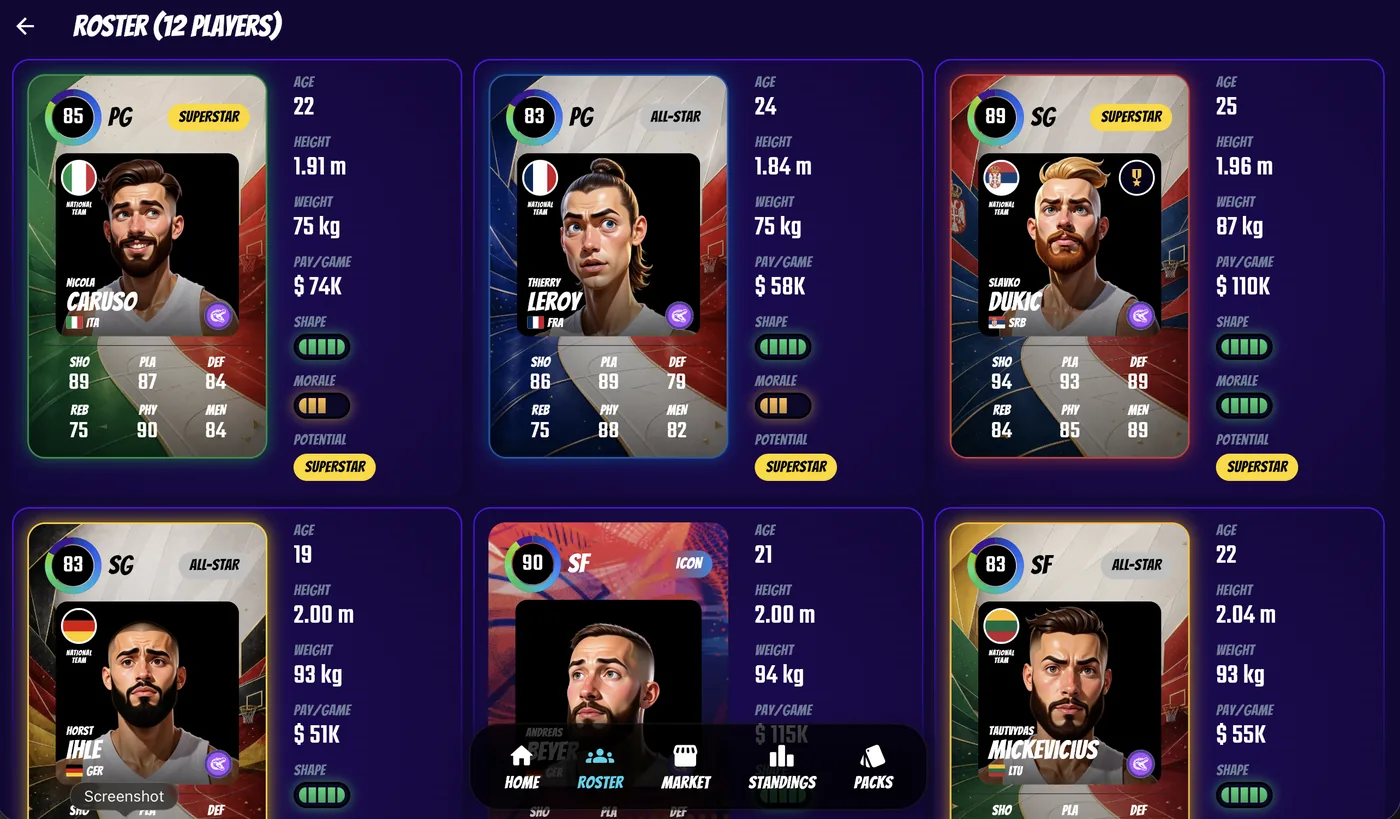
The card's color and style depend on its rarity tier, which is tied to Overall:
| Tier | Overall |
|---|---|
| Challenger | below 55 |
| Skilled | 55–59 |
| Specialist | 60–64 |
| Expert | 65–69 |
| Elite | 70–74 |
| Premier | 75–79 |
| All-Star | 80–84 |
| Superstar | 85–89 |
| Icon | 90–94 |
| Legend | 95 and above |
Behind the card sits a full profile with around 50 ratings in six groups. Overall is a weighted average: shooting and defense count 25% each, playmaking and physical 15%, rebounding and mentality 10%. That's why two players with the same Overall can be completely different: a three-point specialist and a rim protector are not interchangeable.
Every player also has a potential, shown as a tier: it's the ceiling of his development. An 18-year-old Elite with Superstar potential can become a cornerstone; a veteran already at his potential won't improve any further. The profile also lists age, height, weight, salary, season stats and a game-by-game log.
Roster, lineup, tactics, chemistry and morale
Before every game you set your lineup: the starting five on the court, then a backup and a reserve for every position. The engine uses this rotation to decide minutes and substitutions. A roster can hold up to 25 players.
Then you pick your tactics: one offensive and one defensive system from 8 each.
- Offense: 5-Out, Motion, Pace and Space, Princeton, Small Ball, Spread Pick-and-Roll, Run and Gun and Triangle.
- Defense: Drop Coverage, Full-Court Press, Half-Court Trap, Man-to-Man, Match-Up Zone, No-Middle, Pack Line and Switch-Everything.
No system is better than the others across the board: the edge comes from fitting it to your players and hitting the opponent's weak spot. If you don't choose, your team plays an even mix of every system. The tactics guide explains every system and which one beats which.
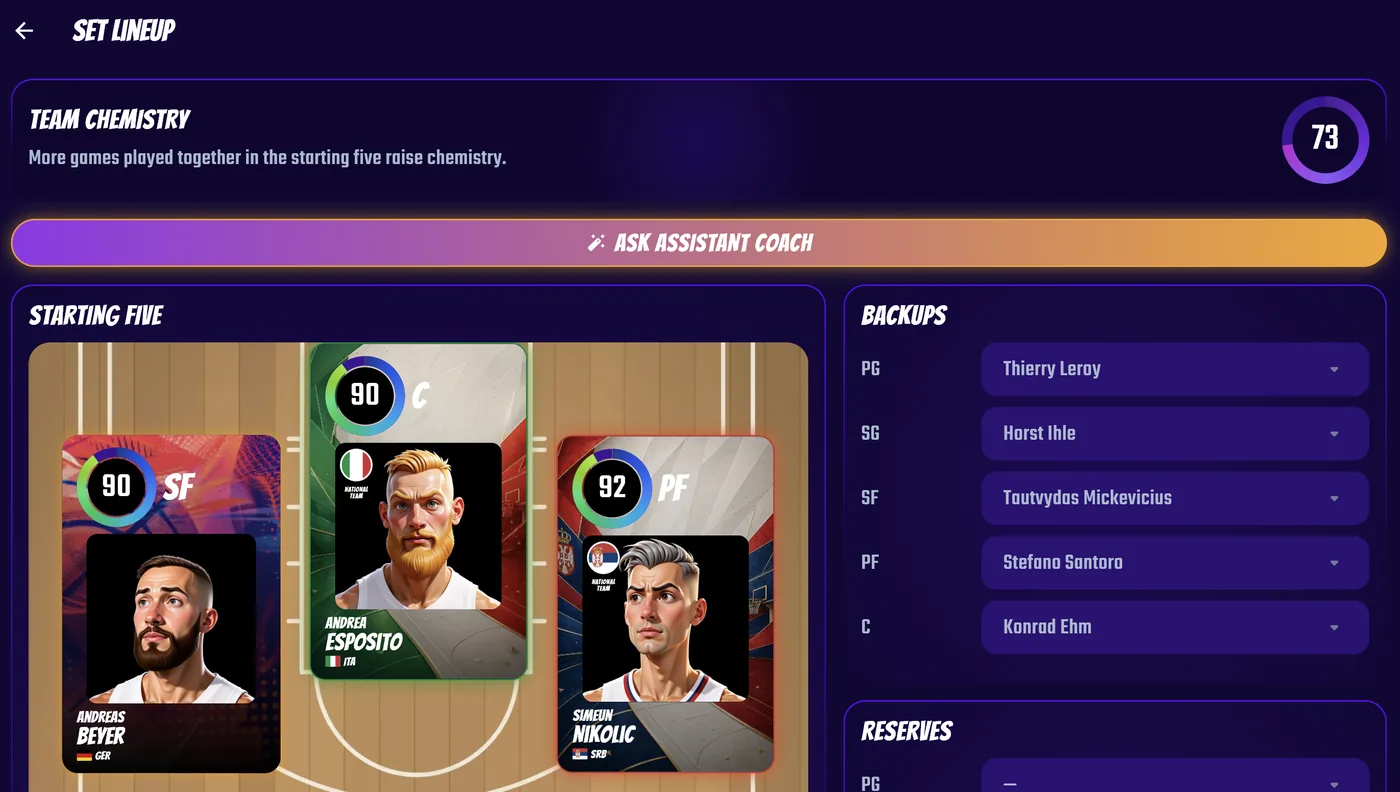
Three values change how players perform over time, and they turn every lineup decision into a decision with consequences:
- Chemistry. Every pair of starters builds up games played together, up to about 40. A starting five that has played together for weeks is more in sync than one that changes every day.
- Morale. Starting raises morale, coming off the bench lowers it. An unhappy player performs worse, so keeping a star out too long has a price.
- Game shape. It runs from 80 to 100 and rises when a player logs healthy minutes, between 20 and 35; it drops if he plays too much or too little. A starter who returns after many games in a row on the bench is also a little rusty in the first quarter.
If you're short on time or want a second opinion, your Assistant Coach suggests a starting five and tactics. At higher levels he scouts the opponent too, instead of only looking at your own squad.
Training: developing players every day
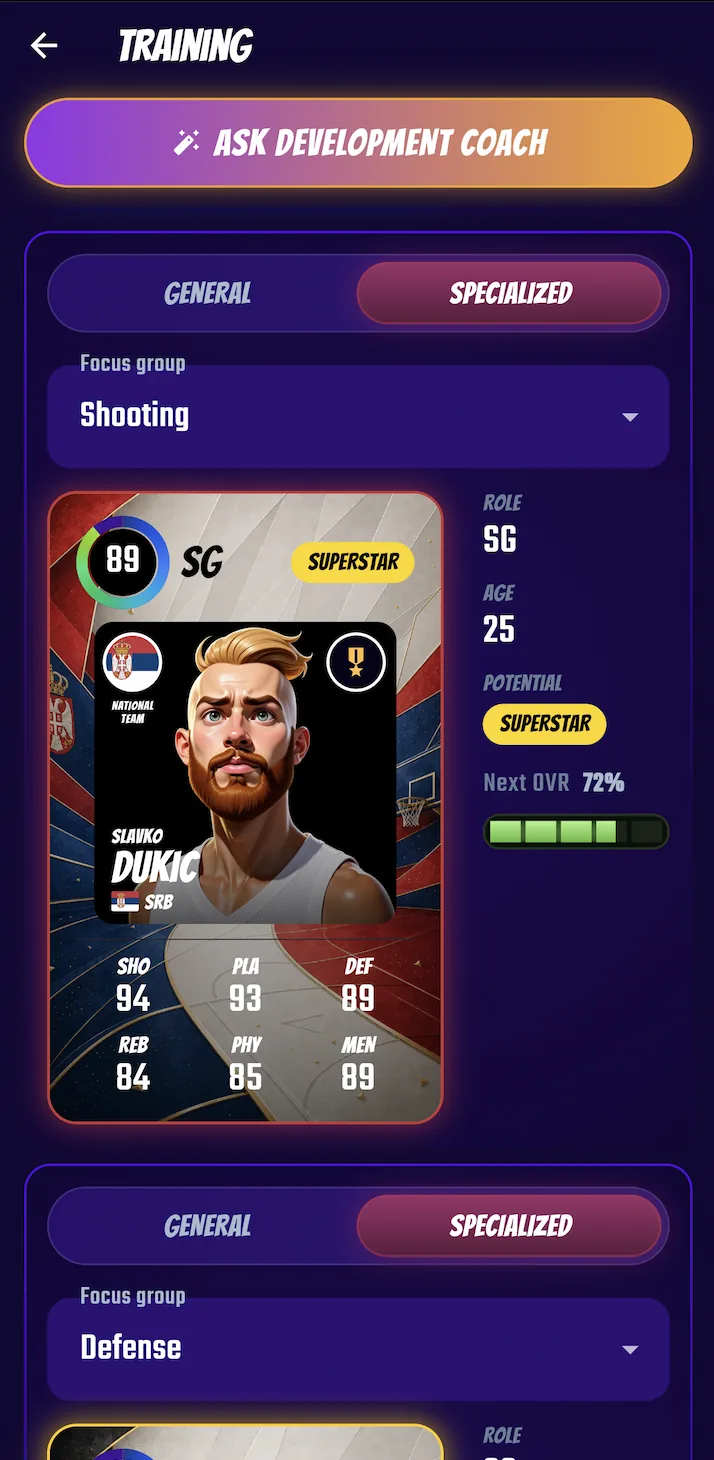
Player development is one of the joys of old-school manager games, and in Swish & Dunk it runs on two tracks. Every morning at 7:00 (Central European Time) there's the daily training session, and after every game each player who took the court gets a small extra bump, sized to his minutes. Giving youngsters minutes makes them grow faster.
For each player you pick a training type:
- General: growth spreads across every rating.
- Specialized: pick a group (shooting, playmaking, defense, rebounding, physical or mentality). 70% of growth goes there, 20% into a related group and 10% into the rest, with a 10% bonus on total growth.
- Physical or Mentality: all growth goes into that group.
- Shape: no skill growth, but a small daily boost to game shape, handy before decisive games.
Growth slows with age and as a player nears his potential, and ratings above 90 climb more slowly. The Training screen shows the next session, the players who jumped in Overall this week and who improved the most in the last session. On request, your Player Development Coach sets the ideal training for everyone on the roster, and the Practice Facility multiplies everyone's growth.
Staff: five people working for you
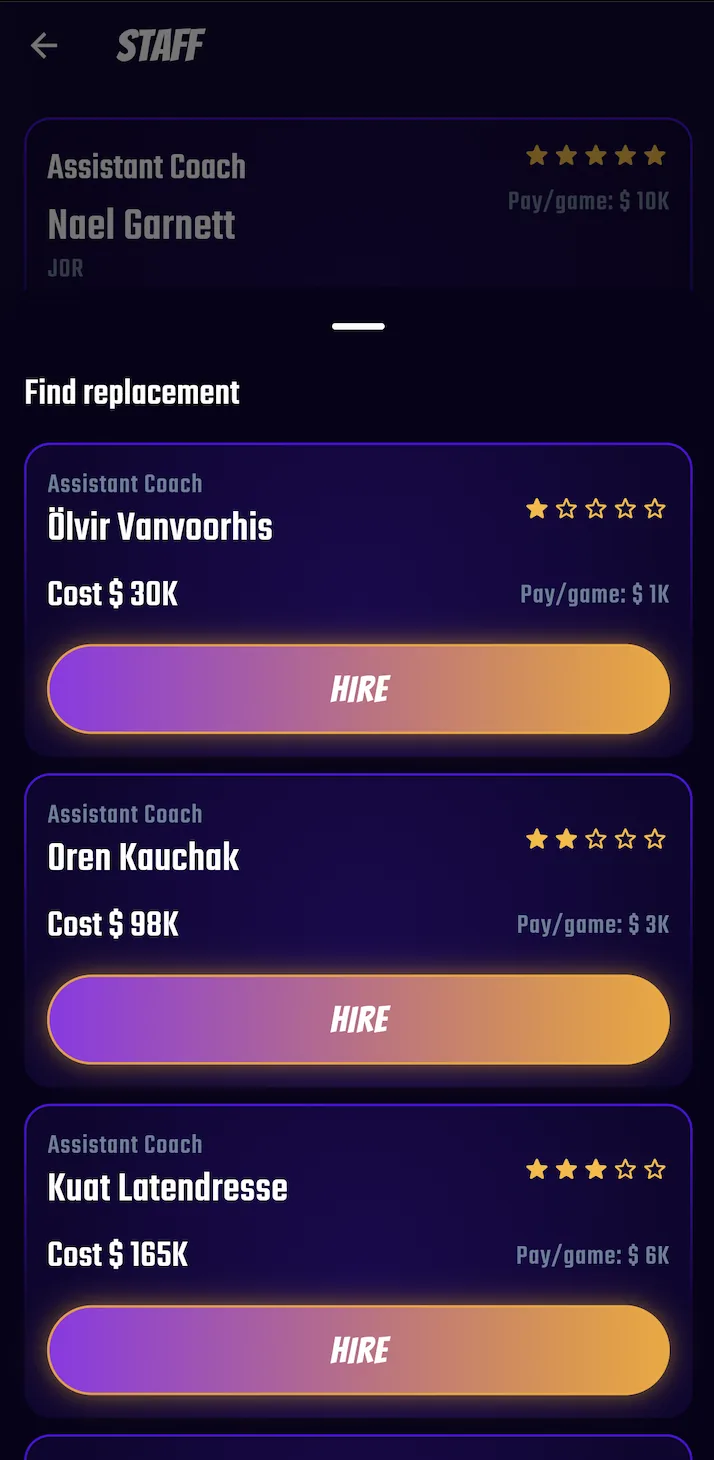
Behind every roster there's a staff of five roles, each with a level from 1 to 5. Staff are paid from the club's balance: a hiring fee and pay for every game. "Find replacement" offers you four candidates, one for each level other than your current one, each with his own name and nationality.
| Role | What it does |
|---|---|
| Assistant Coach | Suggests a starting five and tactics before every game. From level 4 he also scouts the opponent and exploits its weaknesses. |
| Player Development Coach | On request, sets the best training for every player; the higher his level, the smarter the choices. |
| Strength and Conditioning Coach | Helps players recover their game shape after every game. |
| Team Physician | Lowers injury risk and recovery times, down to roughly half at level 5. |
| Chief Revenue Officer | Boosts merchandise income and, on request, prices every arena sector to bring in as much as possible. |
Building your staff is about priorities and budget: a young club might bet on development, one chasing promotion on the physician and conditioning coach, one in the red on the revenue officer.
Club facilities
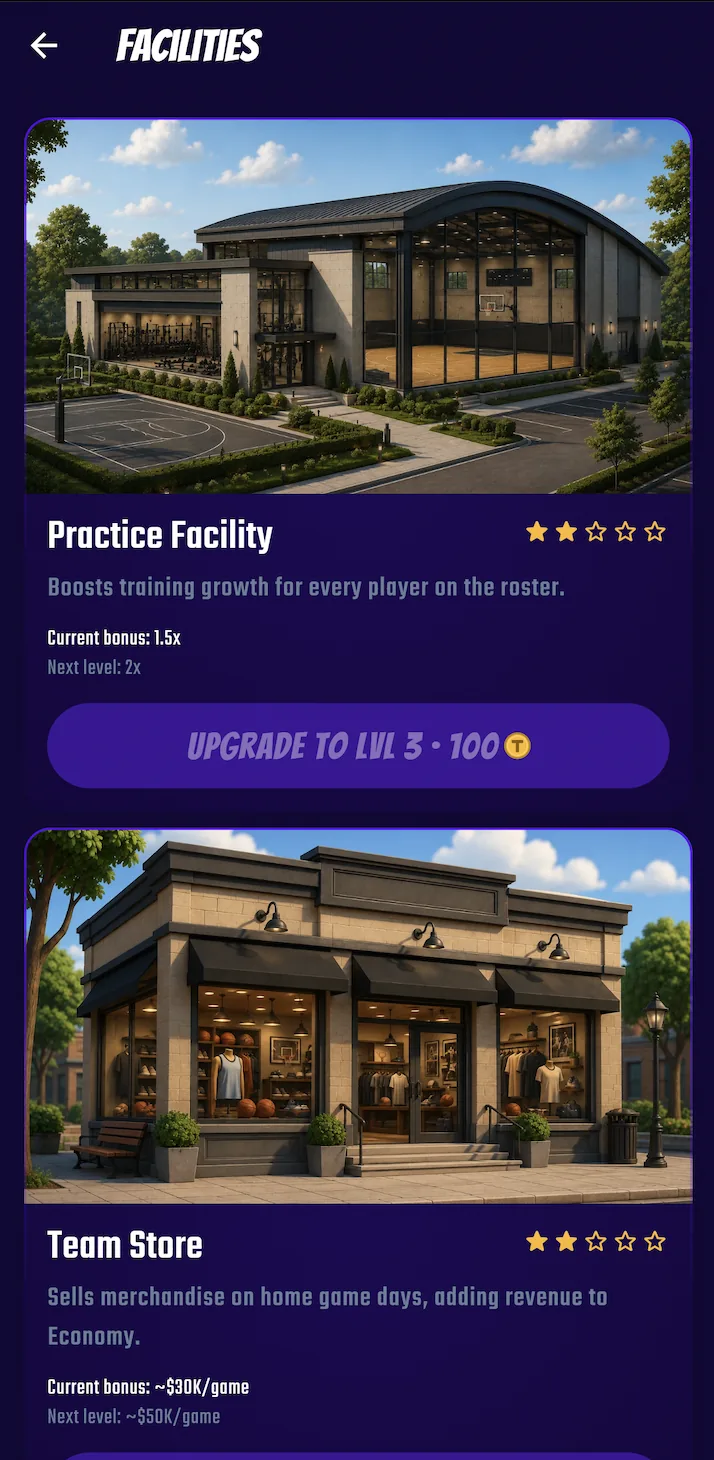
Facilities are long-term investments, and you upgrade them with tokens: 50 for level 2, 100 for level 3, 250 for level 4 and 500 for level 5. There are three:
| Facility | Effect |
|---|---|
| Practice Facility | Multiplies the growth of every player on the roster, up to three times at max level. |
| Team Store | Sells merchandise on home game days, with income that grows at every level. |
| Performance & Medical Center | Speeds up injury recovery, up to three times faster. |
Since tokens also buy packs and consumables, every facility upgrade is a choice: a pack today, or a practice facility that makes everyone better for the rest of the game?
The arena: capacity, sectors and ticket prices
The arena is your club's home and one of its biggest sources of income. It's split into four sectors that expand independently:
| Sector | Starting seats | Max seats | Cost per seat |
|---|---|---|---|
| Courtside (VIP) | 50 | 200 | $2,000 |
| Club / Suite | 500 | 2,000 | $600 |
| Lower Bowl | 2,000 | 8,000 | $120 |
| Upper Bowl | 2,450 | 9,800 | $50 |
Every club opens with 5,000 seats and can grow to almost 20,000. An expansion is paid upfront, but the seats only arrive when construction ends, after two or three weeks, and each sector can have one project running at a time. Courtside is the most expensive sector to expand, but it's also worth the most per seat.
For each sector you set the ticket price, within a range that depends on your division. Attendance grows with your standing: a team at the top fills the building, one at the bottom far less. Prices too high leave seats empty, prices too low leave money on the table: the ticket history shows attendance and price for every sector, game by game, and your Chief Revenue Officer can set the prices for you.
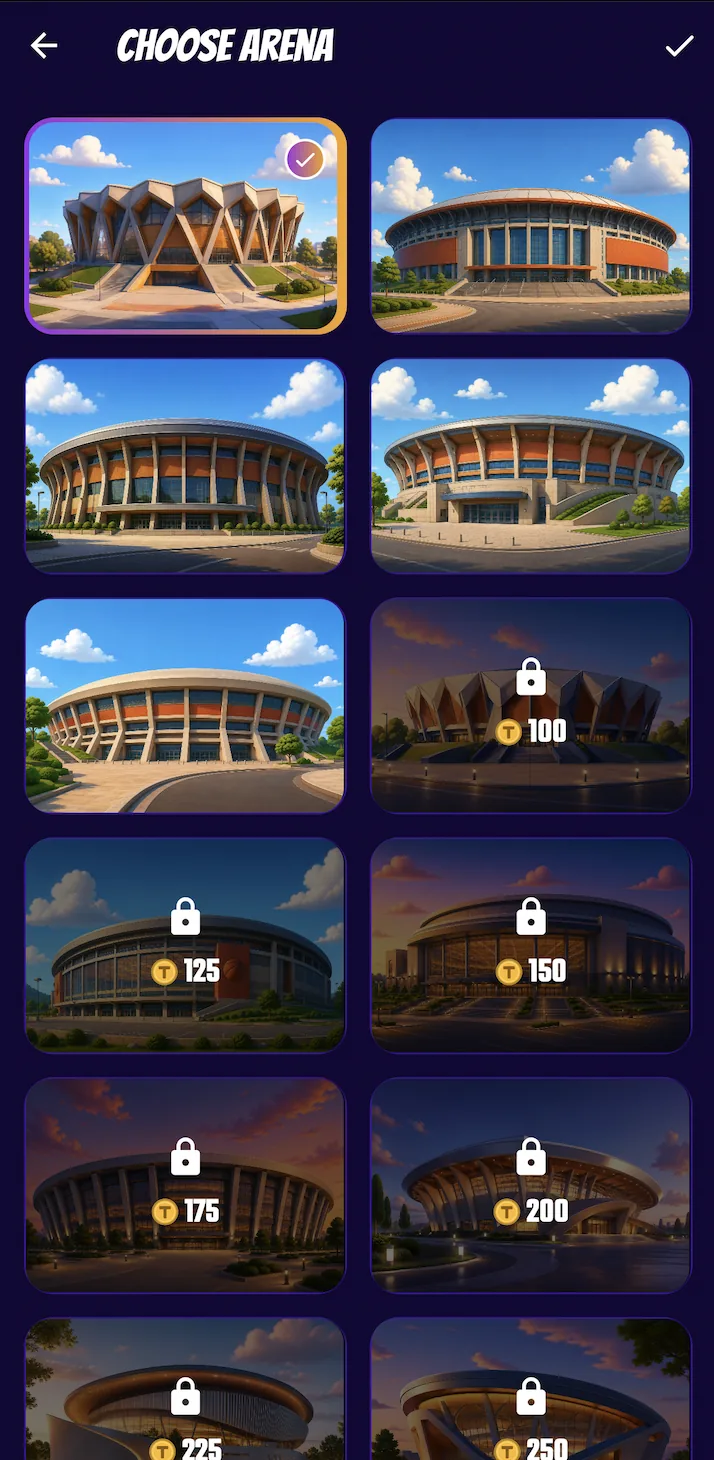
You can also change arenas: the game has a catalog of 39 venues, unlocked with tokens or found inside packs. Your chosen arena appears as the backdrop of your next home game's card.
Club finances
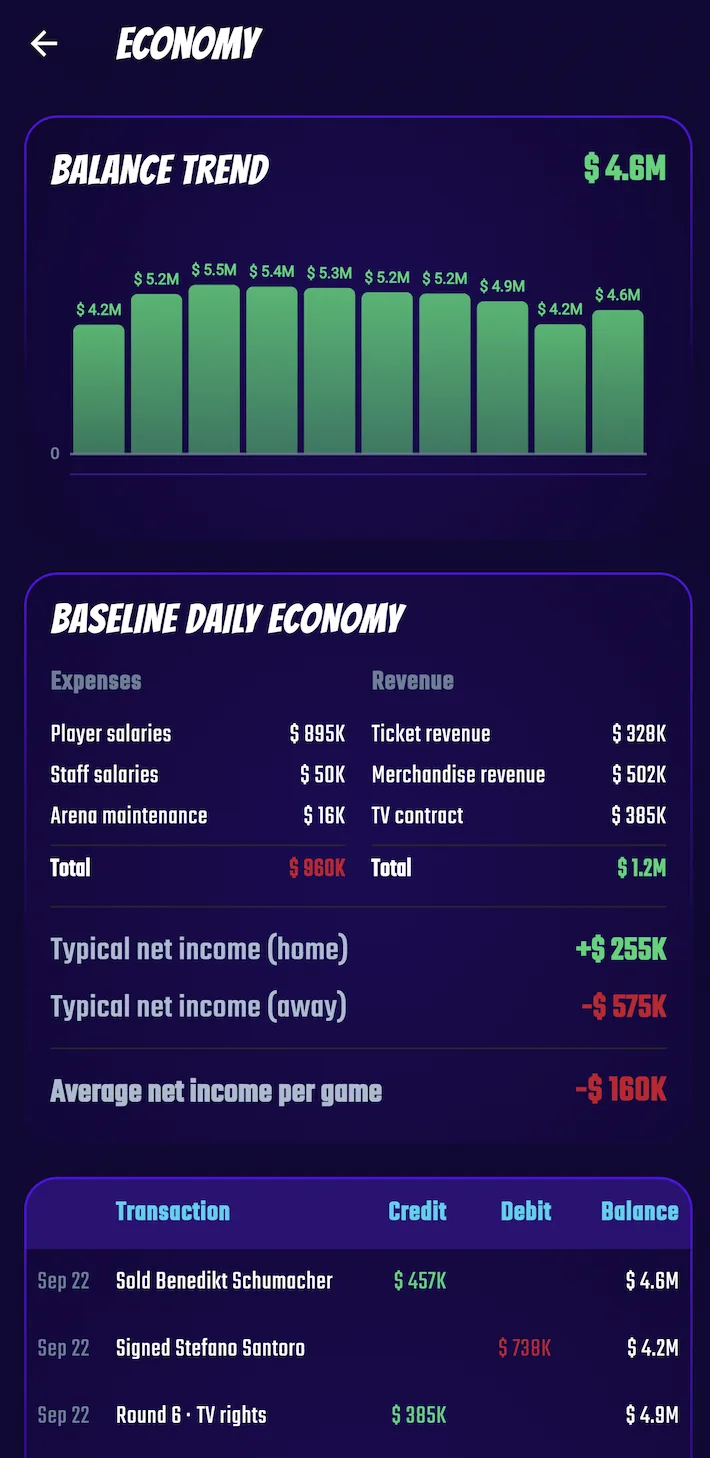
Every game moves your balance. The Economy screen shows your balance trend, your average net income per game and every line item:
- Income: tickets (home games only), TV rights (for both teams, higher in upper divisions), team store merchandise, cup and promotion prizes, market sales.
- Expenses: player salaries, staff pay, arena maintenance, expansions, market purchases.
A player's salary depends on his Overall: low for role players, very high for stars. There's no team salary cap, but there is a balance: a roster full of stars without an arena to pay for it quickly sends you into the red. Building a sustainable club is part of the challenge, just like in the classic manager games.
The market: a live auction house
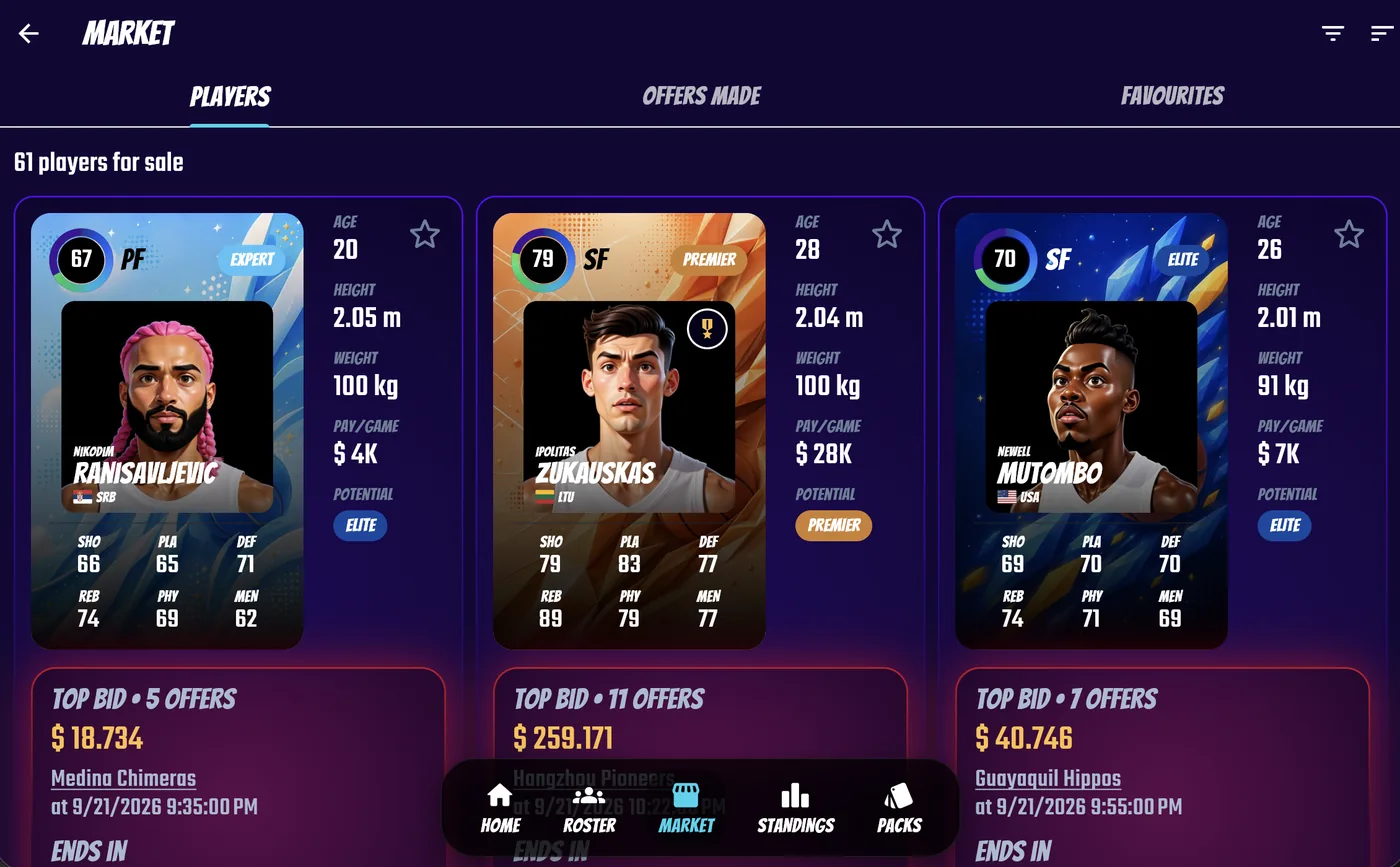
The transfer market is shared by every manager and works like a real auction house. Sellers list a player with an asking price; buyers bid until the deadline.
- The first bid must at least meet the asking price; every bid after that must beat the top bid by at least 5%.
- Funds for live bids are held in escrow and released the moment you're outbid: nobody can bid money they don't have.
- A bid in the final minute extends the deadline by another minute, so nobody can snipe a player at the last second.
- When the deadline passes, the top bidder gets the player and the seller is paid immediately.
You can filter by position, nationality, age, height, weight, salary, Overall, potential and group ratings, sort by deadline, price or Overall, follow your favorite players and keep an eye on the bids you've made. Computer-run clubs buy and sell too, so the market is always alive.
The draft: find the next superstar
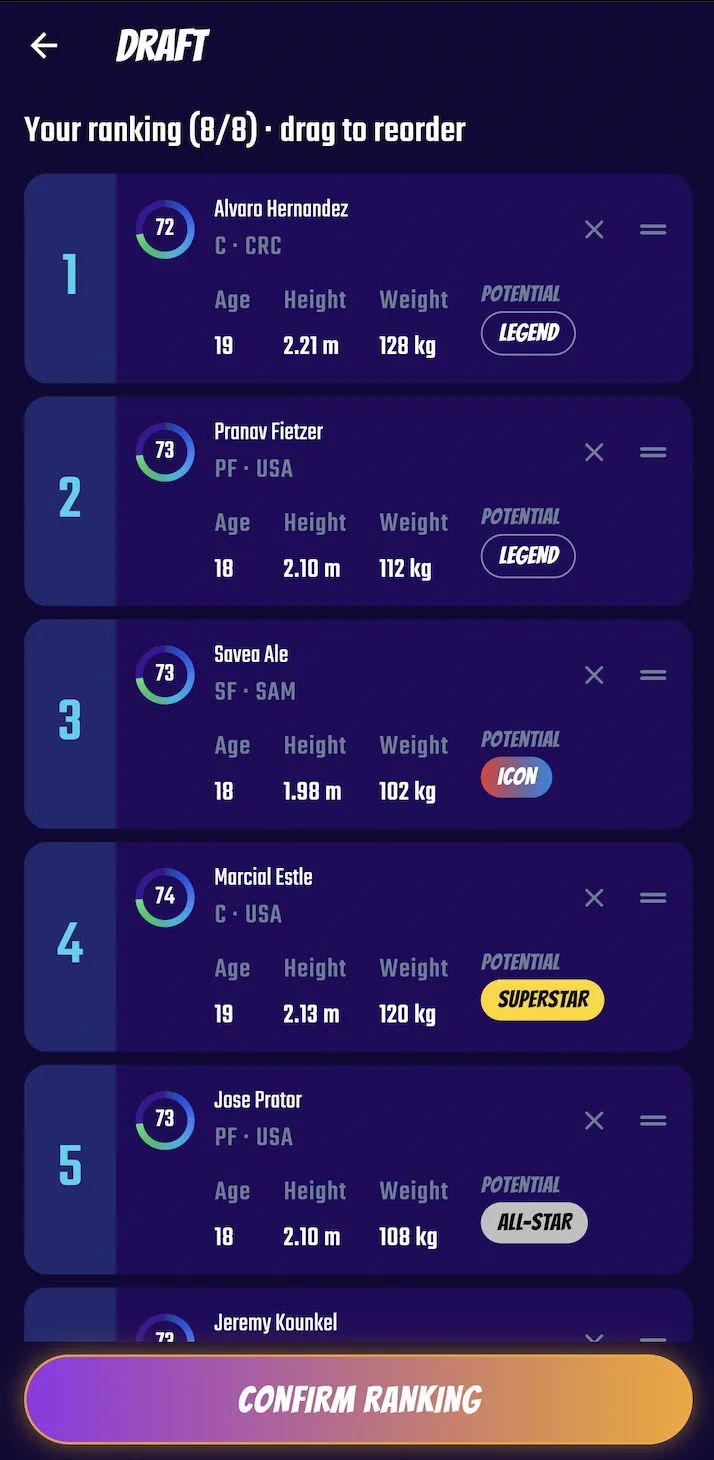
Every season each group gets a new class of 32 prospects aged 18 and 19. You don't need to be online at a set time: you build your board by ranking up to 8 players from most to least wanted, and you can change it anytime while the draft is open.
When the playoffs end, the draft runs on its own over two rounds. Pick order goes from worst record to best, so last place picks first. On each of your turns you get the highest player on your list who's still available; if your list is used up, the best Overall left. Every club leaves the draft with two new players.
The draft is where a good manager and a great manager part ways: an 18-year-old with a modest Overall but Superstar potential, trained well and given minutes, can become the best player in your group.
Pack opening and consumables
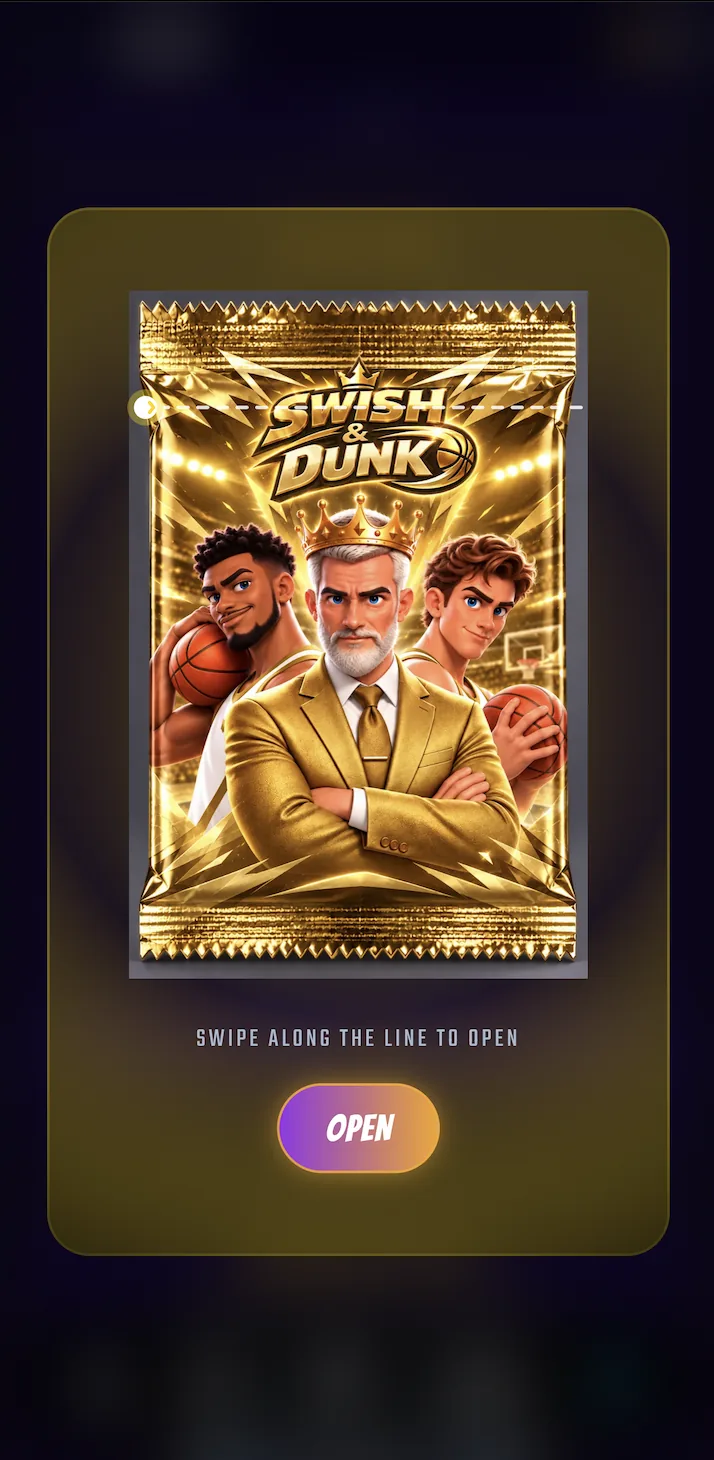
Packs are the heart of Swish & Dunk's modern side. Every pack holds a new player, drawn from a shared pool, and opens with a reveal animation: swipe along the line, the card flips and you find out who you got. It's the same thrill as sports card games, in a game where packs can't be bought with real money.
| Pack | Cost | Guaranteed tier | Consumables |
|---|---|---|---|
| Blue | 5 tokens | Specialist (60+) | Possible |
| Bronze | 10 tokens | Expert (65+) | Likely |
| Silver | 20 tokens | Premier (75+) | At least 1 |
| Gold | 50 tokens | All-Star (80+) | 3 |
| Diamond | 100 tokens | Superstar (85+) | 6 |
Before opening a pack you see the odds of every tier: no hidden surprises. Every pack has a small chance of an Icon or a Legend, and the Diamond pack goes up to 15% Icon and 5% Legend. Some packs also contain an arena for your club. If your roster is full, you need to sell a player before opening a pack.
Consumables come in packs or can be bought with tokens, and you use them on a player when you need to:
| Consumable | Effect | Cost |
|---|---|---|
| Rest Pack | +10 game shape | 3 tokens |
| Treatment Pack | −3 days of injury | 5 tokens |
| Morale Booster | +10 morale | 3 tokens |
Used at the right moment they can change a season: a Treatment Pack can get your center back for the final, a Morale Booster can lift an unhappy star, a Rest Pack gets you ready for the decisive game.
Club identity: crest and jersey
A club is also an identity. With Compose Logo you design your crest from 5 shapes, 22 patterns, over 100 symbols and 25 colors. With Compose Jersey you design your uniform: three colors (body, trim and outline) and 23 patterns, from classic pinstripes, stripes, bands and sashes to elaborate designs like a city skyline, flames, shattered glass, a basketball court and topographic lines. The jersey has a 3D effect that makes it look worn, and the back carries a number and your best player's name.
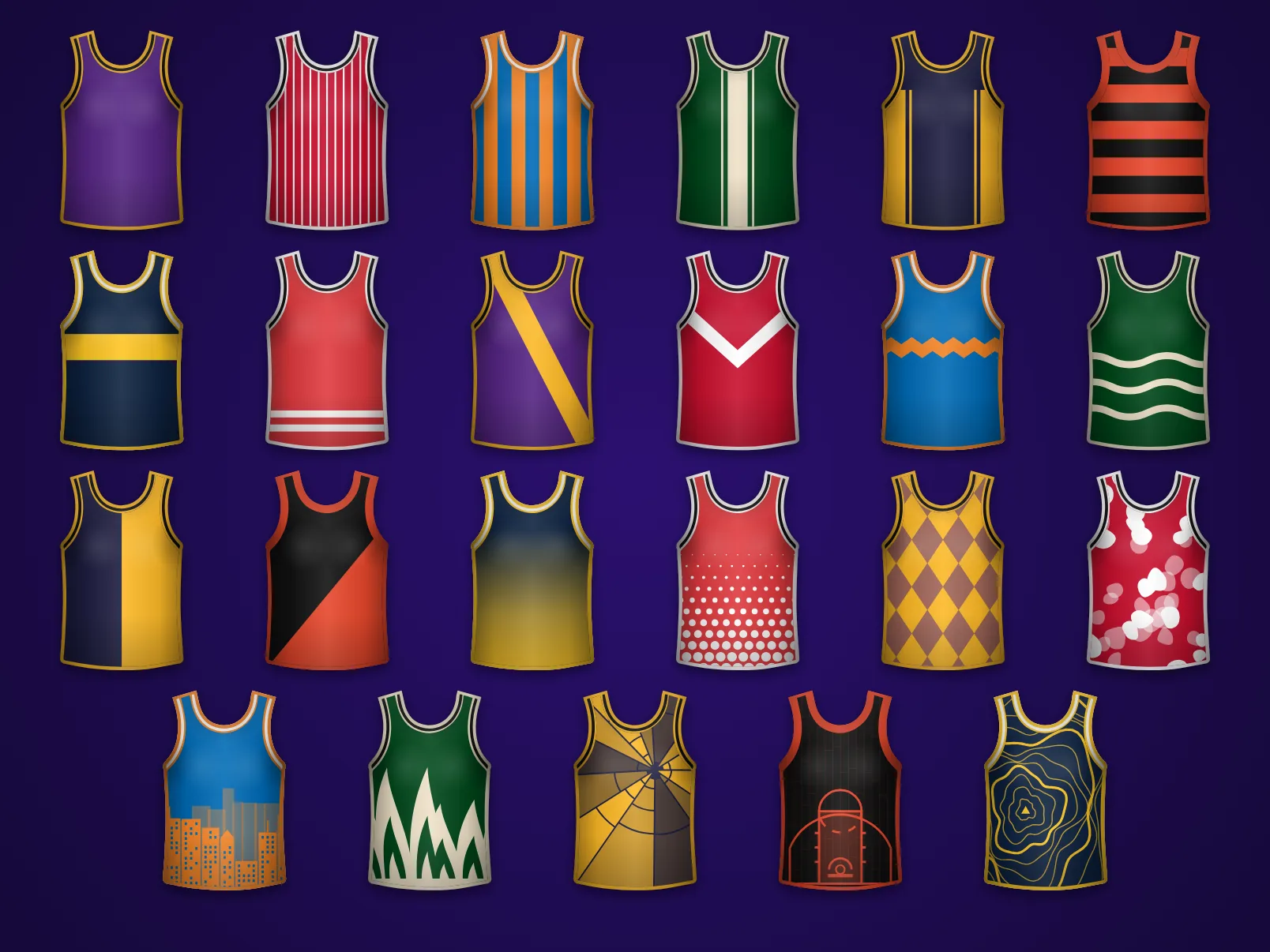
Your jersey and crest appear throughout the game: on game cards, in the standings, in box scores. On the Home screen, as in the most modern soccer manager games, each team is shown by its jersey with the crest on top.
Newsroom, trophies and prizes
The Newsroom tells you what's happening in the Swish & Dunk world: the biggest transfers, record performances, the MVP and Defensive Player of the Year awards, the finals winners and the new world champions. The trophy cabinet collects your club's titles, and individual awards (MVP, Defensive Player of the Year, Finals MVP) stay in your players' history. Promotions, titles and cup rounds won are celebrated with a dedicated screen and their money and token prizes.
On phone, tablet and computer, in 21 languages
Swish & Dunk runs in the browser, with nothing to download: just open the site on your phone, tablet or computer. On a phone you can add it to your home screen and open it full screen, like an app. Your account is the same on every device: set your lineup from the office computer and watch the game from your phone on the couch.
The game is translated into 21 languages: English, Spanish, Portuguese, French, German, Italian, Dutch, Polish, Russian, Serbian, Croatian, Greek, Turkish, Arabic, Chinese, Japanese, Korean, Indonesian, Filipino, Thai and Vietnamese. Inside the app there's a full manual that explains every rule, plus contextual tips that guide you the first time you open each section.
Who is Swish & Dunk for?
- Fans of the classic online manager games looking for the same depth in an interface that also works well on a phone.
- Basketball fans who want to think about rotations, tactics and matchups, not just Overall.
- Anyone who loves collecting cards and opening packs, but doesn't want a game that pushes them to pay.
- Busy people: a few minutes a day is enough, and the game never rewards whoever stays online longest.
If you want to compare it with the alternatives, we've reviewed the main titles in the genre in our guide to the best basketball manager games.
Five tips to get started
- Study your roster before buying. Look at the six group ratings, not just Overall, and pick tactics that suit the players you have.
- Keep your starting five stable. Chemistry and morale reward continuity.
- Give minutes to high-potential youngsters. Game minutes add to daily training.
- Collect your daily reward and spend tokens wisely. A better practice facility makes everyone better forever; a pack is a lucky shot.
- Look after your arena and prices. More income means more market moves, more staff and bigger ambitions.
Frequently asked questions
Is Swish & Dunk free?
Yes, completely. There is no subscription, no premium plan and no season pass, and nothing in the game can be bought with real money: every feature is available to every manager from day one.
Is Swish & Dunk pay-to-win?
No. The tokens used to open packs, buy consumables, upgrade facilities and unlock arenas are earned only by playing: wins, the daily reward and promotions. They cannot be bought, so nobody can buy a stronger team.
Which devices can I play on?
In the browser on phones, tablets and computers, with nothing to download. On a phone you can add it to your home screen and open it like an app.
How much time does it take each day?
A few minutes is enough: there is one game a day at a set time and you set your lineup beforehand. You can spend more time on the market, training, the arena and the draft, but the game never rewards whoever stays online the longest.
Do I need to be online when my team plays?
No. The game tips off on schedule whether you are there or not; when you come back you find the roughly 12-minute live replay, the play-by-play and the full box score.
What is inside a pack?
A player and, depending on the pack, one or more consumables; sometimes an arena for your club too. Every pack guarantees a minimum Overall tier and shows the odds of each tier before you open it.
Can I play against friends and other real managers?
Yes. Every manager plays in the same persistent world: the same groups, the same market and the same cups. Open spots in the groups are filled by computer-run clubs, so leagues are always full.
Which languages is it available in?
21 languages, including English, Spanish, Portuguese, French, German, Italian, Turkish, Japanese, Korean and Chinese.
For a comparison with real basketball, our analysis of 30 NBA seasons shows how the game changed between 1996 and today. And to see where Swish & Dunk fits in the history of the genre, read how manager games have changed over the last 20 years. And to see how the first full season played out, read the Season 1 recap: champions, Cup, World Cup and player grades.
Your club is waiting: take it over today and play your first game tomorrow.
Play now — it's freeLast updated: