How sports manager games have changed in the last 20 years (and why Swish & Dunk takes a third way)
Twenty years ago you played a manager game slowly: one match every few days, a spreadsheet open next to the browser and promotion as the reward after months of work. Today the genre lives mostly on the phone, moves much faster and revolves around tokens, packs and daily rewards, often with a store always within thumb's reach. In this article we look at how and why everything changed, what was gained and what was lost, and why with Swish & Dunk we chose a third way: the pace and patience of the classic manager games, the collecting and the visuals of the modern ones, and no in-app purchases.
The short version
- The 2000s: browser and PC managers, near real-time pace, deep simulation, a one-off purchase or an optional subscription.
- The 2010s: the smartphone arrives. Short sessions, compressed seasons, the free-to-play model.
- Today: multiple currencies, packs and loot boxes, real-time auctions, login bonuses and season passes. The game becomes a service that mostly measures how often you come back.
- Swish & Dunk: slow and thoughtful like the old managers, with collectible cards, packs, tokens and AI-generated faces like the new ones. But tokens can only be earned by playing and there is nothing to buy.
| 2000s manager games | Today's mobile managers | Swish & Dunk | |
|---|---|---|---|
| Pace | Slow, near real-time calendar | Fast, short and frequent sessions | One game a day, long seasons |
| Progress | Scouting, training, budget, tactics | Packs, boosts, premium currency | Training, draft, tactics, tokens earned by winning |
| Business model | One-off purchase or subscription | Free with in-app purchases | Free, with no in-app purchases and no ads |
| Presentation | Tables and menus built for a monitor | Polished visuals, built for the phone | Mobile-first app, cards with AI-generated faces |
| Reward | At the end of the season, after months | Constant, every day | Built over time, with a little excitement every day |
The 2000s: the golden age of patience
In the early 2000s broadband arrived in people's homes, and with it a generation of online browser manager games. Football already had titles like Hattrick; basketball got BuzzerBeater and Charazay, which became a daily ritual for many fans for years. On PC, meanwhile, the Football Manager series took simulation to a level of detail that still seems almost unbelievable today. We tell the full story of one of them, from launch to its shutdown in 2017, in the rise and fall of Charazay Basketball Manager.
These games had one thing in common: time moved almost in real time. In online managers you played a few games a week, a season lasted months and a promising youngster needed whole seasons to become a starter. You couldn't speed anything up. You could only plan.
And people really did plan. The most dedicated players kept spreadsheets of every player's weekly progress, compared salaries and gate receipts, and argued on forums about which defense worked best against which offense. Progress depended on knowing the sport, scouting the youth ranks, managing the budget and tactical skill. Whoever won was whoever understood the game best, and the game was, at heart, the sport itself.
The business model was simple too. On PC you bought the game once. Online you played for free, with an optional subscription that gave you extra stats or a few conveniences but rarely changed results on the court. The real reward came at the end of a long season: promotion, earned after months of work, and unforgettable precisely because of it.
The limits of the old school: office-desk interfaces
Nostalgia shouldn't make us forget the flaws. The manager games of that era were deep, but often hostile to newcomers: dozens of pages, tables packed with numbers, rules explained in long manuals and on forums. It took weeks to really get into the game.
Above all, they were built for a desktop monitor. When the smartphone became the main device people played on, many of these titles struggled to adapt: pages you had to pinch to zoom, nested menus, tiny buttons. Some released an app, but almost always as a cut-down version of the website rather than a game rethought for the phone. The depth was still there, but a new generation of players no longer felt like digging for it.
The mobile revolution: instant accessibility
The 2010s brought app stores and the free-to-play model. The manager game moved to the phone and changed shape to fit how we use it: sessions of a few minutes, in a queue, on the couch, on the bus.
The pace is no longer set by the sporting calendar but by how often we open our phones. Games are played several times a day, a whole season can last a few days and downtime is cut out, because every idle moment is a moment when the player might close the app and never come back. Titles like Top Eleven brought the football manager to a huge audience, far larger than the enthusiasts on the forums.
It was a real gain, too: polished visuals, interfaces designed for the thumb, clear tutorials, the chance to play against friends with a single tap. The genre became accessible to anyone. But sustaining a free game needed a new business model, and that model changed the gameplay as well.
From tactics to reward loops: tokens, packs and in-app purchases
In the freemium model the center of the game gradually shifts from tactics to gamification. The ingredients are familiar to anyone who has played a mobile manager:
- A multi-currency economy. Club money, tokens or premium coins, energy points, medical kits, training items. More currencies mean more chances to run short of something, and more places where the store can offer a shortcut.
- Pay-to-fast. Time becomes something for sale: you can speed up the construction of your stadium, instantly heal an injured player, or refill your team's energy without waiting for the free recharge.
- Pay-to-win. The next step is buying strength directly: packs with better players, training boosts, limited-time offers. In a competitive game, even the time you save is already an advantage.
- Packs, gacha and loot boxes. The transfer market changes: real-time auctions won by whoever holds the most premium currency, or Ultimate Team-style packs built on the thrill of surprise. The appeal of collecting is real, but it is tied to potentially endless spending.
The problem isn't collecting itself, nor having an in-game currency. The problem starts when the game's design is built around frustration: waits designed to be annoying, resources tuned to run out just before you have enough, opponents who move faster because they paid. At that point the player's question is no longer "what's the right tactic?" but "how much will it cost me not to fall behind?".
The push toward instant rewards
There is also a subtler change, in the rhythm of rewards. In classic manager games satisfaction came after months: a promotion, a youngster breaking out, a title. Today the game hands out an almost continuous stream of rewards to encourage daily logins: login bonuses, season passes with dozens of tiers, wheels of fortune, timed chests, push notifications so you don't miss the auction of the century.
The manager game becomes a live service, and its main goal, from the developer's point of view, becomes the retention rate: how many players come back tomorrow, in a week, in a month. That isn't necessarily bad, because a living game needs players who come back. But when every screen is designed to deliver a small hit of dopamine, the big reward, the one that arrives after months of patience, loses its value. If everything is a prize, nothing really is.
Institutions have noticed too. Since 2017 Apple has required apps to disclose the odds of randomized items that can be purchased, and in 2018 the Belgian Gaming Commission ruled that certain paid loot boxes fell under gambling law. The debate over paid packs and loot boxes is still open in many countries.
Twenty years on: what was gained and what was lost
It would be easy to say the past was better. It wasn't. Modern manager games brought things nobody would want to lose: beautiful, clear interfaces, the pleasure of collecting players like trading cards, the ability to play anywhere, the thrill of opening a pack and finding out who's inside.
But something was lost along the way: the feeling that every choice matters, because you can't fix a mistake with a credit card; the satisfaction of a project built over months; the certainty that the opponent who beats you simply managed their team better. The real risk isn't modernity, it's mistaking pressure for engagement.
So the interesting question is a different one: is it possible to take the best of both eras? That's the question Swish & Dunk was born from.
Swish & Dunk: the third way
Swish & Dunk is a free, online, multiplayer basketball manager. The starting idea is simple: keep the heart of the classic manager games, meaning slowness, depth and patience, and dress it in the best things modern managers invented, meaning cards, packs, tokens and visuals designed for the phone. And leave out everything that turns a game into a store.
Slow by design, like the managers of old
In Swish & Dunk you play one game a day, at a fixed time. The regular season lasts 22 rounds, followed by playoffs, promotions, relegations and the draft. Climbing from the tenth division to the top flight takes seasons, not afternoons.
Players develop day by day: every morning there's a training session, and anyone who takes the court gets an extra boost in proportion to the minutes played. An 18-year-old with Superstar potential, picked in the draft and given minutes patiently, can become the best player in your group, but not in a week. Chemistry and morale reward managers who keep a stable starting five; the budget punishes anyone who fills the roster with stars without an arena to pay for them.
It's the same pact as the old manager games: you can't speed up time, you can only use it well. Every game is simulated possession by possession, with player matchups, fatigue, fouls, momentum and clutch finishes, as we explain in the match engine guide. But this slowness doesn't ask you to stay online: a few minutes a day are enough to set your lineup and tactics, and the game is played even if you're not there. When you come back you'll find the replay, the play-by-play and the box score.
Collectible cards, without the credit card
From modern manager games, Swish & Dunk takes the most fun part: collecting. Every player is a card, with a face, a flag, a position, an Overall and ten rarity tiers, from Challenger to Legend. Opening a pack has the same thrill as a sports card game: you drag along the line, the pack opens, the card flips.
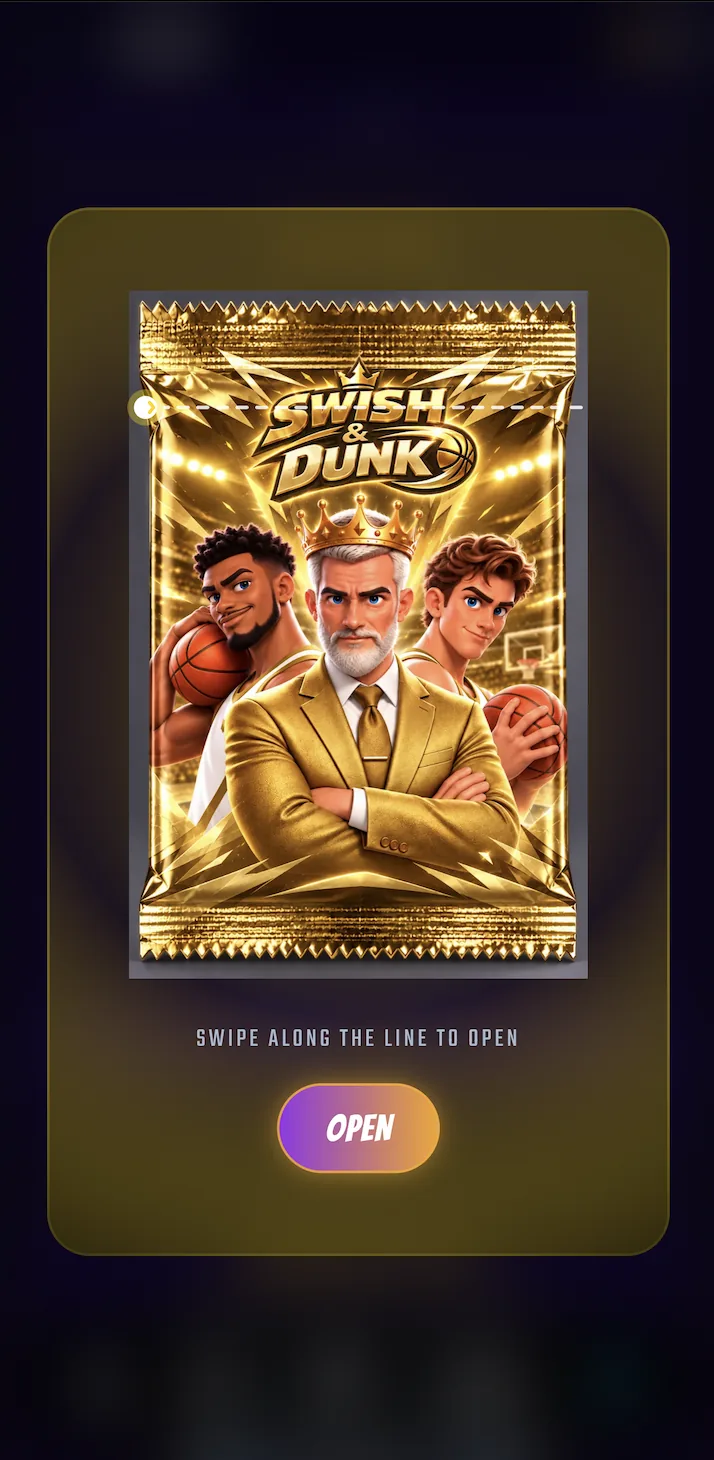
The difference is what it takes to open one. In Swish & Dunk packs cost tokens, and tokens cannot be bought. What's more, before opening a pack you see the odds of every tier: no hidden surprises, no limited-time offer popping up at the wrong moment. A pack is an extra thrill, not the main lever for building your team: the draft, training and the market remain the heart of the game.
Tokens earned by playing, not bought
The token mechanic comes from modern games, but with the opposite rule: the only way to get them is to play.
| How to earn tokens | How many |
|---|---|
| Club starting allowance | 50 |
| Every win (league, playoffs, friendlies, cups) | 3 |
| Daily reward | 1 |
| Division promotion | 50 to 250 |
| Buying them with real money | Not possible |
With tokens you open packs, buy consumables such as the Rest Pack, Treatment Pack and Morale Booster, upgrade your club's facilities and unlock new arenas. Because they're scarce and earned by winning, every token becomes a decision, just like the budget in the old manager games: a pack today, or a higher-level training gym that will make the whole roster grow for the rest of the game? Two managers who put in the same effort have the same chances. What makes the difference is how you run your club.
No manipulative mechanics
Being free isn't enough: plenty of free games are built to push you to pay. Swish & Dunk deliberately gives up the tools that made freemium famous:
- No in-app purchases, no subscription, no premium plan, no paid season pass.
- No ads to watch in exchange for rewards.
- No paid shortcuts: an arena expansion takes weeks of construction, an injury takes its days to heal, and nobody can shorten the wait with real money.
- No currency tuned to run out just before you have enough, and no limited-time offer that pops up after a loss.
- No race to stay online: the daily reward is worth a single token, on purpose. It's a small thank-you for stopping by, not an obligation.
The result is a game where the edge is built by winning, not by paying. When you lose, you know you lost to a manager who did a better job than you, not to a bigger wallet.
Modern visuals and AI-generated faces
The other lesson of modern manager games is that presentation matters. Where many historic managers struggle on the phone, Swish & Dunk is designed for the phone first: every screen works with one thumb, and on tablets and computers the extra space becomes a multi-column layout. You play in the browser, with nothing to download, and you can add it to your Home screen to open it like an app. It's translated into 21 languages.
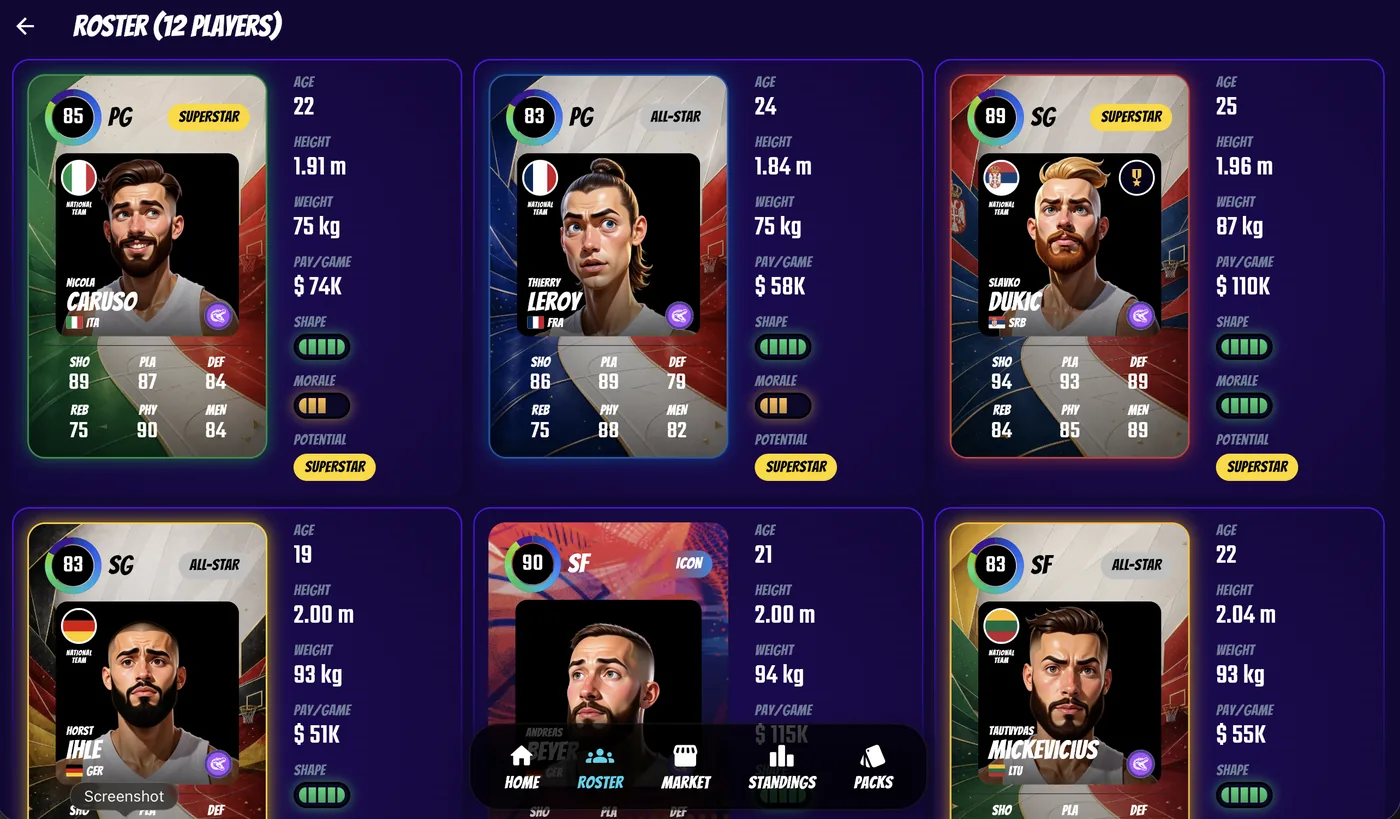
Players have semi-realistic faces generated by artificial intelligence, a different one for each. It sounds like a detail, but it changes your relationship with the team: in the old managers players were rows in a table, here after a few games you recognize your starters at a glance, like the trading cards of real stars. Add to that a crest and jersey you design yourself, a catalog of arenas to move into and games you watch as a compressed live broadcast of about 12 minutes.
The depth is still that of the classics
Under the visuals there's a real manager game. Every player has about 50 ratings, from close-range shooting and weak hand to composure and leadership. There are 8 offensive and 8 defensive tactics, and none is the best across the board: the edge comes from fitting it to your players and your opponent, as we explain in the basketball tactics guide. And the engine follows the logic of real basketball, the one we describe in our analysis of 30 NBA seasons: a three is worth more than a mid-range jumper, and a badly built team pays for it in efficiency.
The market is an auction house shared by every manager, the draft brings a new class of prospects every season, staff and facilities are long-term investments, and the arena has to be managed section by section, price by price. It's the kind of game people used to open a spreadsheet for, and someone will do it here too.
Who this third way is for
- For anyone who loved BuzzerBeater, Charazay or Hattrick and wants the same patience with an interface that works well on the phone.
- For anyone who loves collecting cards and opening packs, but is tired of games that turn every pack into a payment request.
- For anyone with little time: a few minutes a day are enough, and the game doesn't reward whoever stays online the longest.
- For anyone who wants a level playing field, where the only thing you can spend is your brain.
The future of manager games
After twenty years, the manager genre seems to have reached a crossroads. On one side are ever-faster games, more and more like slot machines with a stadium around them. On the other is an audience, often raised on browser managers, asking again for depth, transparency and respect for their time, but without giving up a game that looks good and is comfortable to play on the phone.
We don't think the answer is to go back. We think it's to take the best of both eras: the slowness that gives choices their weight and the modernity that makes the game a pleasure, collecting without gambling, tokens without the store. If you want to see how Swish & Dunk compares with the alternatives, we've reviewed the main titles in the genre in our guide to the best basketball manager games.
Frequently asked questions
What were sports manager games like twenty years ago?
They were mostly browser and PC games that ran on an almost real-time calendar: a few games a week, seasons lasting months, players who developed slowly. Progress depended on knowing the sport, scouting, the budget and tactics, and the business model was a one-off purchase or an optional subscription.
What changed when smartphones arrived?
The pace adapted to short phone sessions: you play often, downtime has been cut out and a season can last just a few days. The free-to-play model brought multiple currencies, packs, real-time auctions, login bonuses and in-app purchases to speed things up or power up your team.
What is the difference between pay-to-fast and pay-to-win?
Pay-to-fast means paying to skip a wait, such as building a stadium or recovering from an injury. Pay-to-win means paying for a direct competitive edge, such as stronger players. The two often overlap, because in a competitive game time saved is already an advantage.
Does Swish & Dunk have in-app purchases?
No. Swish & Dunk is free, with no subscriptions, no ads and nothing to buy with real money. Packs, consumables, facilities and arenas are paid for with tokens, and tokens can only be earned by playing.
How do you earn tokens in Swish & Dunk?
A club starts with 50 tokens, then earns 3 for every win, 1 from the daily reward and between 50 and 250 for every division promotion. There is no store that sells them.
Is Swish & Dunk as slow as the old manager games?
Yes, by design: you play one game a day, the regular season lasts 22 rounds and players develop day by day through training. A few minutes a day is enough, but results come from patience and planning.
The pace of the classic managers, the fun of the cards, no in-app purchases: take over a club and play your first game tomorrow.
Play now — it's freeLast updated: