Anatomy of a modern basketball manager game
What does a basketball manager game need in 2026? The core has barely changed in twenty years: a club to run, a world shared with other managers, a simulation you can trust and a season that rewards planning. Everything around that core has changed. Players moved to their phones, their patience changed shape, and the most successful mobile games taught everyone to love cards, packs and rewards, often with a credit card in the middle. In this article we take a modern basketball manager apart piece by piece: what it has to keep from the classics, why the old browser managers like Charazay faded away, which features the new generation cannot do without, and how Swish & Dunk puts them together without turning into a pay-to-win game.
The short version
- The skeleton never changes: a club to own, a persistent multiplayer world, a credible match engine, an economy, a market, young players and tactics.
- Why the old managers faded: desktop-only interfaces, a slow calendar with rare rewards, hard onboarding, opaque engines and a fragile business model. Charazay is the textbook case.
- What a modern manager needs: a UI built for the phone, a faster daily rhythm, collectible cards, pack opening and tokens as a reward currency, plus a transparent engine and visible odds.
- The trap: the same features are the backbone of pay-to-win, as soon as tokens or packs are for sale.
- Swish & Dunk: mobile-first, one game a day, AI-faced cards in ten tiers, five packs with published odds, and tokens that can only be earned by playing. Nothing is for sale.
The skeleton: what every basketball manager needs
Before talking about what is new, it is worth remembering what a manager game actually is. You do not play the games, you run the club. Whatever the era, the genre stands on the same bones:
- A club you feel you own. A roster, a name, colors, an arena, a budget. The decisions are yours and so are the consequences.
- A persistent, shared world. Real managers in the same leagues, the same market and the same cups. Beating a computer is a puzzle; beating another person is a rivalry.
- A credible simulation. Results have to follow from the roster and the tactics, not from a dice roll on team rating. Otherwise every other system is pointless.
- A real economy. Salaries, revenue, an arena to fill: the money has to force you to choose.
- A market and young players. Buying, selling, drafting and developing are the long-term game.
- Tactics that matter. Systems that beat other systems, so that knowing basketball is an advantage.
None of this is optional, and none of it is modern. The classic browser managers of the 2000s had almost all of it. They did not disappear because the skeleton was wrong, but because of everything they had built around it.
Why the old browser managers slowly faded
The story of Charazay Basketball Manager is the clearest example. For more than a decade it gathered thousands of managers from over 70 countries, then it went through years of decline, was put up for sale without receiving a single bid and went offline for good in September 2017. The hard drive that took the database with it was only the last blow. The real causes were common to a whole generation of games, and BuzzerBeater, which is still online, has survived them rather than escaped them.
- Interfaces built for a desk. Dense tables, small links and nested pages were fine on a monitor in 2006. On a phone, which became the main gaming device a few years later, they were almost unusable, and rebuilding them was too expensive for small teams.
- A calendar that rewarded only the patient. Two league games a week, training in weekly cycles, seasons lasting months. The slowness gave every decision weight, but the real reward, a promotion, arrived only after months of waiting. A new player had very little reason to come back tomorrow.
- Onboarding by homework. To understand the game you had to read forums, wikis and guides written by veterans. Charazay even approved registrations by hand.
- Engines nobody explained. Managers spent years reverse-engineering how skills were weighted, and when a patch changed the balance, years of knowledge were wiped out overnight.
- Players as rows in a table. A name and ten numbers. Hard to get attached to, impossible to show off.
- A fragile business model. Donations and optional subscriptions were fair, but they depended on a shrinking core of loyal players while server costs stayed the same.
Meanwhile, mobile games were solving every one of these problems, and creating new ones. We told that twenty-year story in our article on how manager games have changed. Here we focus on the result: the list of features a basketball manager needs to be worth opening every day in 2026.
The anatomy of a modern manager, feature by feature
1. An interface designed for the thumb
Mobile-first does not mean a website that shrinks. It means starting from a phone held in one hand: big touch targets, one main action per screen, cards instead of tables, information you can read at a glance on the bus. Tablets and computers get more columns, not a different game. And the barrier to entry has to be minimal: ideally nothing to download, so that a link shared in a group chat is enough to start playing.
2. A faster pace, but not a frantic one
The modern manager has to give you a reason to open it every day, with something new each time: a result, a training report, an auction about to close. That means a daily cadence and seasons that last weeks rather than months, so that a promotion feels within reach. The risk is the opposite excess: mobile games that play several matches an hour reward whoever stays online the longest and turn the season into a blur. The sweet spot is a short daily session, with long-term goals still measured in seasons.
3. Players as collectible cards
This is the most useful lesson from modern sports games. A player shown as a card, with a face, a flag, a position, a rating and a rarity color, is something you recognize and remember. The tier tells you at a glance how good he is, and a card that changes color when the player improves turns development into something visible. You stop managing rows in a table and start building a collection.
4. Pack opening
Opening a pack is the small, pure thrill of the genre: the anticipation, the reveal, the card that flips. It works as a reward and as a way to bring new players into the game. But it only works well if two conditions hold: the odds have to be public before you open, and the pack has to be one way to build a team, not the only one. A draft, training and a market must remain the backbone.
5. Tokens as a reward currency
Separating club money from a special currency is a good idea: the budget pays salaries and the market, while tokens pay for the extras, such as packs, consumables and long-term upgrades. Tokens give a value to each win and turn every spending decision into a real trade-off. Their weak point is obvious, and we will get to it in a moment.
6. Transparency
Today's players expect to know how the simulation works and what the odds of a pack are. An engine documented with real numbers turns reverse-engineering into strategy, and published odds turn a pack from a gamble into a known reward.
7. A gentle start
The first five minutes decide whether a new manager stays. You start with a ready-made team, an assistant who can suggest a lineup, hints that appear the first time you open each section. The depth is all there, but it unfolds gradually.
Where modern managers go wrong: the pay-to-win trap
Look at features 3, 4 and 5 again: cards, packs and tokens. They are also, almost word for word, the engine of every freemium game. All it takes is putting a price tag on tokens, and the game changes nature. The best cards end up in the most expensive packs, the most expensive packs are bought by whoever spends the most, and the question on the manager's mind is no longer "what is the right tactic?" but "how much will it cost me not to fall behind?". Add timers you can pay to skip, currencies tuned to run out just before you have enough and offers that pop up after a defeat, and the manager becomes a store with a basketball court around it.
The problem, in other words, is not the features. It is who can buy them. A modern manager can take everything good from mobile games, as long as it refuses this one step.
How Swish & Dunk puts the anatomy together
Swish & Dunk is a free online basketball manager built exactly around this anatomy: the skeleton of the classics, the features of modern games, and one rule that changes everything. Here is how each piece works in practice.
Mobile-first, in the browser
Every screen in Swish & Dunk is designed to be used with one thumb; on tablets and computers the extra space becomes a multi-column layout. It runs in the browser with nothing to download, and on a phone you can add it to the Home screen and open it like an app. It is available in 21 languages. The Home screen shows what you need in a few seconds: the next game with both teams' jerseys, the last result, your position and your last five games.
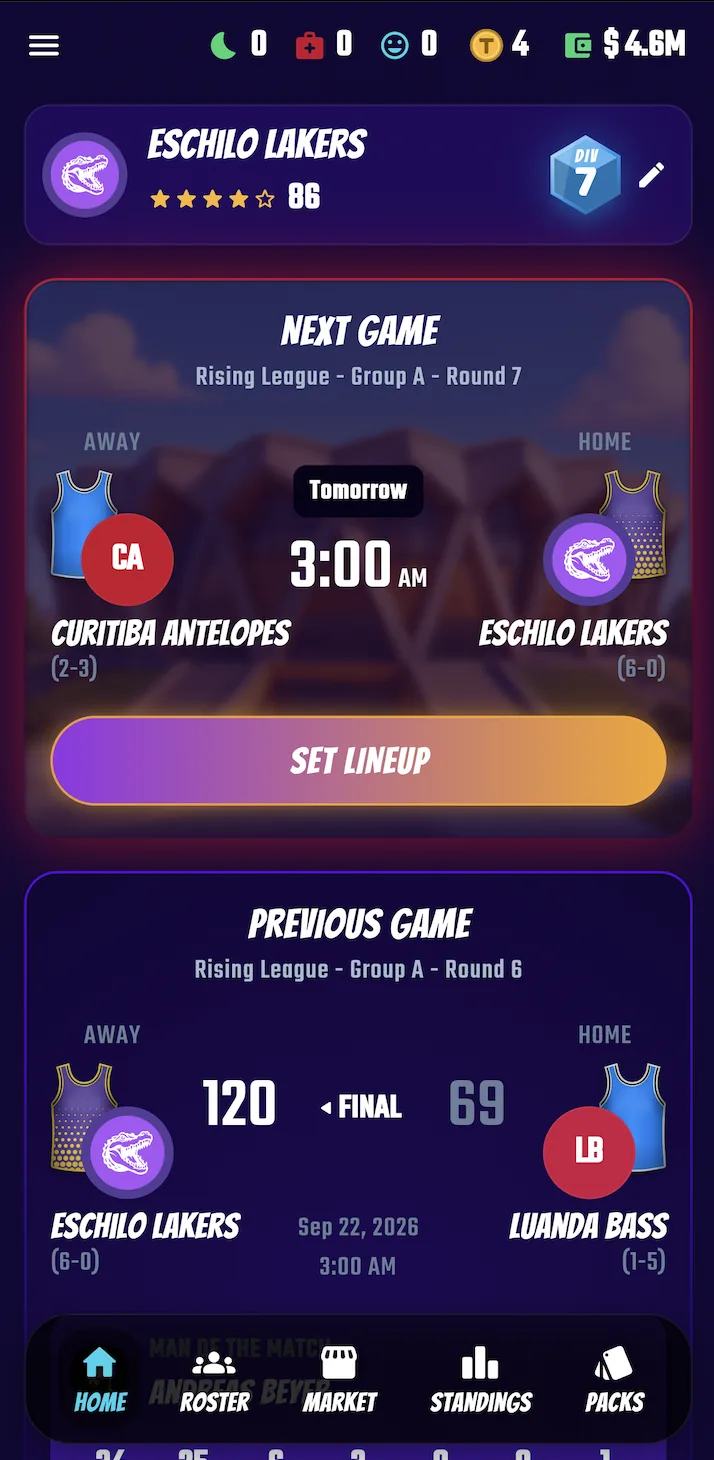
A daily rhythm: one game a day
The pace is faster than in the old browser managers and much calmer than in arcade mobile games. There is one game a day at a set time, against two or three a week in the classics. The regular season lasts 22 rounds, followed by playoffs with a best-of-three final, promotions, relegations and the draft, so a season is measured in weeks, not months. Training runs every morning, and every player who takes the court gets an extra boost sized to his minutes, so something improves every single day.
What has not changed is that you do not need to stay online. Lineup and tactics are set in advance, the game tips off even if you are not there, and when you come back you find a compressed live broadcast of about 12 minutes, the play-by-play and the box score. A few minutes a day are enough. And long-term goals still take seasons: an 18-year-old with Superstar potential picked in the draft does not become a star in a week. How growth really works is explained in our training guide.
Cards with AI-generated faces
Every player is a card with a semi-realistic face generated by artificial intelligence, unique to each player, plus a flag, a position, an Overall ring and six group ratings. There are ten tiers, from Challenger to Legend, each with its own color and artwork, and the card follows the player: when training pushes him into the next band, the card changes with him. Players called up to their national team for the S&D World Cup get their nation's artwork instead, and award winners carry a badge for MVP, Defensive Player of the Year or Finals MVP. All the details are in our guide to cards and pack odds.
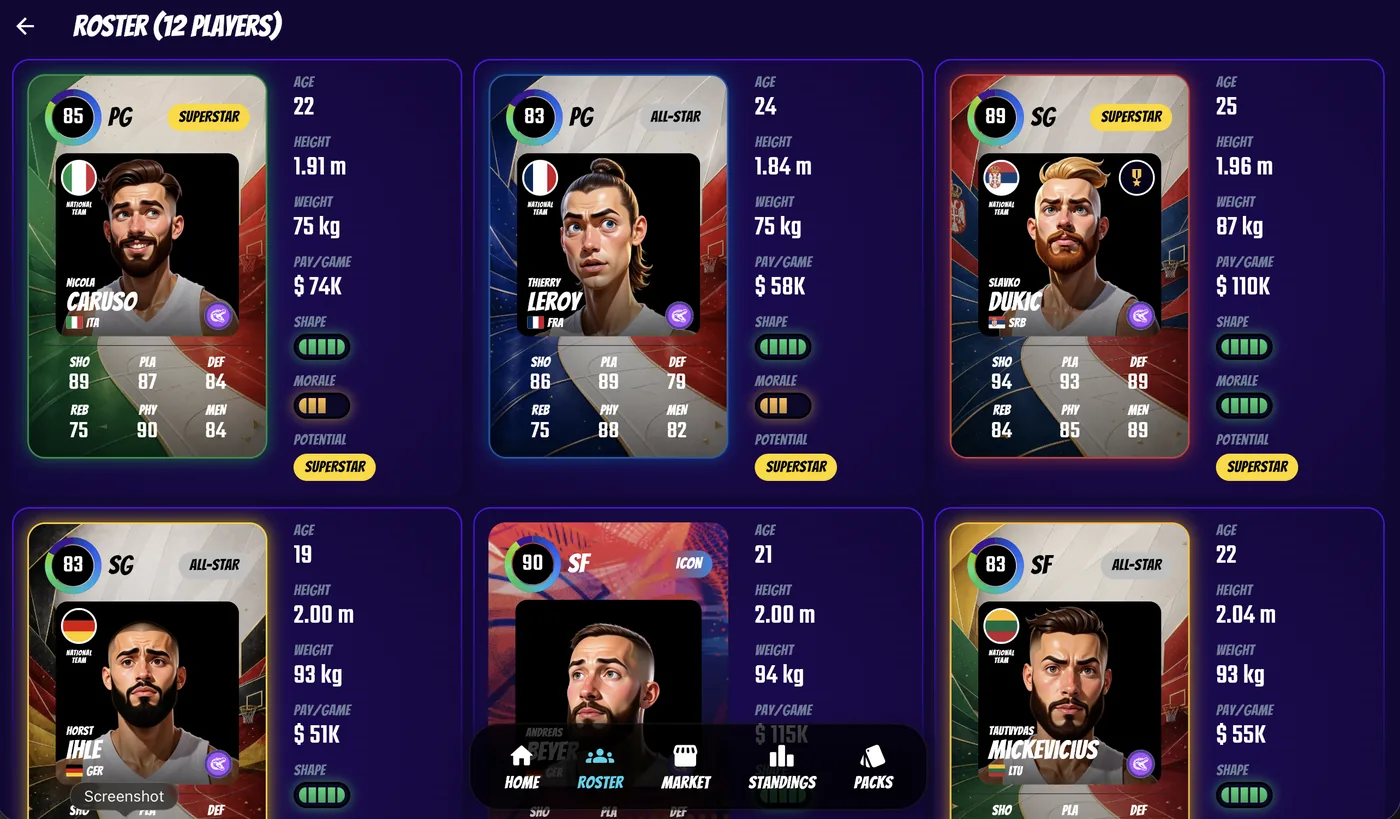
Under the card there is a real player, with about 50 ratings, from close shot to weak hand to clutch. And under the players there is a match engine that simulates every game possession by possession, documented with all its numbers in the match engine guide. The cards are the face of the game, not a replacement for its depth.
Five packs, odds on display
There are five packs, from Blue (5 tokens) to Diamond (100 tokens). Each one contains a player with a guaranteed minimum tier, from Specialist in the Blue to Superstar in the Diamond, and often consumables too; the Diamond also adds an arena to your collection. Before you open one, the game shows the probability of every tier: the chance of a Legend, for example, is 0.1% in the first four packs and 5% in the Diamond. Then you swipe along the line, the pack tears open and the card flips.
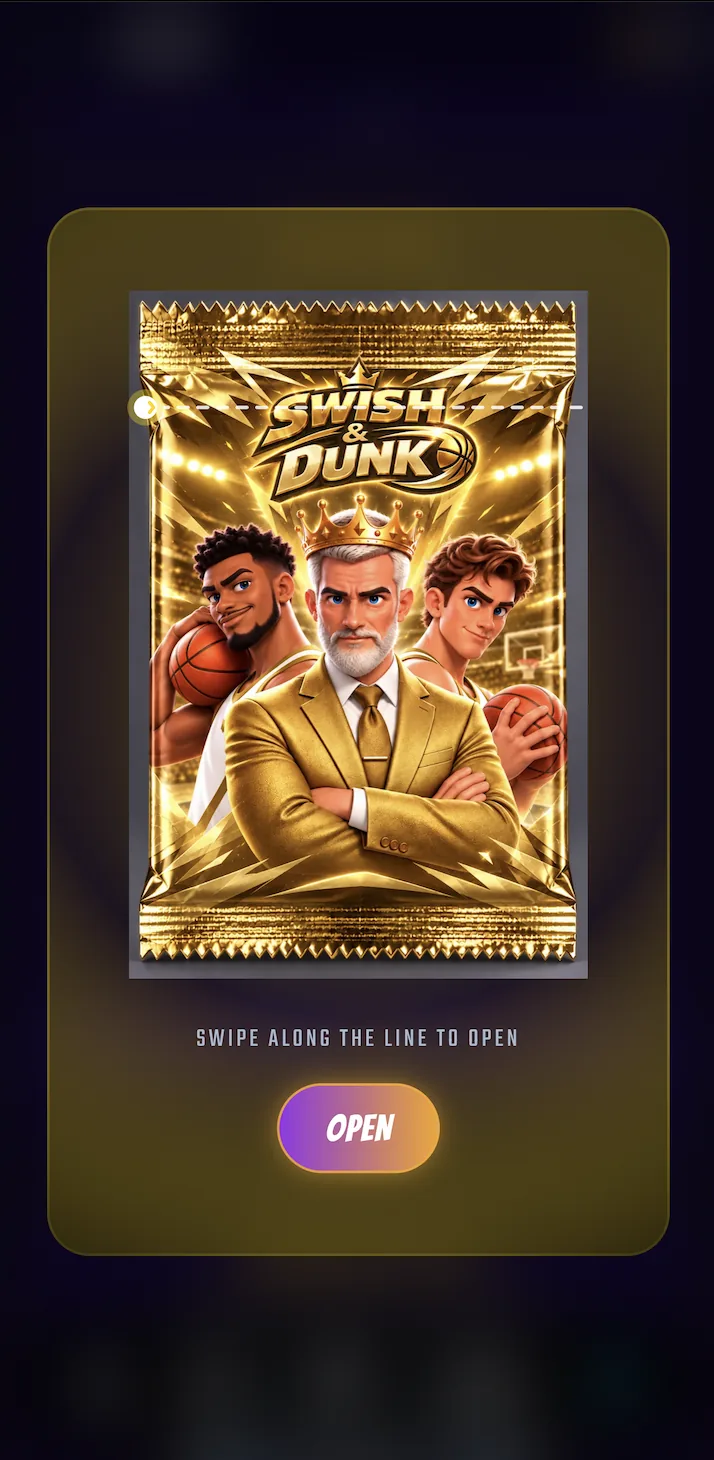
Packs are an extra, not the main route to a strong team. The draft brings a new class of prospects every season, the market is a live auction house shared by every manager, and a well-trained youngster is often worth more than a lucky pull.
Tokens: earned on the court, spent with care
Tokens are the special currency of Swish & Dunk, and they come from one place only: playing.
| How you earn tokens | How many |
|---|---|
| Starting allowance for every club | 50 |
| Every win (league, playoffs, friendlies, cup) | 3 |
| Daily reward | 1 |
| Promotion to a higher division | 50 to 250 |
| Buying them with real money | Not possible |
And they are spent on things that matter: packs (5 to 100 tokens), consumables like the Rest Pack, Treatment Pack and Morale Booster (3 to 5 tokens), facility upgrades (50 to 500 tokens per level) and new arenas (100 to 925 tokens). Since every token costs a win, every choice has weight. A Gold pack is worth about 17 wins; taking the Practice Facility from level 1 to level 5, which multiplies the growth of the whole roster, costs 900 tokens in total. A pack today or a better roster for the rest of the game? That is a manager's decision, not a shopping one. Every source of tokens and money is listed in our guide to rewards.
Why Swish & Dunk is not pay-to-win
The difference is one sentence long: tokens cannot be bought. There are no in-app purchases, no subscription, no premium plan, no paid season pass and no ads to watch for rewards. Without a store, the whole pay-to-win machinery has nothing to grip:
| Typical freemium manager | Swish & Dunk | |
|---|---|---|
| Premium currency | Sold in bundles, often at a discount | Tokens, earned only by playing |
| Packs | The fastest way to a strong team, bought with money | Opened only with earned tokens, odds shown first |
| Waiting times | Skippable for a fee | Arena work, injuries and training take their time for everyone |
| Daily rewards | Designed to keep you logging in | 1 token, on purpose: a thank-you, not an obligation |
| Ads | Watch a video, get a bonus | None |
| Who wins | Often whoever spends more | Whoever runs the club better |
There is also a quieter brake built into the game itself. Even a lucky pull is not a free lunch: salaries in Swish & Dunk depend only on Overall and rise steeply, from about $36,000 per game for an 80-rated player to about $115,000 for a 90 and up to $250,000 for the very best. A roster packed with stars needs an arena and a budget to sustain it, as our economy guide explains. The edge, in the end, comes from what it has always come from in the best manager games: tactics, patience and good decisions. To pick the right system for your players, start with the basketball tactics guide.
A checklist for a modern basketball manager
| Feature | Why it matters | In Swish & Dunk |
|---|---|---|
| Mobile-first UI | The phone is where people play | One-thumb screens, browser-based, installable, 21 languages |
| Daily rhythm | A reason to come back every day | One game a day, daily training, 22-round seasons |
| Collectible cards | Players you recognize and care about | AI-generated faces, ten tiers, national team cards, award badges |
| Pack opening | Excitement and new talent | Five packs, guaranteed minimum tier, odds shown before opening |
| Tokens as rewards | Every win is worth something | 3 per win, 1 a day, up to 250 for a promotion |
| Transparent engine | Strategy instead of guesswork | Possession-by-possession simulation, publicly documented |
| Classic depth | Decisions that last seasons | Draft, live auction market, staff, facilities, arena, economy |
| No pay-to-win | A level playing field | No in-app purchases, no ads, tokens not for sale |
What it still has to prove
To be honest, a good anatomy does not guarantee a long life. Swish & Dunk is a young game: its first season has just ended, its community is still growing, and it does not have the decade of history of the classics. Players who want to simulate ten seasons in an afternoon will find one game a day too slow, and those who live for the forum culture of the 2000s will find a smaller world for now. But the direction is clear: a game that does not need your wallet, only your time and your judgment, and that already writes its own stories, like the players of the month. If you want to see how it compares with the rest of the genre, we have reviewed fourteen titles in our guide to the best basketball manager games.
Frequently asked questions
What makes a basketball manager game modern?
A modern basketball manager keeps the classic core (a club to run, a persistent world, a believable simulation, an economy and a transfer market) and adds an interface designed for the phone, a daily rhythm with seasons that last weeks rather than months, collectible player cards with pack opening, and a reward currency such as tokens. It also explains its match engine and its odds openly.
Why did old browser basketball managers like Charazay decline?
They were built for a desktop monitor, ran on a slow calendar with rewards that arrived only at the end of long seasons, asked newcomers to study forums and manuals, hid how their match engines worked and depended on donations or optional subscriptions that could not pay for servers forever. Charazay went offline in September 2017 after years of decline.
Are collectible cards and packs always pay-to-win?
No. Cards and packs become pay-to-win only when the currency that opens them can be bought with real money. If packs are opened only with a currency earned by playing, and the odds are shown before opening, collecting stays a reward for playing well instead of a store.
Can you buy tokens in Swish & Dunk?
No. Swish & Dunk has no in-app purchases, no subscription and no ads. Tokens are earned only by playing: 50 when you start, 3 for every win in any competition, 1 from the daily reward and between 50 and 250 for a promotion.
Is Swish & Dunk faster than the old browser managers?
Yes, but not frantic. There is one game a day instead of two or three a week, a regular season of 22 rounds followed by playoffs and the draft, and training every morning. A few minutes a day are enough, and progress still takes seasons.
Do I need to download Swish & Dunk?
No. It runs in the browser on phones, tablets and computers, and on a phone you can add it to your Home screen to open it like an app. It is available in 21 languages.
All the pieces of a modern manager, none of the store: take over a club today and play your first game tomorrow.
Play now — it's freeLast updated: